
NEWS
Canada Still Clears Mazatlán as the Cartel War Arrives
Canada still excepts Mazatlán’s tourist strip from its Sinaloa warning, even after the cartel war moved south and 1,600 soldiers landed in the port.

Canada still tells travellers they may fly into Mazatlán even as Sinaloa’s cartel war has moved into the port. Global Affairs last refreshed its Mexico page on September 24, 2026, at 08:53 ET, and the national line remains “exercise a high degree of caution” over crime and kidnapping.
The regional line is harder. Ottawa tells Canadians to avoid non-essential travel to Sinaloa, then carves out Los Mochis and specific areas in and around Mazatlán, and only if they arrive by air or sea. That exception is the product being sold for winter 2026-27. The war is no longer a Culiacán story that happens to mention the beach.
Ottawa Still Carves Out Mazatlán’s Tourist Strip
The Government of Canada does not treat Mazatlán as a banned city. It treats most of Sinaloa as a place to skip, then draws a smaller map around the resort and the historic core, reachable without using the state’s roads. The Sinaloa note on the same page is blunt about what sits outside that map: violent clashes “including in Culiacán and parts of Mazatlán located outside the main tourist zones,” and armed groups that have stopped vehicles on the highway from Culiacán to Mazatlán.
Britain draws a wider circle. The Foreign, Commonwealth and Development Office, current on September 24, 2026, advises against all but essential travel to Sinaloa, except the cities of Los Mochis and Mazatlán, plus the 15D toll road, road 32, and the Copper Canyon rail line. Australia tells its citizens to reconsider travel to Sinaloa except Mazatlan and Los Mochis if they fly in. Canada is the picky one: not the whole city, and not by car.
HOW THREE GOVERNMENTS TREAT MAZATLÁN
| Government | Sinaloa warning | Mazatlán exception | How to enter the exception |
|---|---|---|---|
| Canada | Avoid non-essential travel | Specific areas in and around the city | Air or sea only |
| United Kingdom | All but essential travel | The whole city | City itself is excepted; 15D toll road also listed |
| Australia | Reconsider the need to travel | Mazatlan and Los Mochis | Air |
Canada also keeps a Consular Agency in the Marina Mazatlán mall, on Blvd. Marina Mazatlán, and lists a local tourist-assistance number, CAPTA Mazatlán, at 669-118-4256. Ottawa is staffed in the city it only partly clears.
The Cartel Split Walked South From Culiacán
The fighting that put Mazatlán on those maps started as a betrayal, not a beach crime wave. On July 25, 2024, Ismael “El Mayo” Zambada, a Sinaloa Cartel founder, landed in New Mexico after Joaquín Guzmán López, a son of Joaquín “El Chapo” Guzmán, lured him to a meeting, subdued him, and flew him north. On September 9, 2024, Zambada’s faction, Los Mayos, launched revenge attacks around Culiacán against Los Chapitos, the Guzmán sons’ wing.
Tiziano Breda, ACLED’s Latin America senior analyst, wrote on September 17, 2026, that the first two years produced over 2,400 organized crime violence events, moving Sinaloa from 12th place in Mexico to first. In the second year, overall organized-crime violence fell 28% as Los Mayos gained the upper hand in southern and eastern Culiacán. The dispute did not end. It moved to Mazatlán and Escuinapa, where the factions fought each other and hit businesses they saw as paying the other side. Weaponized drones filled some of the gap left by fewer open clashes.
Mexico’s statistics agency, INEGI, recorded 1,805 homicides in Sinaloa in 2025, as many as 150 more than the state prosecutor’s office logged. Nationwide homicides fell 18% that year. Sinaloa’s count rose 75%, the sharpest increase of any state. Culiacán still accounted for eight of every 10 murders and disappearances in Sinaloa across the two-year war. Then the map flipped.
THE WAR’S PATH TO THE BEACH
- July 25, 2024: El Mayo Zambada is flown to New Mexico after a meeting set by a Chapitos rival.
- September 9, 2024: Los Mayos open revenge attacks in towns around Culiacán.
- 2025: INEGI counts 1,805 Sinaloa homicides, up 75% as the national total falls 18%.
- First week of August 2026: Official tallies in the Mazatlán area log 32 violent events, 14 people murdered, and 8 injured, including 3 state police officers hit by drones on the Mazatlán-Culiacán bypass near El Chilillo.
- September 15, 2026: The army sends 1,600 personnel into the municipality of Mazatlán; the security secretariat and navy add 1,800 more.
- September 24, 2026: Canada refreshes the Mexico advisory. The Sinaloa carve-out for Mazatlán still stands.
A resident of the Concordia highlands, south of the port, sent relatives who had fled into Mazatlán a warning that has become the local shorthand: don’t even go near the mountains, they are full of armed men, and the fighting is still going on in the towns below. Concordia is also where 10 workers from Vizsla Silver, a Canadian mining company, were abducted on February 23 from a camp at La Clementina. The hills behind the resort are not a separate country. They are a short drive from the malecón.
1,600 Soldiers Landed in the Port in September
State and federal officials treat Mazatlán as the asset that has to be held. It is Sinaloa’s main tourist city and the second-largest draw in Mexico’s northwest, with towers on the malecón and new developments pushing north toward Cerritos, a boom that dates to 2017 and runs on Mexican visitors plus Canadian and American retirees. In August, more than 6,000 members of the army, National Guard, navy, and the security secretariat were already ringed around the tourist zone, walking the waterfront, parking military trucks in the Golden Zone, and running checkpoints at Cerritos.
That ring had holes. In the month before that August count, four people were murdered inside the tourist district itself, among the beaches, restaurants, nightclubs, and historic centre. The bodies that search groups keep finding sit mostly in the working-class colonias, where hotel staff and bar workers live. On September 15, Mexico’s Defence Secretariat said that, from that date, it was sending 1,600 troops to Mazatlán municipality: 1,500 soldiers from other parts of the country, plus 100 Special Forces flown from Mexico City to Mazatlán International Airport on a Fuerza Aérea Boeing B-727.
Omar García Harfuch, Mexico’s secretary of security and citizen protection, said the same day that President Claudia Sheinbaum had ordered an immediate extra 800 SSPC officers and 1,000 navy personnel, with the focus on Mazatlán, Culiacán, and the main highway stretches. The International Crisis Group, in a July 7, 2026 report, had already described Mexico mobilising up to 15,000 troops at a time in Sinaloa, enough to quiet the worst firefights in the capital and not enough to stop killings in the countryside.
La Secretaría de la Defensa Nacional @Defensamx1, la Secretaría de Marina @SEMAR_mx y la Secretaría de Seguridad y Protección Ciudadana @SSPCMexico reforzarán de manera inmediata la seguridad en Mazatlán, por instrucciones de la Presidenta @Claudiashein.
Se incorporarán 800…
— Omar H Garcia Harfuch (@OHarfuch) September 15, 2026
THE SEPTEMBER SURGE IN NUMBERS
- Army increment: 1,500 soldiers plus 100 Special Forces, flown in on September 15 for Mazatlán municipality.
- Federal police and navy: 800 SSPC officers and 1,000 navy personnel ordered the same day for Mazatlán, Culiacán, and the highways.
- Cabinet tally for 2026, as of September 15: 1,026 people detained in Sinaloa, 2,031 firearms seized, 47.9 tonnes of drugs taken, 672 labs and stash sites shut.
- Follow-up on September 25: Harfuch said coordinated units detained 8 people and seized 19 firearms, more than 2,000 cartridges, 14 explosive devices, and 415 fentanyl pills.
Javier Alatorre, writing as the surge was announced, said four people had been killed that Monday, among them a US citizen shot in the street, and another man killed in front of a military barracks. The army can thicken the ring. It has not put the city back to 2023.
Canadian Snowbirds Are Booking the Same Beach
Mazatlán’s winter economy is built for long stays, not weekend packages. In October 2025, Mayor Estrella Palacios Domínguez told Canada’s consul, Jonathan Boisseau, and consular agent Wendy Hardouin that about 12,000 Canadians live in the city through the winter. Carlos Berdegue Sacrista, president of the Hotel Association of Mazatlán, said at the Fiesta Amigos show that he expected 20% to 30% more Canadians that season than the winter before, with WestJet and Sunwing flying from nine Canadian cities.
Those seats exist because another winter market is souring. Snowbird Advisor polled 4,000 long-stay travellers in late October 2025 and found 70% planned a US winter, down from 82% the year before, while 23% planned other countries, up from 12%. Stephen Fine, the firm’s president, named Mexico among the substitutes. Carol Thurlow, an Ottawa-born realtor in Mazatlán, said Canadian inquiries in 2025 ran at least 50% above 2024 in her own book.
The 2026-27 airlift has not been pulled. WestJet’s winter schedule restarts Edmonton-Mazatlán twice a week from November 4. A WestJet Mexico sale covering travel from October 25, 2026, to April 24, 2027, lists Mazatlán with Cancun, Puerto Vallarta, Los Cabos, and seven other Mexican cities. The airline is not treating the port as a route to park.
What Canada’s Mexico Advisory Says About Mazatlán
The national caution is not a Sinaloa-only document. It says crime is high across Mexico, that kidnappers have targeted foreigners including Canadians, and that Mexican authorities have put real effort into the big resorts, which then see less gang fighting than the hinterland. It also says the protection is incomplete. Fighting between gangs has taken place in hotels, nightclubs, and restaurants. Innocent bystanders have been injured or killed. “You may be in the wrong place at the wrong time and become a victim of violent crime,” the page reads.
Violent clashes occur regularly between rival armed groups in the state of Sinaloa, including in Culiacán and parts of Mazatlán located outside the main tourist zones. Armed groups have stopped vehicles on the highway from Culiacán to Mazatlán and other major roads.
Government of Canada, Mexico travel advice, September 24, 2026
If you are already in a Sinaloa zone under the avoid-non-essential line, Ottawa’s instructions are short and they do not pretend the city is sealed.
WHAT OTTAWA TELLS VISITORS TO DO
- In a warned Sinaloa zone: Use extreme caution, limit movement, watch local media, and follow local authorities.
- On the roads: Be very cautious on major highways, and do not drive the Culiacán-Mazatlán corridor if you can fly.
- In tourist areas: Stay in them, do not flash wealth, and do not assume a hotel or club is off limits to a cartel fight.
- At night: Avoid going out after dark and skip isolated stretches, a line the page also gives for assaults involving hotel staff, taxi drivers, and fake police.
Timeshare pressure, ATM fraud, express kidnappings from taxis, and break-ins at rental homes sit on the same page. They are the ordinary Mexico risks, and they have not been suspended for the Golden Zone. The Mazatlán exception is a travel-routing rule, not a safety certificate.
Fly In, Stay Off the Culiacán Highway
The practical split in the Canadian advice is the airport versus the maxipista. Arrive on a WestJet or Sunwing jet, and you are inside the excepted map if you stay in the listed tourist areas. Drive from Culiacán, and you are on the road the advisory names as a place where armed groups have been stopping cars. Local traffic jams on that highway still get written up as mystery slowdowns, which is how a checkpoint, a wreck, or a security sweep looks from a driver’s seat at night.
Britain’s page adds a money warning the Canadian page does not spell out in the same way: travel against FCDO advice can void insurance. Canadians who remain inside Ottawa’s Mazatlán carve-out are not travelling against the regional warning. Canadians who wander into Concordia, the sierra, or the Culiacán highway are. That is the line a travel-medical policy will care about when a winter goes wrong.
Drone strikes on police on the bypass, ghost towns in San Ignacio, and the Vizsla Silver abductions are the sierra pattern. They are close enough that a day trip can cross the advisory’s border without a change of climate.
Banners on the Overpass, Cruises at the Pier
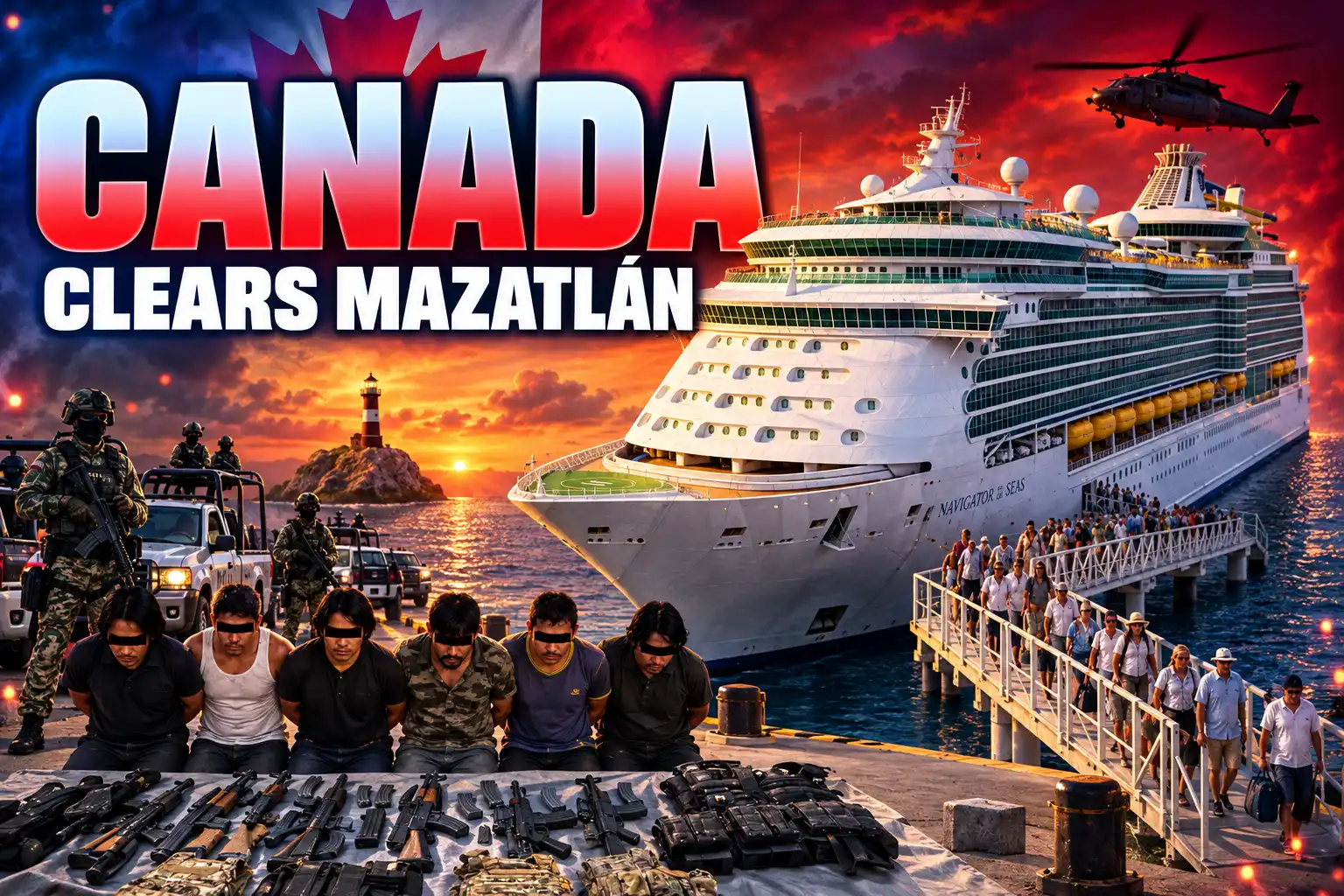
The two Mazatláns now run on the same week. On September 22, the Sinaloa state government posted that Royal Caribbean’s Navigator of the Seas had put more than 3,600 cruise passengers on the dock. On September 24, banners attributed to the Chapitos faction went up on Mazatlán’s southern exit and in Rosario and Concordia, asking Sheinbaum and Harfuch to investigate army and state police units the banners accused of backing Mayito Flaco, a Mayo leader. A house in colonia Sánchez Celis took at least 40 rounds the same stretch of days.
ACLED counted at least 19 attacks on political figures in Sinaloa in the war’s second year, up from 13 in the first, as the factions compete for local officials. Former governor Rubén Rocha left office after public anger and evidence of cartel collusion, Breda noted, with 2027 state elections already warped by the split. The banners are that fight, hung over the road tourists use to leave town.
In its second year, the conflict geography evolved. While overall levels of organized crime violence have decreased by 28%, driven by Los Mayos apparently gaining the upper hand in southern and eastern Culiacán, the dispute has moved to the southern part of the state, particularly in Mazatlán and Escuinapa.
Tiziano Breda, Latin America Senior Analyst, ACLED, September 17, 2026
WestJet is still selling November seats into an airport that sits inside Canada’s exception. The army’s B-727 has already used that airport to land Special Forces. The advisory that named Mazatlán in 2024 has not been withdrawn. It has been narrowed to a strip of coast that soldiers now patrol on foot, while the war that emptied Culiacán’s streets does its next chapter a few colonias inland.

Clay Moulds From the Blyth Hoard Fit Peebles Fittings

Treasury Yields Hit a 24-Year High as AI Joins the Queue

Crew-12 Leaves the ISS With Fedyaev and Adenot Aboard

The Graziers Recall Puts the 60-Day Cheese Rule on Trial

Hugo Chavez’s Hollywood Welcome Meets a Film About Escape

Sons of Behemat Add a Witch and a Middle Rank

Canada Still Clears Mazatlán as the Cartel War Arrives

The FTC Suit That Targets Amazon’s Hidden Ad Floor

Samsung Leads Mistral’s Record European Sovereignty Round

Laepple Automotive Bets on a Vacant Detroit Die Shop
-
 GAMING2 months ago
Sons of Behemat Add a Witch and a Middle Rank
-
 BUSINESS2 months ago
The FTC Suit That Targets Amazon’s Hidden Ad Floor
-
 NEWS2 months ago
Samsung Leads Mistral’s Record European Sovereignty Round
-

 NEWS2 months ago
Apple’s Foldable iPhone Event Revives the Fingerprint Button
-
 AUTO2 years ago
Laepple Automotive Bets on a Vacant Detroit Die Shop
-

 LIFESTYLE2 years ago
The Unstoppable Rise of Hot Honey: Are Food Trends Making UK Restaurant Menus All the Same?
-

 AUTO2 years ago
Tamil Nadu Auto Keeps Growing Inside a Climate Red Zone
-

 LIFESTYLE2 years ago
Women, Gym, and Affairs: A Complex Intersection