
AUTO
Honda’s Ghana Plant Still Runs a 500-Car Bet
Honda’s Tema HR-V line still shows 500 cars a year on the 2026 plant list, a small SKD wager on Ghana’s assembly tariffs rather than a volume factory.

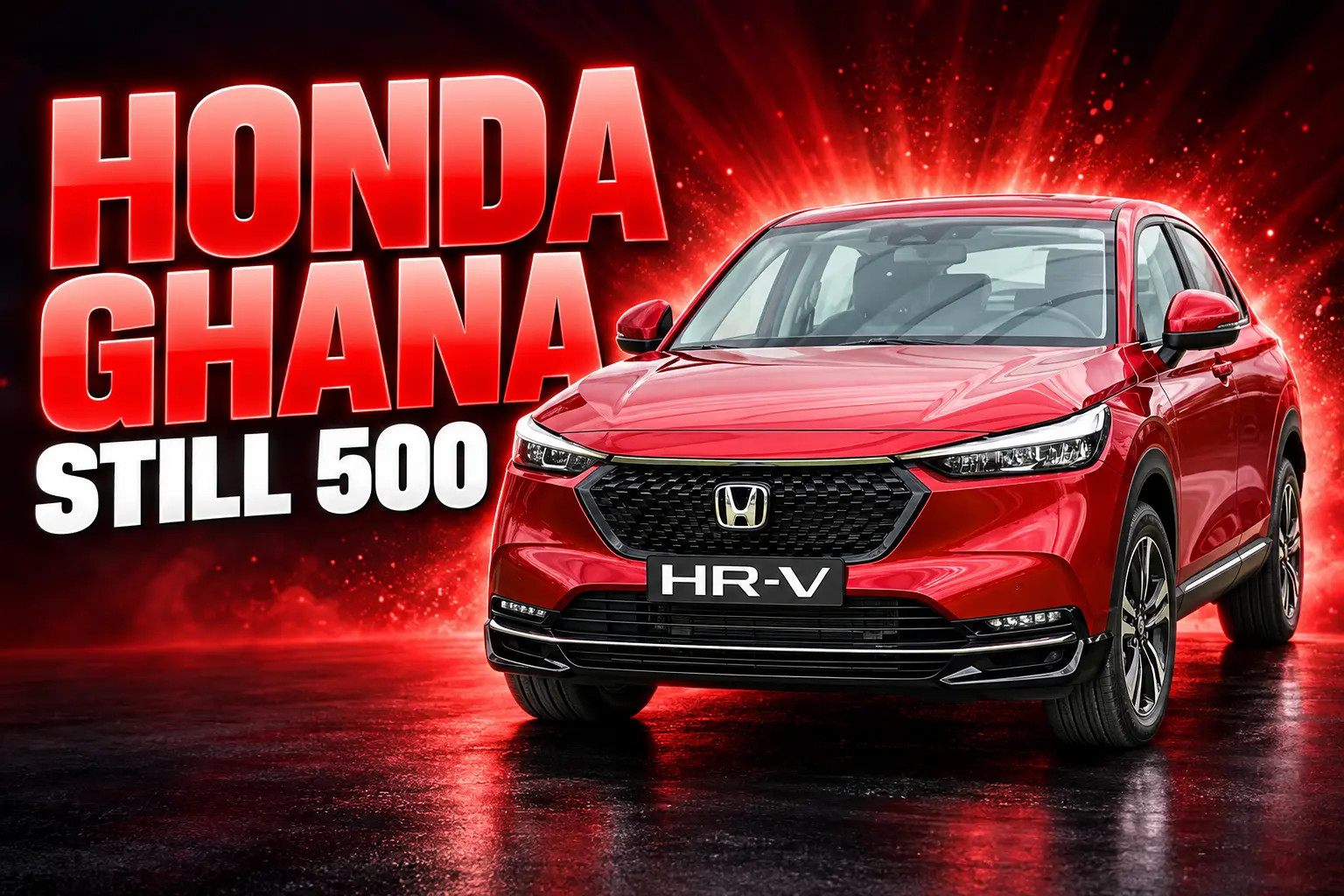
Honda Manufacturing Ghana still shows an annual capacity of 500 HR-V compact SUVs on Honda’s own 2026 plant list, the same figure the company published when the Tema line started in December 2023. The March 7, 2024 ceremony billed the factory as Honda’s second car plant in Africa. Honda put 30 million cedi of its own money into a small semi-knock-down line so it could assemble close to Ghanaian buyers and collect the tariff breaks Accra wrote for registered assemblers.
The printed number has not moved. Honda’s Ghana boss later talked about scaling. Used Hondas keep coming off the same port.
Honda Still Lists the Tema Plant at 500 Cars a Year
Honda Manufacturing Ghana Limited, or HMG, is a wholly owned unit of Honda Motor Co., Ltd., set up in September 2022 with Takashi Nakajima as managing director. Its stated work is automobile production plus the import and wholesale of finished cars. The only production model named at launch was the HR-V.
Katsuhisa Okuda, then Honda’s operating executive for Europe, Africa and the Middle East, used the ceremony to mark the start of production to say the volume was still small and that Honda had chosen to build on its own anyway.
We are very pleased that the second Honda automobile plant in Africa has begun production and we were able to come together to hold this ceremony to mark the start of production. Although production volume is still small, Honda has established a local subsidiary and begun production on our own.
Katsuhisa Okuda, Honda Operating Executive, Head of Regional Unit for Europe, Africa and the Middle East, March 8, 2024 statement
A January 2025 Honda feature said the line had completed its first year in December 2024 and was still an SKD shop. Painted bodies, engines, transmissions, and interior and exterior parts arrive already made. Workers in Tema do the final fit. That is a light plant, not a body shop and paint shop.
HMG AT A GLANCE
- Ownership: 100% Honda Motor Co., Ltd., capital 30 million cedi.
- Start of production: December 2023, HR-V only.
- Capacity on Honda’s 2026 list: 500 units a year, unchanged from launch.
- Staff snapshot: accounting manager Angela Akkon said in that 2025 Honda feature that she oversaw about 15 local associates, including assembly workers.
By September 2025, Daisuke Mita, appearing as managing director of Honda Manufacturing Ghana, said the plant had hired dozens of skilled and semi-skilled workers, many new to auto work. The two staff counts sit months apart. Neither looks like a high-volume factory.
The Tariff Break That Brought Honda to Tema
Honda sold cars in Ghana through distributors from 1997 and opened a local office in 2019. The company did not put its own name on a factory until Ghana’s SKD tariff break took effect in 2022. Honda’s own account is blunt about the sequence. The Japan-Ghana project started in October 2021. HMG was incorporated the next September. Kits and machines then had to clear local authorities before the first Ghana-built HR-V left the line in December 2023.
The Ghana Automotive Development Policy incentives are the commercial logic. Registered assemblers can bring in plant and kits with duties and several domestic levies waived. They also earn a 35% import-duty rebate on a limited number of fully built units, scaled to the kits they assemble. Cars brought in outside the programme face 35% duty on CIF value. The policy text also bans vehicles older than 10 years, salvaged and flooded cars, and new cars without an OEM destination certificate for Ghana.
HOW GHANA RANKS AN ASSEMBLY LINE
| Tier | Corporate tax holiday | FBU duty rebate multiplier |
|---|---|---|
| Basic SKD | Via GIPC, tied to the size of the investment | 1:1 against kit value |
| Enhanced SKD | 5 years | 2:1 |
| CKD | 10 years | 2:1 |
Honda’s published Ghana method matches the lightest tier: final assembly of a partly finished vehicle. The same policy paper tells applicants their assembly plan should show installed capacity of at least 5,000 vehicles a year. Honda’s public figure for Tema is one-tenth of that line. The company has not said how it squared those two numbers with the ministry.
West Africa is the sales map Honda keeps repeating. It runs automobile businesses in Nigeria, Ghana, Benin, and Cote d’Ivoire, and it points to ECOWAS and the African Continental Free Trade Area as the reason to build inside Ghana rather than keep shipping finished cars.
Nigeria Already Ran a 500-Unit Car Line
The Ghana plant is a second try at the same bet. Honda Automobile Western Africa Ltd. began Accord production on July 10, 2015, inside the grounds of Honda’s motorcycle factory in Ogun State. That launch release put annual capacity at 1,000 units and called the shop Honda’s first car plant on the continent. Honda’s Nigerian site still describes it as the first Honda car assembly plant in Africa, an SKD line that won recognized-manufacturer status under Nigeria’s auto policy.
Honda’s 2026 manufacturing directory now gives that Nigerian car shop a listed capacity of 500 units a year, matching Tema. The motorcycle side of Honda Manufacturing (Nigeria) Ltd. is a different scale: the Ota two-wheeler plant is listed at 1,590,000 units a year, with extra bike lines opened in Abuja in 2023 and Kano in 2024.
HONDA’S TWO AFRICAN CAR PLANTS
| Plant | Start | Launch capacity | 2026 listed capacity | Launch model |
|---|---|---|---|---|
| Honda Automobile Western Africa, Ogun | July 2015 | 1,000 units/year | 500 units/year | Accord |
| Honda Manufacturing Ghana, Tema | December 2023 | 500 units/year | 500 units/year | HR-V |
Yusuke Hori, then Honda’s Africa and Middle East chief, said in 2015 that Nigeria’s volume was still small. Okuda said the same thing about Ghana nine years later. In June 2026, Daisuke Mita, speaking as managing director of Honda Automobile Western Africa, said the Nigerian car factory remained underused and that a 10-year growth plan had not been fully realized. Forex trouble and unsigned auto-policy texts were the reasons he gave.
HONDA’S WEST AFRICA CAR TIMELINE
- 1997: Honda starts selling cars in Ghana through distributors.
- April 2013: Honda Automobile Western Africa is incorporated in Nigeria, capital 1.85 billion naira, wholly owned by Honda Motor.
- July 10, 2015: Accord SKD begins in Ogun, launch capacity 1,000 units a year.
- 2019: Honda opens a Ghana office.
- October 2021: Japan-Ghana factory project starts.
- September 2022: Honda Manufacturing Ghana is established in Tema.
- December 2023: First HR-V is assembled in Ghana.
- March 7, 2024: Official start-of-production ceremony in Tema.
- December 2024: Honda marks the plant’s first full year.
Ghana was supposed to be the cleaner copy of Nigeria, with a newer SUV and a policy Accra had written to pull global brands in. The listed capacity is the same 500.
What Buyers Still Load at Tema Port
Honda’s 2025 feature put the hard market fact in one line. In 2024, imported used cars made up about 90% of Ghana’s automobile market, and raising new-car sales was the open problem. Honda cited Japan’s foreign ministry for a population Honda put at 34 million in 2023, with more than 60% in their 20s or younger, as the reason the buyer pool should grow.
The Honda badge is already famous in Ghana. That is not the bottleneck. Classified lots and shipping agents still move older CR-Vs and HR-Vs from U.S. auctions into Tema, with clearance quotes attached, because that is the price a private buyer can actually pay. A new locally assembled Honda has to beat that landed used car on monthly money, not on a press-release slogan.
When the first Ghana-built Honda was shown in March 2024, the split in public argument was already that simple. People were glad a factory existed. They also asked whether an ordinary salary could buy the car, and whether “made in Ghana” meant more than last-stage bolting. Those two doubts still sit on the same plant.
A memorial board at the Tema office carries the line Honda’s local staff repeat: “Made in Ghana by Ghanaians for Ghanaians with Honda Global Quality.” Angela Akkon, who handles accounting, administration, and human resources at the small plant, told Honda the HR-V is a global model and, at the same time, a car built in Ghana, by Ghanaians, for Ghanaians. The slogan is doing a lot of work in a market that still prefers a used Honda off the boat.
Seven Other Assembly Plants Share the Same Squeeze
Honda is late to a crowded field. Ghana launched the auto policy in 2019 to turn a used-import market into an assembly hub for West Africa. Volkswagen opened in Tema with a line built for 5,000 units a year. Toyota, Nissan, Kia, Hyundai, Peugeot and local name Kantanka also set up. In June 2026, Salem Kalmoni, chief executive of Japan Motors Ghana, told an industry roundtable there were 10 bona fide assemblies in the country and seven plants, and that prices had come down and been passed to buyers.
Volume is still the missing piece. Plants built for thousands of units a year are competing for a thin new-car slice while used imports take the rest. Panelists at that same roundtable pushed government fleets and staff-car finance as the fastest way to give the lines real throughput. Without that demand, a 500-unit Honda shop is not an outlier. It is the honest size of the new-car market Honda is willing to tool for.
WHY THE NEW-CAR LINES STAY SMALL
- Used-car price gap: About 90% of the market, on Honda’s 2024 reading, is still an imported used vehicle.
- Thin finance: The auto policy promised asset-based loans for programme vehicles; assemblers still say retail credit is the bottleneck.
- VAT relief pulled: Locally assembled vehicles had a 20% VAT zero-rate through 2025. The 2026 budget did not extend it. The Automobile Assemblers Association of Ghana warned that plants and engineering jobs were at risk.
- Kit-depth politics: Accra now says light SKD should not collect the same tax break as deeper local work.
Ryota Utaka, who supports the Ghana business from Honda’s Africa and Middle East office in Dubai, called the work irregular and said parts can sit in port while the line waits. That is the daily version of the same problem: a small SKD plant lives or dies on customs, not on stamping presses.
Accra Now Wants More Than Final Bolting
The policy Honda used to justify Tema is being rewritten while the plant is still on its launch capacity. On September 15, 2026, President John Dramani Mahama, commissioning a separate assembly expansion in Tema, said the finance and trade ministries were finishing a new incentive package for semi-knock-down work. Assemblers will have to hit a local-content percentage, not yet published, before they qualify for VAT relief.
We don’t want manufacturers who bring the whole car, they just remove the steering and the tyres, and they bring it here, put the tyres and put the steering, and say we’ve assembled this vehicle in Ghana.
John Dramani Mahama, President of Ghana, Zonda Tec plant commissioning, Tema, September 15, 2026
He named batteries, tyres, wiring harnesses, seats, glass, plastics, and metal parts as the components he wants made in Ghana. Nothing was signed that day. The percentage, the timetable, and the enforcement all wait on the next budget. For Honda, the point is immediate. Its published method is SKD. A rule that punishes tyre-and-steering assembly will test whether Tema is deep enough to keep the tax treatment it came for.
Preferential government buying was already in the 2019 policy. So was a dedicated export push into ECOWAS. Those tools only matter if the state actually orders locally assembled cars and if a 500-unit line can spare vehicles for the border. Neither has shown up in Honda’s public Ghana numbers.
The Ghana Boss Says the Line Can Grow
Mita’s September 2025 message to Ghana’s investment agency was that the plant had launched, stabilized, and was now aimed at scale. He said Honda had come in under Ghana’s automotive agenda, that GIPC had helped with registration and the technical agreement, and that the company was transferring know-how to local staff. He also said customers were getting new vehicles at competitive prices. Honda has not published a Ghana sales total that would let anyone check that claim against the 500-unit ceiling.
Honda still prints 500. That is the only capacity figure on the company’s global plant list for Tema, including the Japanese directory dated in late September 2026. If output has risen, Honda has not changed the number it shows the world. If output has not risen, the Ghana line is doing what the Nigeria line did: sit on a kit plant, collect policy access, and wait for a new-car market that used imports still own.
The wager was a small, wholly owned SKD shop in a country Honda had sold into for 27 years, built after Accra paid assemblers to show up. Two full years after the first HR-V, the listed capacity is the launch capacity. Mita can talk about scaling. Until Honda prints a bigger figure, Tema remains a 500-car bet.

The NFL Hits Jed York With the 2014 Irsay Penalty

Run Hide Fight Infidels Hits the Paywall, Not Hollywood

Samsung Raises Galaxy S26 Prices After Its Phone Unit Goes Red

Eurozone Inflation at 3.8% Tests Lagarde’s Yield Argument

Paramount Gets Warner Bros and a Five-Year Movie Quota

Sons of Behemat Add a Witch and a Middle Rank

Canada Still Clears Mazatlán as the Cartel War Arrives

The FTC Suit That Targets Amazon’s Hidden Ad Floor

Women, Gym, and Affairs: A Complex Intersection

The Unstoppable Rise of Hot Honey: Are Food Trends Making UK Restaurant Menus All the Same?
-
 GAMING4 weeks ago
Sons of Behemat Add a Witch and a Middle Rank
-
 NEWS2 years ago
Canada Still Clears Mazatlán as the Cartel War Arrives
-
 BUSINESS1 month ago
The FTC Suit That Targets Amazon’s Hidden Ad Floor
-
 LIFESTYLE2 years ago
Women, Gym, and Affairs: A Complex Intersection
-

 NEWS1 month ago
Apple’s Foldable iPhone Event Revives the Fingerprint Button
-
 LIFESTYLE2 years ago
The Unstoppable Rise of Hot Honey: Are Food Trends Making UK Restaurant Menus All the Same?
-

 NEWS4 weeks ago
Samsung Leads Mistral’s Record European Sovereignty Round
-

 ENTERTAINMENT2 years ago
SetonFest Grew From a 1981 Picnic Into Carmel’s Carnival