AUTO
What Is a Vortec Engine? How to Match Badge and Code
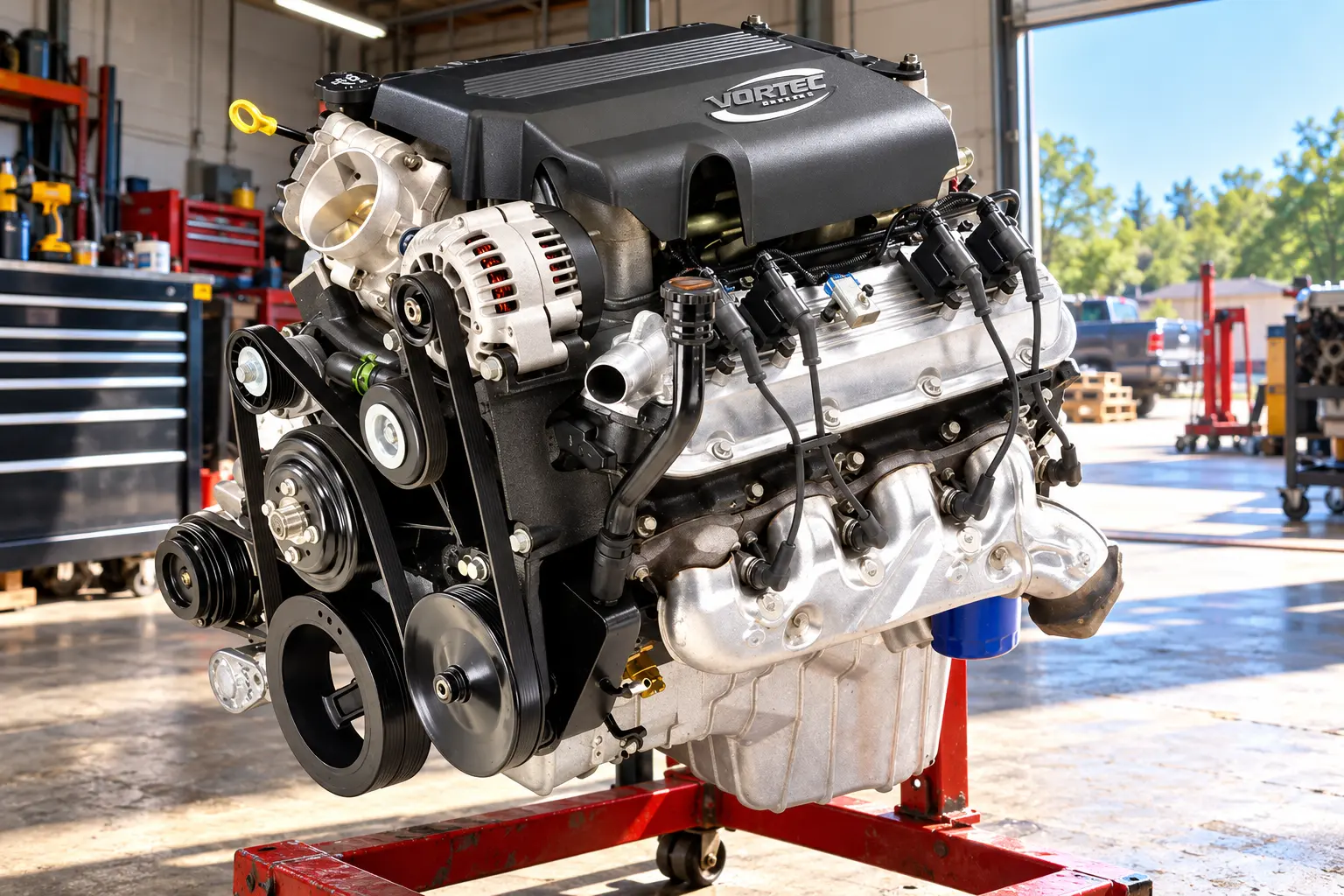
A Vortec engine is the trademark GM used on several gasoline truck families. The cc badge names the size, and the RPO code names the engine.

A Vortec engine is a gasoline truck engine General Motors sold under a trademark, and the word alone does not name one block. The name first showed up in advertising for the 1985 model year 4.3 liter V6, tied to a swirl inside the combustion chamber that was meant to mix air and fuel more evenly. The same badge later covered inline fours, fives, and sixes, a long-running V6, two generations of small-block V8s, and two big-blocks.
The number after Vortec is a rounded size in cubic centimeters. A Vortec 5300 is a 5.3 liter V8, and a Vortec 4200 is a 4.2 liter straight-six. Those engines do not share parts, a head design, or a parts counter listing.
You can use this page to match the badge on a fender or a classified ad to the family under it, then read the three-character code that tells you which version is actually in the truck before you order anything.
How the Vortec Name Started on GM Trucks
Chevrolet literature used Vortec for the truck and van version of the 4.3, a 90-degree V6 of 262 cubic inches that is a shortened small-block V8. In 1985 that truck engine was the carbureted LB1, while many cars got a throttle-body version under a different code. The swirl the ads described came from the shape of the port, an idea GM had already tried on a smaller four-cylinder, and the point was a faster, more even burn at the engine speeds a loaded truck actually uses.
The trademark did not stay on that one chamber. Through the 1990s and 2000s it became the gasoline-truck label across compact pickups, full-size pickups, vans, and mid-size SUVs. Two trucks can both say Vortec on the fender and still need completely different gaskets, sensors, and intakes.
The Swirl Port on the First Truck 4.3
On the early truck small-blocks, the swirl came from a ramp under the intake valve that twisted the incoming mix. Those swirl-port heads, used on throttle-body 305s and 350s from the late 1980s into the mid-1990s, traded some high-rpm airflow for mixture motion at low lift. They are the heads the original Vortec advertising was talking about, and they are not the castings most people now call Vortec heads.
If you are looking at a valve cover from that era, the last three digits of the casting number are the practical ID. Builders separate the swirl-port castings from both the older perimeter-bolt heads and the later truck heads, because the port, the chamber, and the intake bolts do not line up across those three groups.
Iron Heads on the 1996 Truck 350
For 1996, truck and van 350s switched to a new iron head, the L31, with a heart-shaped chamber and a spark plug moved toward the center of the bore. Guides on those castings put the truck 350’s rating at 255 horsepower with the new heads, against 200 horsepower on the truck 350 they replaced. The two production castings end in 906 and 062, full numbers 10239906 and 12558062, and they are the same head in two castings.
That head is what most small-block builders mean when they say Vortec. It is a Generation I small-block part from a narrow run of late-1990s trucks and vans. It has nothing to do with the aluminum heads on a 2005 Silverado 5.3, even though that truck also wears a Vortec badge.
How to Read a Vortec Displacement Badge
Modern Vortec names use the displacement in cubic centimeters, rounded. The Vortec 4200 is the clearest example: the straight-six is 4,160 cc, and the badge rounds that to 4200. The same habit produced 5300 for a 5,328 cc V8 and 8100 for an 8,128 cc big-block. The badge gets you into the right size class, and it stops there.
| Badge | Layout | Architecture | Actual size |
|---|---|---|---|
| Vortec 2200 | Inline-4 | GM 122, pushrod | 2,189 cc |
| Vortec 2800 | Inline-4 | Atlas, DOHC | 2,770 cc |
| Vortec 2900 | Inline-4 | Atlas, DOHC | 2,921 cc |
| Vortec 3500 | Inline-5 | Atlas, DOHC | 3,460 cc |
| Vortec 3700 | Inline-5 | Atlas, DOHC | 3,653 cc |
| Vortec 4200 | Inline-6 | Atlas, DOHC | 4,160 cc |
| Vortec 4300 | V6 | 90-degree small-block V6 | 4.3 L (262 cu in) |
| Vortec 4800 | V8 | Gen III or IV small-block | 4,807 cc |
| Vortec 5000 | V8 | Gen I small-block | 5,012 cc |
| Vortec 5300 | V8 | Gen III or IV small-block | 5,328 cc |
| Vortec 5700 | V8 | Gen I small-block | 5,733 cc |
| Vortec 6000 | V8 | Gen III or IV small-block | 6.0 L (364 cu in) |
| Vortec 6200 | V8 | Gen IV small-block | 6,162 cc |
| Vortec 7400 | V8 | Big-block | 7,439 cc (454 cu in) |
| Vortec 8100 | V8 | Big-block | 8,128 cc (496 cu in) |
Read down the architecture column before you read the size. A 3500 and a 5300 are both “thirty-five hundred” in casual talk, and they are an inline-five and a V8. The four-digit badge is the whole name GM put on the fender, so the layout has to come from the truck, not from the number.
Vortec Inline Engines in Mid-Size GM Trucks
The inline Vortec engines split into an older pushrod four and the later Atlas family. Atlas is the factory name for the aluminum inline engines in the mid-size trucks and SUVs, and every one of them was sold with a Vortec badge. They share bore spacing ideas, a 102 mm stroke, dual overhead cams, four valves per cylinder, and variable valve timing on the exhaust cam only.
Vortec 2200 Pushrod Four
The Vortec 2200 is the last North American version of the GM 122 four, used as the base engine in the Chevrolet S-10, GMC Sonoma, and Isuzu Hombre. It is an iron-block, aluminum-head pushrod engine with two valves per cylinder, built in Tonawanda, New York, and it is unrelated to the Atlas fours that followed it in the Colorado.
- Size: 2,189 cc, from an 89 mm bore and an 88 mm stroke.
- Output: 120 horsepower and 140 lb-ft of torque.
- Codes: RPO L43 and LN2.
If a listing says “Vortec four-cylinder,” ask which truck. An S-10 four and a Colorado four do not share a head gasket, a computer, or a bellhousing pattern.
Atlas Fours and Fives
Atlas production ran from 2002 to 2012. The fours and fives went into the Chevrolet Colorado, GMC Canyon, and related Isuzu trucks, and the five also went into the Hummer H3. Blocks and heads are aluminum, with replaceable steel liners, a 10.0:1 compression ratio, and a 6,300 rpm redline. The fours and fives use dual balance shafts. The six does not need them.
- Vortec 2800, LK5: 2.8 liters, 2004 to 2006, 175 horsepower at 5,600 rpm and 185 lb-ft at 2,800 rpm on GM’s 2006 Vortec 2800 spec sheet.
- Vortec 2900, LLV: 2.9 liters, 2007 to 2012, 185 horsepower at 5,600 rpm and 190 lb-ft at 2,800 rpm, with a larger 95.5 mm bore.
- Vortec 3500, L52: 3.5 liters, 2004 to 2006, 220 horsepower at 5,600 rpm and 225 lb-ft at 2,800 rpm, also the first H3 engine.
- Vortec 3700, LLR: 3.7 liters, 2007 to 2012, 242 horsepower at 5,600 rpm and 242 lb-ft at 4,600 rpm, with a revised head.
The straight-six shares 75 percent of its components with the 2.8 and the 3.5, and those two smaller engines share 89 percent with each other. That sharing stays inside the Atlas family. None of it reaches a 5.3 V8 that happens to carry the same brand name.
Vortec 4200 in the TrailBlazer and Envoy
The LL8 Vortec 4200 is the engine the others were cut down from. It is a 4.2 liter straight-six, 93 mm by 102 mm, built for the Chevrolet TrailBlazer, GMC Envoy, and Oldsmobile Bravada in 2002, and also used in the Buick Rainier, Saab 9-7X, and Isuzu Ascender through 2009. Introduced at 270 horsepower at 6,000 rpm and 275 lb-ft at 3,600 rpm, it moved to 275 horsepower for 2003 with the same torque, then to 291 horsepower at 6,000 rpm and 277 lb-ft at 4,800 rpm for 2006 after a mass-airflow sensor and an internal redesign.
It made the Ward’s 10 Best Engines list each year from 2002 through 2005. Exhaust-only variable valve timing let the family meet emissions rules without an EGR valve. Owners who know the engine tend to talk about it as the overlooked one, because a fender that only says Vortec hides a twin-cam six that has nothing in common with the V8 in a Silverado of the same year.
The Vortec 4300 V6 in Trucks and Vans
The Vortec 4300 is that original 4.3, and the name stayed on truck and van 4.3s through the 2014 model year. It is still the small-block-based 90-degree V6, with the same bore and stroke family as the classic 350, which is why people call it three-quarters of a small-block. Early truck engines were carbureted, later ones moved through throttle-body injection to central port injection, and a balance shaft became part of the production block in the mid-1990s.
Several RPO codes sit under the one badge, including LB4, L35, LF6, LU3, and LG3. They are all the 4.3 family, and they are not interchangeable with the 4.3 EcoTec3 that arrived in the 2014 Silverado. That later six is a Generation V engine with direct injection. If you are buying a water pump, an intake, or a computer for a “4.3 Vortec,” the last year of the old engine and the first year of the new one are the line you cannot cross.
Small-Block Vortec V8s in GM Trucks
Full-size Chevy and GMC trucks used three different small-block architectures under Vortec V8 badges. The 5.0 and 5.7 of the 1990s are Generation I engines, the same basic small-block that dates to 1955, with the L31 heads described above. From 1999, the 4.8, 5.3, 6.0, and later 6.2 are Generation III and Generation IV engines, the truck versions of the LS family. GM generally kept the LS name on car engines and the Vortec name on truck engines, even when the architecture matched.
Vortec 5000 and Vortec 5700
The Vortec 5000 is the L30, a 305 cubic inch truck small-block listed at 5,012 cc, used in C/K trucks and vans in the second half of the 1990s. The Vortec 5700 is the L31 350, listed at 5,733 cc, with the roller cam and the heart-shaped iron heads. Both still use a distributor and a cable throttle, and both take Generation I small-block thinking: older mounts, an older computer, and the intake that matches those heads.
A 1998 truck 350 and a 1999 truck 5.3 can sit in similar body styles and both be called Vortec. The bellhousing, the accessory drive, the reluctor wheel, and the engine mounts changed with the Generation III block. Parts that fit the 5700 do not become correct for a 5300 because both engines have eight cylinders and a Chevy bowtie.
Vortec 4800 Through Vortec 6200
These are the engines people swap, tow with, and argue about. The 4.8 (LR4, then LY2 and L20) and the 5.3 share a 96 mm bore. The 4.8 stroke is 83 mm, and the 5.3 stroke is 92 mm, so the 5.3’s extra displacement is 9 mm of stroke, not a bigger bore. The 6.0 uses a 4.00 inch bore and the 5.3’s stroke, and the Vortec 6200 is the 6.2 liter at 6,162 cc.
- Block metal: Most truck engines are iron, but the LM4 and the high-output L33 5.3s are aluminum, so “Vortec means iron, LS means aluminum” does not hold.
- Generation III: LR4 4.8, LM7 and L59 5.3, LM4 and L33 5.3, LQ4 and LQ9 6.0, with a 24-tooth reluctor and no variable valve timing.
- Generation IV: LY2 and L20 4.8, several 5.3s, LY6 and L96 6.0, L92 and related 6.2s, with a 58-tooth reluctor on the engines that use it, and variable valve timing on some of them.
Active Fuel Management, which shuts off four cylinders under light load, shows up on Generation IV 5.3s such as the LY5, LMG, LH6, and LC9. Shops treat a tick on cylinders 1, 4, 6, and 7 as the complaint that follows those lifters, and they treat the iron 4.8 codes as the same basic truck V8 without that system. The displacement on the door sticker will not tell you which group you are in. How those five RPO codes differ is the sort of split that matters: LM7, L59, L33, LQ4, and LQ9 are all “a Vortec” in ads, and they are five engines.
What Does Vortec MAX Mean?
Vortec MAX is a high-output 6.0, not a different brand of engine. GM first sold that engine as the HO 6000, RPO LQ9, and around the 2005 model year started putting a Vortec MAX badge on Silverado and Sierra trucks that had it. On later Generation IV trucks the MAX badge moved to the L76. A standard 6.0 in those years is an LQ4 or an LY6. If you are comparing two 6.0 trucks, the badge is a hint and the RPO is the proof, because a worn sticker and a seller’s memory both drift.
Big-Block Vortec Engines in Heavy-Duty Trucks
The Vortec 7400 is the L29, and a related L21, a fuel-injected 454 big-block for 2500 and 3500 trucks, heavy Suburbans, and Express and Savana vans. Introduced for 1996 and built for about five years, it is a 454 with a hydraulic roller cam, multi-port injection, and a bore and stroke of 4.25 inches by 4.00 inches. The L29 rating that shows up in the rebuild literature is 290 horsepower at 4,000 rpm and 410 lb-ft at 3,200 rpm. Owners who towed with the last of these still talk about that low-rpm pull, and about how far a big tank would go compared with what came next.
The Vortec 8100, RPO L18, replaced it in full-size pickups for 2001 and ran through 2009. It keeps a 4.25 inch bore and lengthens the stroke to 4.37 inches, for 8,128 cc, about 496 cubic inches. Block and heads are iron, with two valves per cylinder. Published output spans 210 to 340 horsepower and 325 to 455 lb-ft depending on the job, from chassis-cab work to a loaded 2500. It is still a big-block, with its own firing order and its own parts, and it is the end of the line for a production Chevy gasoline big-block in a truck. The complaint that follows it in owner stories is range: more engine, and in some Suburbans a smaller tank than the 7.4 it replaced.
How to Identify a Vortec Engine
Start with the truck in front of you, not with the badge. The build sticker in the glove box lists regular production option codes, and the engine is one three-character code on that sticker. LM7, LL8, L18, and L31 are engines. “Vortec 5300” is a marketing name that several codes share.
- Read the glove box sticker. Find the three-character engine RPO and write it down before you search for parts.
- Use the VIN only as a backup. The eighth character identifies the original engine, and only if nobody has swapped it.
- Bring the model year with the letter. The same character means different engines in cars, in Generation III trucks, and in Generation IV trucks.
- Match the code to metal, fuel, and lifters. Iron or aluminum, gasoline or flex-fuel, and Active Fuel Management or not, all sit in the RPO.
A worked case: a 2004 Silverado listed as a 5.3, with T as the eighth VIN character, is an LM7 if the engine is original. That is the common iron Generation III Vortec 5300, gasoline, with a 24-tooth crank wheel and no cylinder deactivation. The same liter badge with B in that position is an L33, the aluminum high-output 5.3. The eighth-digit VIN chart Summit Racing publishes is built for this exact job, and it only applies to the original engine.
| 8th VIN digit | RPO | Original truck engine |
|---|---|---|
| V | LR4 | Gen III iron Vortec 4800 |
| T | LM7 | Gen III iron Vortec 5300 |
| Z | L59 | Gen III flex-fuel Vortec 5300 |
| U | LQ4 | Gen III iron Vortec 6000 |
| N | LQ9 | Gen III Vortec HO 6000 or Vortec MAX |
| B | L33 | Gen III aluminum Vortec 5300 high output |
| A | L20 | Gen IV iron Vortec 4800 |
| 0 | LMG | Gen IV iron Vortec 5300 |
| G | L96 | Gen IV iron Vortec 6000 |
| Y | L76 | Gen IV Vortec MAX, on a truck |
Letter Y is also used on a car engine, and letter J is worse: it can be a 5.3, a hybrid 6.0, or a car engine depending on the vehicle. When the sticker and the VIN disagree, believe the sticker only if you have confirmed the block is the original one. A swapped truck needs the casting and the reluctor counted in the bay.
How Vortec, LS, and EcoTec3 Names Split
Calling a 5.3 “an LS” is fair as architecture and sloppy as a parts order. Generation III and Generation IV truck engines share the LS layout: cam in the block, coil-near-plug ignition, and a deep-skirt block. They also differ from the car engines in oil pans, exhaust manifolds, accessory brackets, and, on many trucks, an iron block. Someone who buys “LS heads” for a Vortec 5300 still has to match port shape, chamber volume, and whether the engine uses a 24-tooth or 58-tooth crank wheel.
For the 2014 Silverado and Sierra, GM retired the Vortec name on the half-ton trucks and introduced EcoTec3. Chris Perry, then Chevrolet’s vice president of marketing, said the new name pointed to variable valve timing, direct injection, and cylinder deactivation together. The gasoline sizes stayed familiar, a 4.3, a 5.3, and a 6.2, and the 5.3 in that first EcoTec3 wave was rated at 355 horsepower. Chevrolet expected that 5.3 to power about three out of four of those Silverados. The older 6.0, including the L96, stayed in heavy-duty trucks after the half-tons moved on.
EcoTec3 is also not the Ecotec four-cylinder family. Same letters, different engines, and a truck ad that says Ecotec can mean a car-based four or a direct-injected truck V8 depending on the year. The Vortec word, on a gasoline GM truck from 1985 through the early 2010s, means the badge in the table above.
Common Mistakes When Buying Vortec Parts
PARTS THAT THE BADGE WILL NOT SORT
- One family: An intake, a head gasket, or a harness listed for “Vortec” is unfinished until it names the RPO or the layout.
- Same liters: A 4.8 and a 5.3 share a bore and do not share a crank, so a rebuild kit has to say which stroke it is for.
- Iron or aluminum: Head bolts, head gaskets, and motor mounts change with the L33 and LM4 even though both are 5.3s.
- The wrong 6.0: Vortec MAX means LQ9 or, later, L76, not every 6.0 liter truck engine from 1999 on.
- Lifters by rumor: A tick does not prove Active Fuel Management, and a 5.3 badge does not prove those lifters are in the valley.
- 1996 heads on any 350: The 906 and 062 castings need the intake and the valvetrain that match them, not a 1970s intake that happens to be a small-block Chevy.
The pattern under those mistakes is the same. The seller, the junkyard tag, or the fender gave you a size, and the part you are buying cares about the architecture. Write down the RPO, the model year, and whether the engine looks original, and the listing either matches or it does not.
Frequently Asked Questions
Is a Vortec Engine a Diesel?
A Vortec engine in this lineup is gasoline. In heavy-duty Chevy and GMC trucks the diesel beside the gas 6.0 is a Duramax, and that diesel never used the Vortec badge. A seller who says “Vortec diesel” is mixing the two engines that shared a hood; ask for the RPO, or look for the Duramax badge, before you price the truck or order filters.
Which Vortec 5300 Can Run on E85?
Only the flex-fuel codes can run E85, and the 5.3 badge does not say which trucks have them. The L59 is the flex-fuel Generation III Vortec 5300, while the common iron LM7 is a gasoline engine. Later Generation IV 5.3s include both gasoline and flex-fuel versions, so the glove box code, not the filler neck color you remember from another truck, is the check before you buy a pump or fill the tank.
Can L31 Vortec Heads Fit an Older Small-Block?
The 906 and 062 castings are a different head from a 1960s or 1970s small-block casting, even though both are iron small-block heads. You match the intake, the valve covers, and the chamber size to those castings. Bolting an older intake onto them because both once lived on a 350 is the mismatch head guides keep correcting.
Do Marine Vortec Engines Match the Truck Versions?
Boat builders including Volvo Penta, MerCruiser, Indmar, and PleasureCraft marinized GM long-blocks by adding marine manifolds, starters, and alternators. The marine Vortec 5700 is the older 5.7 small-block, so a marine 5.7 listing is not a truck 5.3 and not a Generation III engine. Cooling, the flame arrestor, and the cam spec are marine choices on top of that long-block.
Will EcoTec3 Parts Fit a Vortec Engine?
The 2014 truck engines were described as all-new, sharing displacement and only a handful of parts with the Vortec engines they replaced. A 5.3 intake, injector, or piston from an EcoTec3 truck does not carry over to a Vortec 5300 because both are called 5.3 liters. Direct injection and the earlier port injection use different fuel parts even when the liter number on the tailgate matches.
The next time a fender says Vortec 5300, treat the number as a size and the glove box code as the engine. That code is what you maintain, tow with, and buy parts for.


Clay Moulds From the Blyth Hoard Fit Peebles Fittings

Treasury Yields Hit a 24-Year High as AI Joins the Queue

Crew-12 Leaves the ISS With Fedyaev and Adenot Aboard

The Graziers Recall Puts the 60-Day Cheese Rule on Trial

Hugo Chavez’s Hollywood Welcome Meets a Film About Escape

Sons of Behemat Add a Witch and a Middle Rank

Canada Still Clears Mazatlán as the Cartel War Arrives

The FTC Suit That Targets Amazon’s Hidden Ad Floor

Samsung Leads Mistral’s Record European Sovereignty Round

Laepple Automotive Bets on a Vacant Detroit Die Shop
-
 GAMING2 months ago
Sons of Behemat Add a Witch and a Middle Rank
-
 NEWS2 years ago
Canada Still Clears Mazatlán as the Cartel War Arrives
-
 BUSINESS3 months ago
The FTC Suit That Targets Amazon’s Hidden Ad Floor
-
 NEWS2 months ago
Samsung Leads Mistral’s Record European Sovereignty Round
-
 AUTO2 years ago
Laepple Automotive Bets on a Vacant Detroit Die Shop
-

 LIFESTYLE2 years ago
Hot Honey: What It Does on UK Restaurant Menus and at Home
-

 NEWS3 months ago
Apple’s Foldable iPhone Event Revives the Fingerprint Button
-

 LIFESTYLE2 years ago
Women Gym Affairs: Why They Start and What to Do After