
BUSINESS
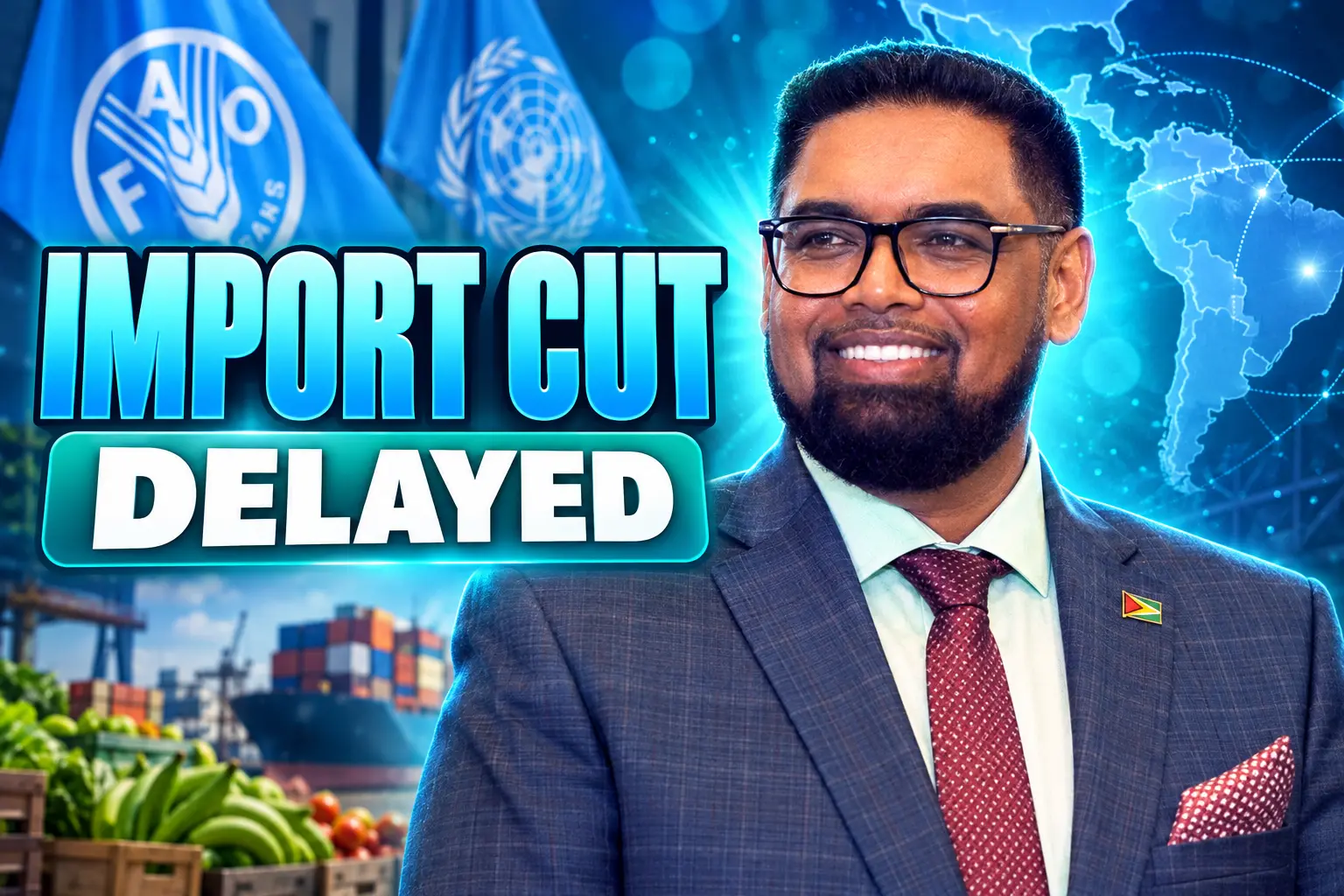
Guyana’s FAO Conference Outlived Its 2025 Food Deadline
Guyana hosted the FAO regional conference as the shop window for a 2025 food-import cut. That deadline is now 2030, even as farm output in Guyana is up.

CARICOM has moved its 25 percent food-import cut from 2025 to 2030, after Guyana hosted the FAO regional conference that was supposed to set the region’s food course.
Farm output in Guyana is higher. The Caribbean’s hunger rate is not, and Brazil has already run the follow-on FAO session in Brasília.
Georgetown Hosted 33 Governments for a First FAO Session
The 38th FAO Regional Conference for Latin America and the Caribbean closed in Georgetown on 21 March 2024. All 33 member governments backed the session, the first the organization had ever held in Guyana.
Senior officials met online from 11 to 13 March. Ministers then sat from 18 to 21 March in hybrid form at the Arthur Chung Conference Centre. The official report records 526 people at the officers’ meeting and 719 at the ministerial session, including 28 ministers, one head of state, and one prime minister.
That head of state was President Mohamed Irfaan Ali, who is also CARICOM’s lead head for agriculture and food security. Agriculture Minister Zulfikar Mustapha chaired the conference. FAO Director-General Qu Dongyu opened it with him. Qu told delegates the meeting was being held for the first time in Guyana, “a meeting point between Latin America and the CARICOM.” The last time a Caribbean capital hosted was Montego Bay, Jamaica, from 5 to 8 March 2018.
Ali told the opening that decisions “must be data driven as far as possible,” and he called for a shift “back to the bowl from the box.” FAO’s Caribbean office posted the speech as it happened.
🗣️🇬🇾 President of Guyana & Chairman of CARICOM@DrMohamedIrfaa1 delivered a statement at the 38 #FAOAmericasConference #LARC38 on the need for our food production systems to be data driven, climate secure, inclusive & have financial support.🚜🌱
More👉🏾https://t.co/Vf7Zl66XOU ➡ pic.twitter.com/0HdsXMnp0K— FAO in the Caribbean (@FAOCaribbean) March 18, 2024
FAO later said about 12,000 people watched the two segments online. A launch event on 7 February 2024, also at the Arthur Chung centre, had already shown the logo and a promotional video. The session itself was the vote.
FROM THE GEORGETOWN LAUNCH TO BRASILIA
- 7 February 2024: Guyana and FAO launch the conference at the Arthur Chung Conference Centre.
- 11-13 March 2024: Senior officers meet online, with 526 participants from 33 members.
- 18-21 March 2024: The ministerial session sits in Georgetown. Mustapha is elected chair. Brazil offers to host the next session.
- 21 February 2025: CARICOM heads, meeting in Barbados, extend the 25 by 2025 import-cut plan to 2030.
- 2-6 March 2026: The 39th regional conference meets in Brasília, as Brazil had promised in Georgetown.
The calendar is the simplest measure of what Georgetown did and did not settle. FAO’s next two-year work plan has already been rewritten in Brazil. CARICOM’s import-cut clock still runs.
Four Priorities and a Letter From Brazil’s President
Delegates gave unanimous backing to FAO’s Strategic Framework 2022-31 and to four priorities for the next biennium. Those four lines are FAO’s “Four Betters” rewritten for the region.
THE FOUR FAO PRIORITIES AGREED IN GEORGETOWN
- Better production: More efficient, inclusive, and sustainable output of crops, livestock, forests, and fish.
- Better nutrition: An end to hunger and a push for food security and diet quality.
- Better environment: Care of water, forests, soil, and biodiversity, plus climate adaptation.
- Better life: Less poverty and inequality, with more resilience after shocks.
Ministers also sat in roundtables on fisheries under FAO’s Blue Transformation approach, on trade as a way to cut hunger, and on the water-forest-biodiversity-soil mix under a changing climate. Special sessions covered family farming, small island states, and FAO’s Hand-in-Hand investment maps.
During these days, we have addressed issues that are fundamental for our region, fisheries, and aquaculture for sustainability; investments for resilience; sustainable and inclusive agri-food systems; reducing hunger and malnutrition through trade as a strategic driver of development in the region, among others. Our work does not end with the closing of this Conference.
Zulfikar Mustapha, Minister of Agriculture of Guyana and Chairperson, FAO LARC38 closing, Georgetown
Brazil used the same week to claim the next chair. President Luiz Inácio Lula da Silva, writing as G20 president pro tempore, said: “I am pleased to announce Brazil’s willingness to host the 39th FAO Regional Conference in 2026. It will be a unique opportunity for us to evaluate our progress and our strategies in terms of food and nutrition security.”
That evaluation has already happened. The Georgetown priorities were a two-year mandate, not a standing doctrine, and Brasília wrote the 2026-2027 list in March 2026.
Why CARICOM Pushed the 2025 Food Target to 2030
The FAO meeting sat beside a harder Caribbean number. CARICOM had pledged to cut a more than USD 6 billion food-import bill by 25 percent by the end of 2025. Ali had sold that goal as Vision 25 by 2025. Island agriculture ministers who flew into Georgetown treated the week as a working session for that cut, not a side ritual of speeches.
On 21 February 2025, at the 48th Regular Meeting of the Conference of Heads of Government in Barbados, Ali announced the date would move to 2030. He cited Hurricane Beryl’s damage to farms and continued shocks in global supply chains. New goals were added. The brand became 25 by 2025+5.
He also claimed progress. “If you look at 2022 to the end of October/November 2024, we have had about a 24 percent increase in food production across the Region,” he told reporters, pointing to cold storage, farm-to-market roads, solar dryers, and a rise in private lending. Guyana’s agriculture ministry later put the audited regional gain at 23.1 percent between 2022 and 2024, against annual production targets that themselves kept moving.
Jamaica’s Prime Minister Andrew Holness, posting on 10 July 2025 after the 49th Heads meeting, still credited Ali and called Guyana a model. “Guyana, now food self-sufficient, sets a strong example for the region,” he wrote, while confirming the 2030 date.
Self-sufficient is a production claim. The import bill is a trade claim. Guyana’s own food-import account, compiled by the agriculture ministry from ITC Trade Map and FAO figures, rose from USD 252.5 million in 2020 to USD 513.3 million in 2024. That is a nominal doubling during the same years Georgetown was telling the region to import less.
Mustapha said on 1 September 2026 that several island states lost ground to hurricanes, and that other CARICOM members now ask Guyana for technical help. The 2030 date, in that telling, is time to finish a job 2025 did not close. The Heads did not keep the original scoreboard. They changed the clock.
Output Hit 1.81 Million Tonnes as Prices Kept Rising
On the tonnes Guyana can count, the ministry’s 2025 harvest is larger than the 2020 harvest. Domestic output across 15 CARICOM priority commodities rose from 1.41 million tonnes in 2020 to 1.81 million tonnes in 2025, a 27.9 percent rise in priority crops, or 394,698 tonnes. Mustapha pointed to corn, coconut, and soybean for animal feed, and he said about 300 acres of onions were due in Region Nine.
Livestock rose 12.5 percent over the same five years. Poultry was up 11.5 percent, beef 11.7 percent, pork 6 percent, and eggs 12.4 percent. “We are not only doing agro-processing to sell locally,” Mustapha said. “Our agro-processing products are being sold in different parts of the Caribbean.”
Against the 2025 production targets CARICOM set, Guyana’s annual hit rate ran ahead of the community average after 2022.
PRODUCTION HIT RATES AGAINST 2025 TARGETS
| Year | CARICOM output (tonnes) | CARICOM hit rate | Guyana output (tonnes) | Guyana hit rate |
|---|---|---|---|---|
| 2022 | 1,919,188 | 57% | 898,847 | 56% |
| 2023 | 2,090,461 | 70% | 1,115,707 | 82% |
| 2024 | 2,362,321 | 82% | 1,260,020 | 88% |
Those rates measure tonnes against a target, not dollars against a grocery bill. Guyana’s 2026 Mid-Year Report found food prices up 6.7 percent between the end of 2025 and June 2026, accounting for 3.4 percentage points of a 4.4 percent rise in overall consumer prices. Vegetables alone added 2.5 points. The other-crops subsector shrank an estimated 6.4 percent in the first half of 2026, with vegetable output down 4.2 percent and producing crops down 19.1 percent.
Rice held up. Millers took 414,088 tonnes of rice equivalent in that half year, against 410,194 tonnes a year earlier. The same report blamed imported inflation, retail mark-ups, and poor weather, and it flagged El Niño risk later in 2026. A larger harvest in 2025 did not freeze prices in 2026.
The Caribbean Still Carries Most of the Hunger
FAO, IFAD, PAHO, UNICEF, and WFP, in the 2025 Regional Overview of Food Security and Nutrition, found Latin America and the Caribbean had cut hunger for a fourth straight year. Undernourishment stood at 5.1 percent of the population in 2024, down from a 6.1 percent peak in 2020. That still left 33.6 million people hungry.
The split inside the region is the Georgetown problem in one table of rates. South America was at 3.8 percent, or 16.7 million people. Mesoamerica was at 5 percent, or 9.1 million. The Caribbean was at 17.5 percent, or 7.8 million, almost unchanged in recent years, and Haiti accounted for much of that weight at 54.2 percent in the 2022-2024 triennium. Brazil, Costa Rica, Uruguay, and Guyana are the four countries with hunger below 2.5 percent in Guyana’s company.
HUNGER AND DIET COST IN 2024
- Hunger, region: 5.1 percent of people, 33.6 million, were undernourished in Latin America and the Caribbean.
- Hunger, Caribbean: 17.5 percent, 7.8 million people, with Haiti at 54.2 percent over 2022-2024.
- Food insecurity: 25.2 percent of the region, 167.2 million people; 51.9 percent in the Caribbean.
- Healthy diet: 181.9 million people could not afford one; 141 million adults lived with obesity.
Moderate or severe food insecurity was 5.3 percentage points higher for women than for men. The Independent Chair of the FAO Council had already warned the Georgetown hall that the region paid the world’s highest cost for a healthy diet. That cost did not fall away with a conference logo.
So the host country can show a hunger rate under 2.5 percent and a 27.9 percent rise in priority tonnes, and the subregion that filled the hall’s CARICOM seats can still show a hunger rate more than three times the regional average. The ministerial declaration from Georgetown named Haiti and small island states as special cases. The 2024 numbers say those cases are still the rule in the Caribbean, not a footnote.
Brazil Has Already Hosted the Follow-On Conference
LARC39 met in Brasília from 2 to 6 March 2026. FAO Assistant Director-General René Orellana Halkyer told senior officers that the region had posted four consecutive years of falling hunger, then listed the people still left out: more than 33 million hungry, one in four facing moderate or severe food insecurity, nearly 182 million unable to afford a healthy diet.
He also scored the 2024-2025 work that Georgetown had authorized. The Hand-in-Hand Initiative, which the Guyana agenda had flagged, had investment programmes in 15 countries and three subregions, a portfolio of USD 2.94 billion, and USD 1.75 billion mobilized. Member states then adopted a new two-year roadmap by consensus. The four-priority language sounded familiar because it was. FAO resets it every session.
What did not reset is the CARICOM lead. Ali still holds the agriculture portfolio in the quasi-cabinet. Mustapha still speaks for a 2030 cut and for a Guyana that wants to be a net exporter to the islands. In June 2026, the Inter-American Institute for Cooperation on Agriculture said Guyana would host a centre of excellence in innovation, technology transfer, and farm training, with Brazil’s EMBRAPA on the science side. That hub is the practical sequel to Lula’s 2024 letter: Brazil runs the FAO meeting, then plants a training shop on the host soil of LARC38.
Mustapha’s 2030 production target for the whole community is 4.3 million tonnes. Georgetown gave him a chair, a logo, and a two-year FAO mandate that has already expired. The import-cut date he inherited is five years later than the one on the 2024 banners. El Salvador is listed to host the 40th regional conference in 2028. The Caribbean’s grocery ships will still be on the water.
Frequently Asked Questions
When Was the 38th FAO Regional Conference Held?
The officers’ segment ran online from 11 to 13 March 2024, and the ministerial segment ran in hybrid form from 18 to 21 March 2024 in Georgetown. FAO recorded the hybrid format as exceptional and said it created no precedent. The launch event that unveiled the logo was earlier, on 7 February 2024 at 11:00 at the Arthur Chung Conference Centre.
Who Chaired the Georgetown FAO Session?
Zulfikar Mustapha, Guyana’s minister of agriculture, was elected chairperson. Franklin Palacios, Ecuador’s minister for agriculture and livestock, and Paulo Teixeira, Brazil’s minister for agrarian development and family agriculture, were elected vice-chairpersons. Winston Pinnock, ambassador of the Bahamas, served as rapporteur.
What Priorities Did LARC38 Set for FAO?
The 33 members endorsed four regional priorities aligned with better production, better nutrition, a better environment, and a better life, plus FAO’s Strategic Framework 2022-31. The agenda also carried Hand-in-Hand investment targeting, the 1000 Digital Villages Initiative, and One Country One Priority Product, which sat beside the four headline lines rather than replacing them.
When Did CARICOM Move the 25 by 2025 Goal?
Heads of government extended the initiative on 21 February 2025 at their 48th Regular Meeting in Barbados, after Hurricane Beryl and supply-chain shocks. The original aim had been a 25 percent cut in a regional food-import bill put at more than USD 6 billion. The new horizon is 2030, under the label 25 by 2025+5.
Where Is the Next FAO Regional Conference?
The 39th session has already been held, in Brasília from 2 to 6 March 2026. FAO’s regional office lists the 40th session for El Salvador in 2028. Regional conferences meet every two years and set FAO’s work for the following two-year period.

Hugo Chavez’s Hollywood Welcome Meets a Film About Escape

Googlebooks Hit Shelves With Finished Hardware and a New OS

The NFL Hits Jed York With the 2014 Irsay Penalty

Run Hide Fight Infidels Hits the Paywall, Not Hollywood

Samsung Raises Galaxy S26 Prices After Its Phone Unit Goes Red

Sons of Behemat Add a Witch and a Middle Rank

Canada Still Clears Mazatlán as the Cartel War Arrives

The FTC Suit That Targets Amazon’s Hidden Ad Floor

Apple’s Foldable iPhone Event Revives the Fingerprint Button

Women, Gym, and Affairs: A Complex Intersection
-
 GAMING1 month ago
Sons of Behemat Add a Witch and a Middle Rank
-
 NEWS2 years ago
Canada Still Clears Mazatlán as the Cartel War Arrives
-
 BUSINESS1 month ago
The FTC Suit That Targets Amazon’s Hidden Ad Floor
-
 NEWS1 month ago
Apple’s Foldable iPhone Event Revives the Fingerprint Button
-
 LIFESTYLE2 years ago
Women, Gym, and Affairs: A Complex Intersection
-

 AUTO2 years ago
Laepple Automotive Bets on a Vacant Detroit Die Shop
-
 LIFESTYLE2 years ago
The Unstoppable Rise of Hot Honey: Are Food Trends Making UK Restaurant Menus All the Same?
-

 NEWS4 weeks ago
Samsung Leads Mistral’s Record European Sovereignty Round