
ENTERTAINMENT
The Flying Monkeys in Wizard of Oz: What the Golden Cap Does
In Baum’s 1900 novel, the flying monkeys in Wizard of Oz obey the Golden Cap three times per owner, and a refused command still spends one of those uses.

You probably met them as a shrieking swarm leaving the Wicked Witch’s castle. In L. Frank Baum’s 1900 novel, The Wonderful Wizard of Oz, the text calls them the Winged Monkeys. The flying monkeys in Wizard of Oz take their orders from whoever wears the Golden Cap.
Whoever wears that cap may call them three times, and a command they cannot carry out still uses one of those calls. You can follow the charm, the wedding curse behind the cap, every order the book records, and the changes the 1939 film made.
Winged Monkeys in Baum’s 1900 Book
They show up twice, and the second visit is the one that explains them. In Chapter 12, The Search for the Wicked Witch, the Witch spends her last use of the cap to have the strangers destroyed, all except the Lion. Dorothy calls them herself in the chapter called The Winged Monkeys, and the King tells her why they have to come when the charm is spoken.
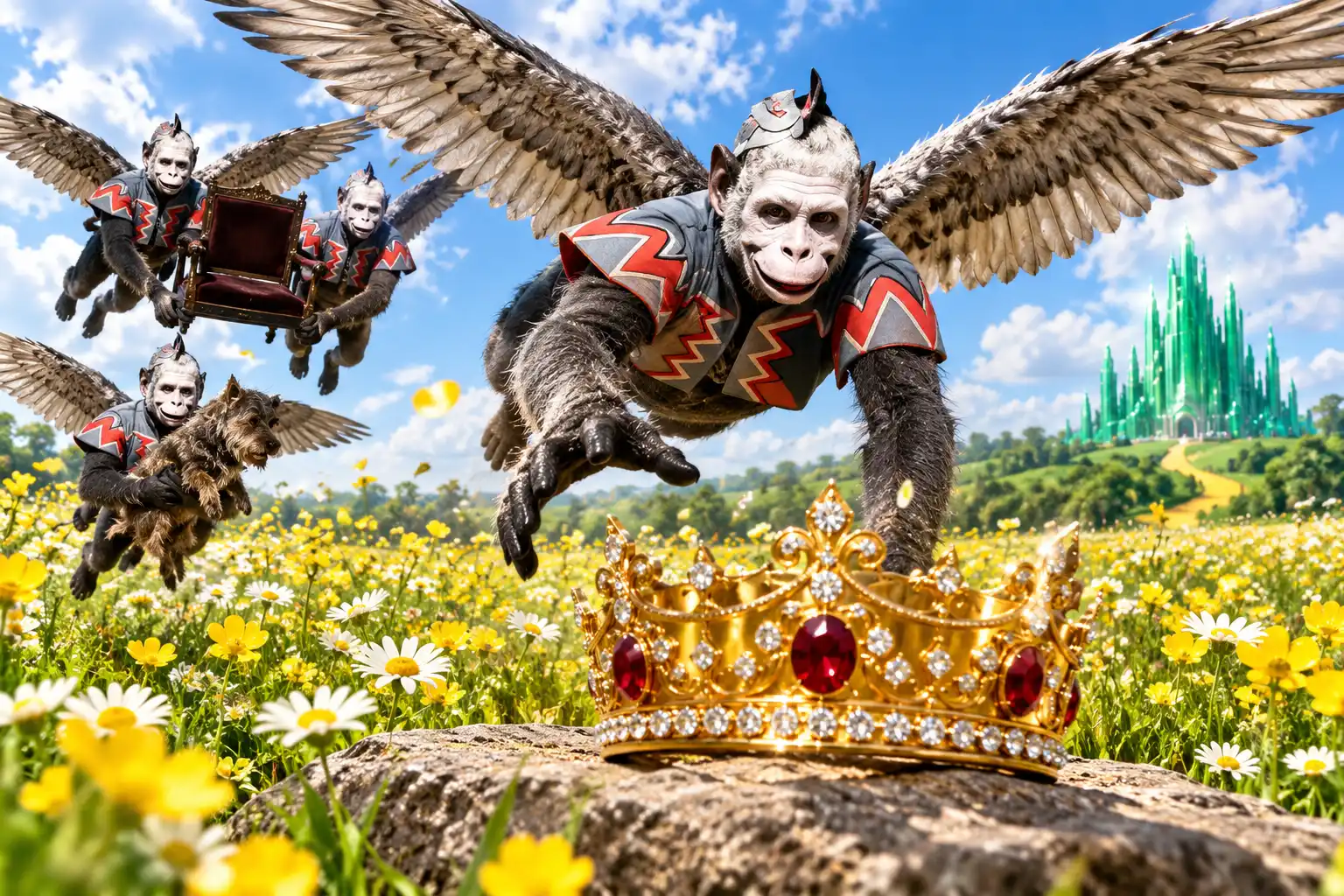
Before that call, Dorothy, the Scarecrow, the Tin Woodman, and the Cowardly Lion are lost in wide fields of buttercups and yellow daisies, with the Emerald City at their backs. Dorothy blows a whistle the Queen of the Field Mice gave her, and the Queen arrives with her people. She is the one who notices the cap and tells Dorothy to use it, then she hurries the mice away because the monkeys think it is fun to plague them.
On the flight, two of the largest monkeys make a chair of their hands so Dorothy rides without being hurt, and the King is one of that pair. A smaller monkey carries Toto, who tries to bite him. The Scarecrow and the Tin Woodman are uneasy at first, because they remember the earlier attack, then they watch the woods pass underneath and enjoy the ride.
They are a speaking people, and the King laughs when Dorothy asks why they obey. Guides to the book describe them as jungle monkeys with bird-like feathered wings. In the chapters you mostly meet immense wings, plain speech, and mischief that is not the same thing as loyalty to a witch.
The Golden Cap Charm and Its Three Uses
Dorothy is wearing the cap during that flight, and she only learned the charm that morning. The cap had been sitting in the Witch’s cupboard, with a circle of diamonds and rubies running around it. While packing food for the walk back, Dorothy tries it on, finds that it fits, and keeps it because it is pretty. She does not know it is charmed until the Queen tells her to look inside.
The directions are written on the lining. In Baum’s 1900 text of the novel, whoever owns the cap can call the Winged Monkeys three times, and no person can command them more than that. The count belongs to the owner. A new owner starts again at three, so calls that an earlier owner never made do not pile up inside the cap.
You put the cap on and say the charm in three poses, in this order.
- Stand on your left foot and say, “Ep-pe, pep-pe, kak-ke!”
- Stand on your right foot and say, “Hil-lo, hol-lo, hel-lo!”
- Stand on both feet and shout, “Ziz-zy, zuz-zy, zik!”
Dorothy’s friends do not know she is working a charm. After the first line the Scarecrow asks what she said. The Tin Woodman hears “Hil-lo, hol-lo, hel-lo!” and answers, “Hello!” The charm ends on the third line. Chattering and the flap of wings fill the air, the band lands, and the King bows and asks for the command.
The Witch had already used the cap twice before Dorothy saw it. The first time, the monkeys helped her make the Winkies her slaves and set herself to rule their country. The second time, they helped her fight the Great Oz and drive him out of the land of the West. She holds the third and last call until her wolves, her crows, and her bees are gone.
She then tells the King to go to the strangers in her land and destroy them all except the Lion. The monkeys do that harm, and they toss the Scarecrow’s clothes into a tall tree. They do not harm Dorothy. The leader sees the mark of the Good Witch’s kiss on her forehead, stops short, and tells the Witch that his power over the band is ended. The monkeys laugh, chatter, and fly out of sight.
Gayelette, Quelala, and the Wedding Prank
The King tells this history on the way to the city, and he sets it long before Oz came out of the clouds to rule. His people lived free in the great forest, flying from tree to tree, eating nuts and fruit, and calling nobody master. Some of them were too full of mischief. They pulled the tails of animals that had no wings, chased birds, and threw nuts at people walking the paths.
Away in the North lived Gayelette, a beautiful princess and a powerful sorceress. Her magic went to help people, and she was never known to hurt anyone who was good. She lived in a palace built from great blocks of ruby. Her sorrow was that she could find nobody to love, because the men around her seemed too stupid and too ugly for someone so beautiful and wise.
She found a boy who was handsome, manly, and wise beyond his years. She took him to the ruby palace and used her magic to make him as strong and good and lovely as any woman could wish. When he grew up he was called Quelala, said to be the best and wisest man in the land, and his looks were so fine that she hurried the wedding.
The King’s grandfather was King of the Winged Monkeys near that palace, and the old fellow loved a joke better than a good dinner. Just before the wedding he saw Quelala walking beside the river in a rich costume of pink silk and purple velvet. At his word the band flew down, seized Quelala, carried him over the middle of the river, and dropped him in. The grandfather called for the fine fellow to swim out and see if the water had spotted his clothes.
Quelala was too wise not to swim, and his good fortune had not spoiled him. He laughed when he reached the surface and swam to shore. Gayelette ran out and found the silk and velvet ruined. She knew who had done it. She had every Winged Monkey brought before her, and her first sentence was that their wings should be tied and that they should be dropped in the river, the same trick they had played.
The grandfather pleaded hard, because the monkeys would drown with their wings tied. Quelala said a kind word for them too. Gayelette spared them on one condition: the Winged Monkeys should ever after do three times the bidding of the owner of the Golden Cap. The cap had been made as a wedding present for Quelala, and the King says it is said to have cost the princess half her kingdom. The monkeys agreed at once.
What Did Each Owner Ask the Winged Monkeys?
Once you know the curse, you can count every order the cap carries in this book. Four owners lay wishes on the monkeys. The three-use limit starts over with each new owner, and a wish the monkeys cannot perform still spends a use. Quelala’s unused calls do not wait in the cap for the Witch.
| Owner | Uses | What they were ordered to do |
|---|---|---|
| Quelala | 1 | Stay where Gayelette can never see a Winged Monkey again |
| Wicked Witch of the West | 3 | Enslave the Winkies; drive Oz from the West; destroy the strangers except the Lion |
| Dorothy | 3 | Carry the party to the Emerald City; try to cross the desert toward Kansas; carry them over the Hammer-Heads |
| Glinda | 3 | Carry the Scarecrow to the Emerald City, the Tin Woodman to the Winkies, and the Lion to his forest |
The gift of the cap to the Monkey King comes after Glinda’s third order, not as a fourth wish. That handoff is what ends the binding.
Quelala’s Single Command
Quelala was the first owner, and he laid one wish. His bride could not bear the sight of the monkeys, so after the wedding he called them into the forest and ordered them always to keep where she could never again set eyes on a Winged Monkey. They were glad to do it, because they were afraid of her.
Nothing in that order sends them to fight or to carry anyone. It is a banishment from the northern palace, and the King says it was all they ever had to do until the cap fell to the Wicked Witch of the West. The book does not show Gayelette wearing the cap herself.
The Wicked Witch’s Three Commands
By the time Dorothy is in the Winkie country, two of the Witch’s calls are already history. The King later names them in the same order the earlier chapter gave.
- The monkeys help her enslave the Winkies and set her to rule their country.
- They help her fight the Great Oz and drive him out of the land of the West.
- On her last call she orders them to destroy the strangers in her land, except the Lion.
That last call is the attack Dorothy survives because of the kiss. When it is over, the King tells the Witch she will never see the band again. The cap stays in the cupboard. Dorothy picks it up after the Witch is gone, still not knowing what the lining says. The Witch had also been watching the Silver Shoes Dorothy wears, because those shoes were the power she still wanted once the cap was used up.
Dorothy’s Three Commands
Her first command is the ride in Chapter 14. She says they wish to go to the Emerald City and have lost the way. The King says they will carry the party. The Queen of the Mice had said the trip would take less than an hour, and the green, shining walls are in sight as the King finishes his story. The band sets the travelers down carefully before the gate, the King bows low, and they fly away. Dorothy calls it a good ride. The Lion says the cap was a lucky thing to bring out of the castle.
Her second command comes after Oz has told her that a balloon is the way across the desert. The Scarecrow suggests she call the Winged Monkeys and ask them to carry her over it. She puts the cap on again. The King refuses, and the refusal still spends the use.
That cannot be done. We belong to this country alone, and cannot leave it. There has never been a Winged Monkey in Kansas yet, and I suppose there never will be, for they don’t belong there. We shall be glad to serve you in any way in our power, but we cannot cross the desert.
The King of the Winged Monkeys, The Wonderful Wizard of Oz
He bows and flies out through the window with the whole band. Dorothy is no closer to Kansas, and she has one call left. A soldier with a green beard then points her toward Glinda, the Good Witch of the South, whose castle stands on the edge of the desert in the Quadling country.
Her third command is at the hill of the Hammer-Heads, who will not let the party climb through to that country. Dorothy puts the cap on, says the words, and asks the King to carry them over the hill to the Quadlings. He says it shall be done. As they pass over, the Hammer-Heads yell and shoot their heads high in the air, and they cannot reach the monkeys. The band sets Dorothy, her three friends, and Toto down in the Quadling country. Her three calls are gone.
Glinda’s Three Commands
Dorothy gives Glinda the cap willingly. She says it is of no use to her now, and that the new owner can command the Winged Monkeys three times. Glinda answers that she thinks she shall need their service just those three times. She spends them on the friends Dorothy is about to leave.
- She has the monkeys carry the Scarecrow to the gates of the Emerald City. Oz has made him its ruler, and the hill of the Hammer-Heads is the thing that worries him on the way back.
- She has them carry the Tin Woodman safely to the land of the Winkies, where he will rule.
- She has them carry the Lion to his forest over that same hill, where the beasts have made him their king.
With the three uses spent, Glinda says she will give the cap to the King of the Monkeys, so that he and his band may thereafter be free for evermore. The Witch’s death, back in the Winkie country, had only ended the Witch’s own three uses. Glinda ends the binding by handing the cap to the King after her own third command.
The 1939 Film and Its Silent Flying Monkeys
The 1939 film keeps the swarm and drops this count. The monkeys are intelligent enough to follow orders, and they are given no dialogue. The film never speaks a three-wish rule and never shows the charm said aloud. The Golden Cap is only glimpsed, so the service plays as fear of the Witch.
- Baum’s monkeys speak and tell their history on the wing. The film gives them no lines.
- The cap in the book is a three-use charm with the words on the lining. The film shows the cap and never has the Witch stand on one foot to summon them.
- The Witch’s last book order spares the Lion, and the kiss on Dorothy’s forehead spares her. On screen the monkeys take Dorothy and Toto, pull the Scarecrow apart, and leave the Tin Man and the Cowardly Lion free to rebuild him and come after Dorothy.
After the Witch melts, the film monkeys leave the story. The one you can pick out of the troop is Nikko, played by Pat Walshe, with his wings clipped. His name is printed in the credits and never spoken on screen. The Witch orders him to throw Toto in a river, and Dorothy stops that order. He is beside her when she throws down the hour glass after the rescue, and he is there again after she has melted.
One clear look at the cap comes just after the poppy spell breaks. The Witch watches Dorothy and the Lion in her crystal ball, Nikko hands her the Golden Cap, she says that somebody always helps that girl, and she throws the cap across the room. A scene cut before the finished film had her send Nikko for the cap so the monkeys could take the ruby slippers from the sleeping girl. The spell breaks before she gets the chance. The cap that stays in the picture looks almost identical to W. W. Denslow’s drawing for the book, the one captioned with the monkeys catching Dorothy in their arms.
A musical number called “The Jitterbug” was meant to send a magic insect ahead of the monkeys to weaken Dorothy’s party. The picture for that number is lost. The soundtrack survives, and stage versions built from the film often put the song back, with extra work for the monkeys to do.
Flying Monkeys in Later Oz Stories
Stage and screen versions after that film invent new origins, and they do not share the cap’s arithmetic. If you mix them into Baum’s count of three, the wedding bargain disappears.
Wicked and Its Stage and Screen Versions
In Gregory Maguire’s novel Wicked, Elphaba makes the flying monkeys during experiments on what separates ordinary animals from Animals who can speak. Most of them cannot talk. Her favorite, Chistery, speaks by repeating similar-sounding words, and that pattern eases in later books of the series. The stage musical and the films made from it keep a related origin, so those monkeys are her creation.
Come to Baum’s chapter from that version and the King feels like another kind of creature. He remembers a grandfather, a joke by a river, and a bargain he is still paying. He is not one of Elphaba’s experiments, and he can tell the whole story in ordinary speech while he carries Dorothy.
The Wiz and Oz the Great and Powerful
The Wiz turns the Flying Monkeys into a motorcycle gang whose leader is named Cheetah. They have no wings of their own. Metal wings sit on the bikes. After they are returned to their own forms, they carry Dorothy and her friends back to the Emerald City, which is the one job that still matches Baum’s errand for Dorothy.
Oz the Great and Powerful (2013) splits the idea in two. Finley, voiced by Zach Braff, is a winged monkey whom Oscar Diggs saves from a lion and then befriends. The armies of Theodora and Evanora are Winged Baboons, feral, unable to speak, with leathery bat-like wings. Those baboons are the swarm that plays as pure threat. Finley can talk, and he is not under a cap.
The Phrase Flying Monkeys Outside the Book
The film swarm, not the book bargain, is what jumped into everyday speech. Away from Oz, a flying monkey is a person who does someone else’s harmful errands: defending an abuser, carrying that person’s version of events, or pressuring the target. The 1939 swarm is also the scene adults still point to when they talk about being scared by the film as children.
The insult borrows those silent servants. Baum’s monkeys also carry Dorothy to safety, refuse a trip that would take them out of Oz, and go free when Glinda gives the cap to their King. A wedding joke, a sorceress who was talked down from drowning them, and a hard count of three sit under the wings the film taught people to fear.
Frequently Asked Questions
Is Gayelette the Same Witch as Glinda?
No. Gayelette is the northern sorceress who had the Golden Cap made as Quelala’s wedding gift and bound the monkeys to its owner. Glinda is the Good Witch of the South, and Dorothy meets her only after the three Dorothy commands are already spent. The book never puts Gayelette and Glinda in the same scene, and only Glinda holds the cap in the final chapter.
Who Are the Hammer-Heads the Monkeys Fly Over?
They are the armless people on the rocky hill that blocks the road into the Quadling country. Dorothy sees hundreds of them, one behind nearly every rock, and a head can shoot forward on its neck to strike anyone who tries to climb. On her third command the Winged Monkeys fly over that hill, and the heads cannot reach them. The same hill is why Glinda later spends a command carrying the Scarecrow home.
Where Can You Read the Winged Monkeys Chapter?
You can read the whole novel free, and you can hear Chapter 14 read aloud. The University of South Florida hosts a free audio reading of the chapter in its Lit2Go collection, and that chapter is 2,001 words. Project Gutenberg hosts the complete 1900 text as well, which is the wording the charm and the King’s story come from.
Did Quelala Use All Three Commands?
No. He used one. After the wedding he called the monkeys into the forest and ordered them to stay where Gayelette would never see them again. The King says that was all they had to do until the Wicked Witch got the cap, so the book never describes a second or third order from Quelala, and it never saves his spare calls for a later owner.
Glinda’s last act with the cap is to hand it to the Monkey King. After that gift the book shows no further owner and no further summons. The next swarm you picture, on a screen or in a sharp remark, is the 1939 troop, unless someone has put the Golden Cap back on and counted to three.

Clay Moulds From the Blyth Hoard Fit Peebles Fittings

Treasury Yields Hit a 24-Year High as AI Joins the Queue

Crew-12 Leaves the ISS With Fedyaev and Adenot Aboard

The Graziers Recall Puts the 60-Day Cheese Rule on Trial

Hugo Chavez’s Hollywood Welcome Meets a Film About Escape

Sons of Behemat Add a Witch and a Middle Rank

Canada Still Clears Mazatlán as the Cartel War Arrives

Samsung Leads Mistral’s Record European Sovereignty Round

The FTC Suit That Targets Amazon’s Hidden Ad Floor

Laepple Automotive Bets on a Vacant Detroit Die Shop
-
 GAMING2 months ago
Sons of Behemat Add a Witch and a Middle Rank
-
 NEWS2 years ago
Canada Still Clears Mazatlán as the Cartel War Arrives
-
 BUSINESS2 months ago
The FTC Suit That Targets Amazon’s Hidden Ad Floor
-
 NEWS2 months ago
Samsung Leads Mistral’s Record European Sovereignty Round
-
 AUTO2 years ago
Laepple Automotive Bets on a Vacant Detroit Die Shop
-

 NEWS2 months ago
Apple’s Foldable iPhone Event Revives the Fingerprint Button
-

 LIFESTYLE2 years ago
Women Gym Affairs: Why They Start and What to Do After
-

 LIFESTYLE2 years ago
Hot Honey: What It Does on UK Restaurant Menus and at Home