
BUSINESS
Anchorage Roof Warnings Left the Weak Trusses Standing
Anchorage mailed 1,070 roof collapse warnings in 2024, capping snow at 15 pounds on roofs coded for 40, and the same trusses remain in service.

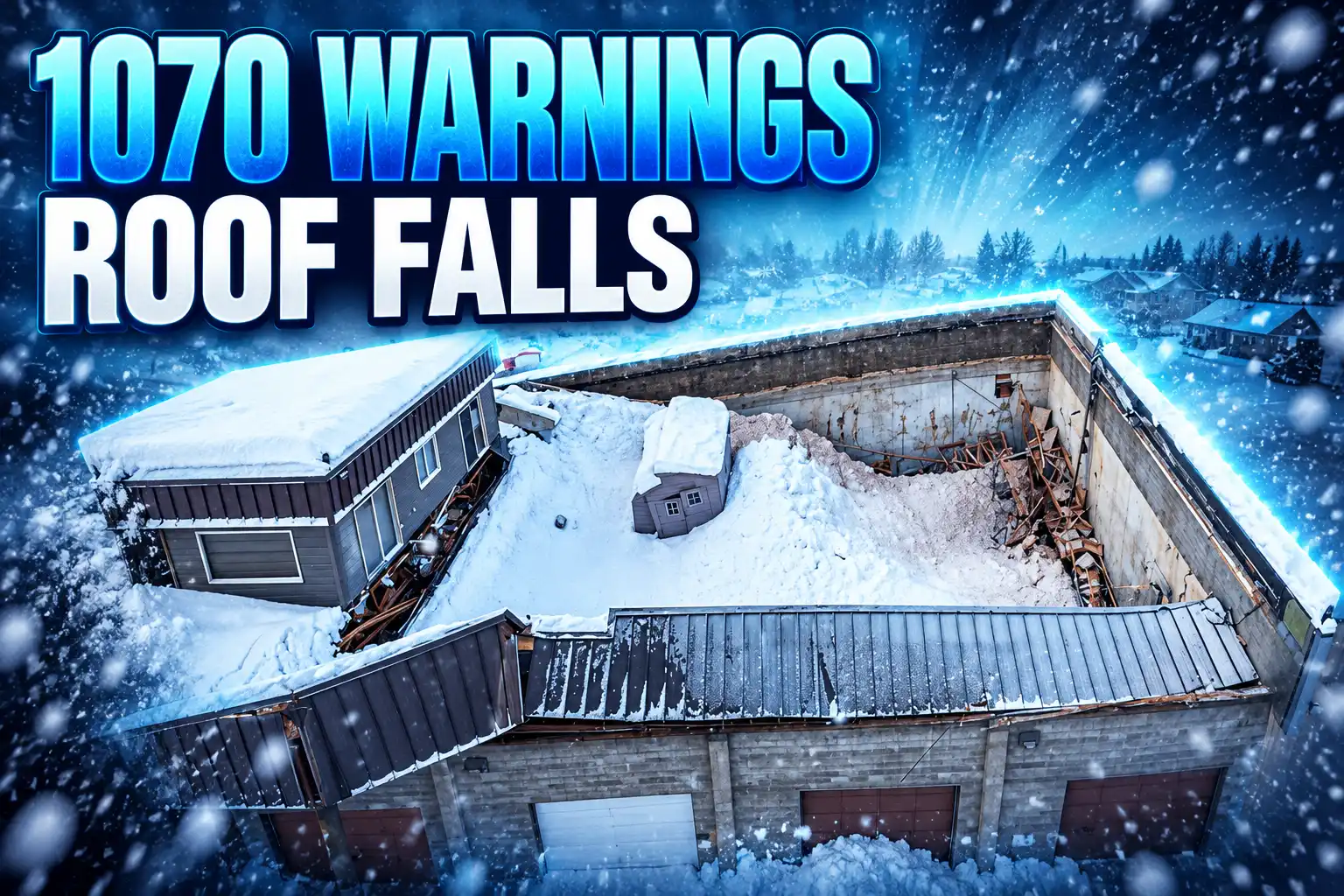
The Municipality of Anchorage mailed about 1,070 commercial owners a warning that their roofs could fail under snow, then watched another one fall the next day. The notices went out late on Jan. 30, 2024, from the Development Services Department, as the city logged its sixth commercial roof failure of a winter that would finish as the second snowiest on record.
The letter told owners to keep people out until the snow came off, and to hold the load under 15 pounds per square foot on roofs that municipal code, dating to the 1960s, still rates at 40.
The City Mailed 1,070 Letters and Another Roof Fell
Acting Building Official Ross Noffsinger said the city believed it had hundreds of the problem buildings and that the failure risk was high enough to write the owners directly. In late January 2024, Development Services sent about 1,070 copies of the city’s original roof warning to commercial owners, asking them to confirm the truss type, clear the snow, and hire an engineer.
The three-step letter to property owners named the construction the city had already seen fail: wood trusses with metal gang-nail plates, built before 1990, flat or nearly flat, and used as commercial space with long spans. If the roof matched that list, or if the owner could not tell, the occupancy advice was blunt.
If your roof is of the construction type of concern, as described above, or if you’re unsure of your roof construction, we recommend that no one occupy the space until the snow is removed from the roof.
Ross Noffsinger, Acting Building Official, Municipality of Anchorage letter
The same letter said those roofs had failed multiple times under less than 25 pounds of snow, that a high share of the ones engineers had opened up already showed distress, and that snow should not be allowed to exceed 15 pounds until the roof was proven safe. Regular removal was the holding pattern, not a one-time scrape.
A 10,000-square-foot building at 7400 Old Seward Highway, built in 1979, partially collapsed on Jan. 31, 2024, the day after the mailing. Plan review engineer Daniel King said that address was on the list. A local account flagged the Old Seward failure the same afternoon the notices became public, which matched what inspectors found on site: parallel-chord wood trusses with gang-nail plates, the exact class the letters described.
THE WEEK THE LETTERS LANDED
- Jan. 30, 2024: Development Services mails about 1,070 letters, and a roof fails at 611 Raspberry Road on an unshoveled building, per an aerial drone survey.
- Jan. 31, 2024: The Old Seward building on the mailing list partially collapses; Noffsinger puts the uncleared load at about 30 to 35 pounds after 17 inches of snow earlier that week, with more than 8 feet on the season.
- Early February 2024: King says the department has identified over 100 more suspect buildings and mailed those owners too, with a further round planned for tenants.
- Feb. 5, 2024: Two more commercial roofs fail over the weekend, taking the season to at least eight and the two-winter total to at least 24, with 111.2 inches of snow on the books.
Noffsinger had already said a later step could be figuring out how to retrofit the roofs. The letters themselves did not order that work. They asked owners to identify the framing, get the snow off, and call an engineer.
Why These Trusses Fail Below the Code Load
Anchorage has required roofs in the Bowl to carry 40 pounds of snow per square foot since at least the 1960s. The city’s own snow removal guidance for wood trusses states that many buildings cannot safely hold that weight, and that collapses have occurred under substantially less than the code minimum, mostly in pre-1990 wood roofs joined with metal gang-nail plates.
The plates are galvanized sheets with stamped prongs pressed into the wood. On trusses from the 1970s and 1980s, the city says the plates were often too small, poorly seated, or stopped short of the top of the top chord, so the wood splits along the grain under load. Inspectors have watched plates peel off underbuilt or overloaded trusses. Long web members often lack the bracing that keeps them from buckling, and pre-1990 roofs were likely never designed for snow drifts, a requirement that entered the Uniform Building Code in 1988 and Anchorage in January 1989.
WHAT THE CITY SAYS GOES WRONG
- Short plates: Top-chord bearing trusses from that era often place the gang-nail plate so the top chord splits parallel to the grain, a cross-grain tension failure.
- Loose hardware: Plates can loosen from seasonal moisture movement, long-term load, and earthquakes, and wood loses some strength when it stays stressed.
- Missing brace lines: Web members longer than about 6 feet commonly need lateral restraint; without it the city treats their capacity as reduced or negligible.
- Drift and ponding: Buildings finished before 1990 were likely not designed for drifted snow, and low-slope roofs can pond water and ice at scuppers the plumbing code treats as overflow, not primary drains.
After a truss already shows distress, collapse, or a peeled plate, due diligence rules for failed trusses kick in under Policy S.12, signed by Noffsinger and dated Jan. 8, 2023. The policy sits on Anchorage Municipal Code 23.70, the dangerous-building chapter, because these failures happen far below the design load, the cause is often hard to pin down, and proprietary plates make ordinary analysis uncertain. An Alaska-registered civil or structural engineer has to look at every similar truss under similar or greater load, not just patch the bay that fell. Occupancy on temporary shoring, except for construction and evaluation, needs the Building Official’s sign-off.
That is why the 15-pound cap in the letter matters. The city was not asking owners to babysit roofs up to the code number. It was telling them the code number is not the capacity of this class of building.
24 Collapses Across Two Record Winters
By early February 2024 the municipality put the two-winter count at at least 24 commercial roofs fully or partly down. Almost all shared the same wooden truss style. No residential buildings had failed in that run, which officials tied to shorter spans, interior bearing walls, and steeper pitches that shed snow.
The 2022-23 winter produced at least 16 failures, which Noffsinger called the largest grouping since 2011-12, when at least 14 roofs went down under the still-standing seasonal record of 134.5 inches at the National Weather Service Sand Lake office. Climate specialist Rick Thoman, using that Sand Lake series, later put 2023-24 at 133.3 inches, 171 percent of normal and second on the 71-winter record. The 2022-23 season had already delivered 107.9 inches, enough to break the same trusses a year before the near-record.
SNOW AND FAILURES THE CITY HAS LOGGED
| Season | Sand Lake snow | Commercial roof failures |
|---|---|---|
| 2011-12 | 134.5 inches (record) | At least 14 |
| 2022-23 | 107.9 inches | At least 16, including one death |
| 2023-24 | 133.3 inches (second on record) | At least 8 by Feb. 5; two-winter total 24 |
| Late January 2026 | About 57 inches by then | About 20 pounds on the roof; no new warning |
The 2023-24 list included a Spenard Builders Supply dispatch building on Dec. 20, a vacant warehouse at 4640 Gambell Street on Dec. 27, a 17,500-square-foot warehouse at 7920 Schoon Street on Jan. 8 with 80-foot truss spans, a 1978 complex at 5401 Cordova Street on Jan. 12, Raspberry Road on Jan. 30, Old Seward on Jan. 31, then 2020 East Dowling Road and 1218 West International Airport Road on Feb. 4. Portions of the Schoon Street building were occupied when it came down; no injuries were reported. Noffsinger said the roof there looked unshoveled and that the city was still seeing this truss design fail at around 25 pounds of snow.
At Cordova Street the owner had the trusses strengthened the previous summer, and the roof still failed. That is the pattern the letters were written around: local repairs that leave the rest of the same truss family in place, which is the exact gap Policy S.12 was written to close after a failure.
Sadie Huffer and the People Still on the Roof
The only death in the two-winter run was Sadie Jane Huffer, 37, a licensed clinical social worker, killed on Feb. 17, 2023, when the roof of Turnagain CrossFit at 1101 East 76th Avenue came down during a fitness competition. More than two dozen people were inside. Two others were trapped and freed. The gym building dated to 1979, inside the vintage the city later mailed about. Ice that had built on a sloped roof was an early factor Noffsinger cited, on top of the same plate-connected wood trusses.
Fashion Pact, a thrift shop in a 1983 building, lost its roof in March 2023. Owner Britini Clancey reopened in a new location and, in January 2026, was still shoveling a flat roof with family help. “I’m worried about many roofs in Anchorage,” Clancey said. “Experiencing a building collapse made me very aware of it. Honestly, some nights I don’t sleep because there’s so much snow.”
The letters were written to owners, not to the people who actually go onto the roofs. Handout AG.30 tells those owners to hire licensed, bonded roofing companies because the work is high and hazardous. A Feb. 7, 2024 notice from Mayor Dave Bronson’s office added that any hired crew should carry Workers Compensation insurance. The city never published a count of shovel-crew injuries from those winters, but the next year’s household survey filled in who is actually climbing.
Tenants sat in a gap of their own. King said the city could not brand every building of that era as dangerous until it had been investigated, and that a further mailing was being prepared for tenants in buildings that might still be at risk if the snow stayed. Occupants were the ones the letter said should stay out, and they were not the names on the envelopes.
A Map the City First Would Not Name
Officials built the at-risk list from property records, aerial surveys, and Google Maps imagery, then declined at first to publicize specific addresses, citing theft. Ten days after the mailing, Development Services published an interactive map of more than 1,000 commercial wood structures built between 1970 and 1995, drawn from the same data as the 1,070 letters, and plotted prior collapses on it.
Noffsinger said the aim was to weed out, surgically, buildings with the parallel-chord wood roof truss that was showing a pattern of failure. King stressed that the letters were notices that owners could have that construction, not a finding that every mapped parcel was already in distress. The map made the inventory public after the city had said it would not list the addresses. Owners still had to crawl a ceiling, hire an engineer, or file a “Parallel Chord Truss Verification” request so the city could keep community-wide statistics.
Noffsinger, in a January 2024 question session, said the first move would be a friendly letter and that if that path failed, the Assembly could adopt a stricter rule. No citywide retrofit mandate followed in the record of the next two winters. Policy S.12 still applies after distress or collapse. The 40-pound design number did not move. The 15-pound operating cap lived in a letter and a handout.
Most Residents Still Expect the Next Cave-In
Jennifer Schmidt, an associate professor of natural resource management and policy at the University of Alaska Anchorage Institute of Social and Economic Research, ran a household survey in 2025 as part of a collaborative project that included the National Science Foundation. She started it after she climbed her own roof to clear snow and got hurt, then asked how common that was.
A survey of 421 Anchorage households found over 70 percent of respondents concerned about heavy snow on their roofs, a share Schmidt said rises to 80 percent if “maybe” answers are included. She was surprised by the level. The researchers sent the questionnaire across the municipality and got more replies than they had aimed for. A companion survey of businesses drew a weaker response.
WHAT THE 2025 HOUSEHOLD SURVEY FOUND
- Who climbed: 54 percent of respondents had gone onto their own roofs, and 27 percent had hired someone to clear snow.
- Who paid a price: 43 percent reported a negative consequence, including cost, torn shingles, chimney or landscaping damage, exhaustion, and injury.
- Who knows the policy: Half said they did not know whether insurance would cover a collapse, and respondents wanted clearer rules for when to act.
- What Schmidt will not claim: High concern, she said, is not the same as high structural risk; the work measured perception.
The project also noted how thin the city’s own snow intelligence is in town. Researchers identified just one urban snow-monitoring station in Anchorage and said more are needed to match snow on the ground with snow on roofs, because most stations sit in nearby mountains rather than in the Bowl where the commercial trusses are. That gap is why the municipality still walks onto a roof with a one-square-foot cutter and a sack.
January 2026 Set a Snow Record Without Stressing Roofs
Greg Soule, who by then was in charge of building code for the municipality, said on Jan. 30, 2026, that January had set a snow record but that roof loads were about halfway to capacity. Crews had just taken a measurement. “We basically just have a device that is one square foot in area,” Soule said. “We then shove that into the snow that’s on the roof, and then you slip something underneath it, pull it up, and then dump that into a sack, and then weigh that.”
The sack came in at about 20 pounds. Soule still described 24 commercial roof collapses in the past few years, almost all with the same wooden trusses, and still reported no residential failures. By that Wednesday the city had about 57 inches of snow. If the total grew to 90 to 100 inches, he said, it might be a good time to clear a roof. King, speaking around the same storm, said the city was not recommending shoveling and was not putting out notices at that load. Interior warning signs, Soule said, are windows and doors that start to stick and cracks in drywall.
Clancey was already on her flat roof anyway. The 15-pound cap from the 2024 letter was never repealed in public. The 40-pound code number was never raised to match the roofs that had already failed at 25. The map of more than 1,000 commercial wood buildings from 1970 to 1995 is still the inventory. Two quieter winters after the near-record did not retire the plates. They left the same trusses in service, with the city still weighing snow a square foot at a time and still telling the public to wait for the next warning.

Hugo Chavez’s Hollywood Welcome Meets a Film About Escape

Googlebooks Hit Shelves With Finished Hardware and a New OS

The NFL Hits Jed York With the 2014 Irsay Penalty

Run Hide Fight Infidels Hits the Paywall, Not Hollywood

Samsung Raises Galaxy S26 Prices After Its Phone Unit Goes Red

Sons of Behemat Add a Witch and a Middle Rank

Canada Still Clears Mazatlán as the Cartel War Arrives

The FTC Suit That Targets Amazon’s Hidden Ad Floor

Apple’s Foldable iPhone Event Revives the Fingerprint Button

Women, Gym, and Affairs: A Complex Intersection
-
 GAMING1 month ago
Sons of Behemat Add a Witch and a Middle Rank
-
 NEWS2 years ago
Canada Still Clears Mazatlán as the Cartel War Arrives
-
 BUSINESS1 month ago
The FTC Suit That Targets Amazon’s Hidden Ad Floor
-
 NEWS1 month ago
Apple’s Foldable iPhone Event Revives the Fingerprint Button
-
 LIFESTYLE2 years ago
Women, Gym, and Affairs: A Complex Intersection
-

 AUTO2 years ago
Laepple Automotive Bets on a Vacant Detroit Die Shop
-

 LIFESTYLE2 years ago
The Unstoppable Rise of Hot Honey: Are Food Trends Making UK Restaurant Menus All the Same?
-

 NEWS4 weeks ago
Samsung Leads Mistral’s Record European Sovereignty Round