
NEWS
Samsung Raises Galaxy S26 Prices After Its Phone Unit Goes Red
Samsung added $100 to Galaxy S26 phones in October, passing a DRAM squeeze to buyers while its chip unit books record profit.

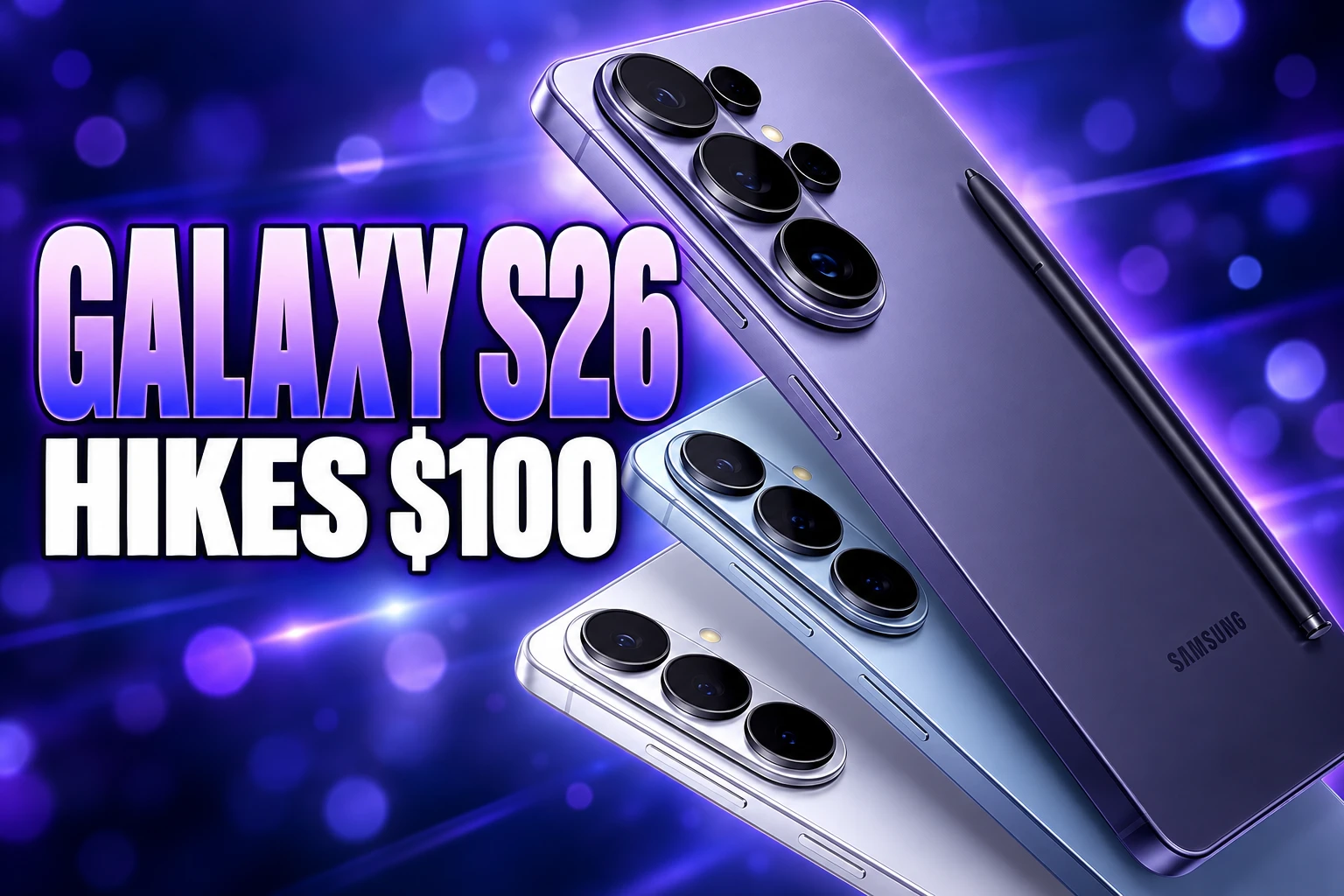
Samsung raised Galaxy S26 list prices by $100 on October 1, and by $200 on the 1TB Ultra. The new U.S. floor on the base phone is $999, seven months after a March launch that already sat above the Galaxy S25.
The increase showed up on Samsung.com in the United States, Canada, the United Kingdom, mainland Europe, India and South Korea. The Galaxy S26 FE did not move.
Galaxy S26 List Prices Jump Seven Months After Launch
Samsung Electronics Co., Ltd. changed the tags on the Galaxy S26, S26+ and S26 Ultra without a U.S. newsroom note. In Seoul the company confirmed the won increases. Most unlocked U.S. configurations rose $100. The 1TB Ultra, the only S26 with 16GB of RAM and a terabyte of storage, rose $200 to $1,999.
U.S. Unlocked Tags After October 1
The March lists already sat above last year’s S25 on the base and Plus models. The Ultra’s 256GB phone had held at $1,299 until this change. The S25 256GB phone listed at $860, the S25+ at $1,000 and the S25 Ultra at $1,300.
U.S. SAMSUNG.COM LIST PRICES
| Model | Storage | March list | October 1 list |
|---|---|---|---|
| Galaxy S26 | 256GB | $899 | $999 |
| Galaxy S26 | 512GB | $1,099 | $1,199 |
| Galaxy S26+ | 256GB | $1,099 | $1,199 |
| Galaxy S26+ | 512GB | $1,299 | $1,399 |
| Galaxy S26 Ultra | 256GB | $1,299 | $1,399 |
| Galaxy S26 Ultra | 512GB | $1,499 | $1,599 |
| Galaxy S26 Ultra | 1TB | $1,799 | $1,999 |
Some U.S. retailers still showed the old prices on October 1, so a checkout page outside Samsung.com was not a guarantee of the new floor.
What Europe, India and Korea Now Charge
The same $100-class move landed in euros, pounds, rupees, Canadian dollars and won, with the 1TB Ultra taking a larger step in every market checked. Korea’s 256GB phones each rose 149,600 won, about $110. The 1TB Ultra there is now 2,821,500 won, up 276,100 won.
REGIONAL STICKERS AFTER THE HIKE
| Market | S26 256GB now | Ultra 256GB now | 1TB Ultra now |
|---|---|---|---|
| United States | $999 | $1,399 | $1,999 |
| Europe | €1,100 | €1,550 | €2,150 |
| United Kingdom | £960 | £1,360 | £1,860 |
| India | ₹103,000 | ₹155,000 | ₹215,000 |
| Canada | CAD $1,400 | CAD $2,050 | CAD $2,850 |
| South Korea | 1,403,600 won | 1,947,000 won | 2,821,500 won |
India’s rupee tags had already moved before the dollar site changed. Apple and Google each added about $100 on recent phones in the same memory squeeze, so the S26 is not an isolated sticker.
DRAM Went From $13 to $26
The phones did not gain a camera or a chip in October. The bill that moved is memory. DRAMeXchange put average DRAM at $13 in March, when the S26 went on sale, and at $26 at the end of September. That is a double in the life of one flagship cycle.
Counterpoint Research estimated that memory’s share of production costs for premium smartphones rose 16 points over that stretch, to 43% from 27%. The 1TB Ultra carries the most RAM and NAND in the range, which is why it took the $200 step instead of $100.
THE COST STACK BEHIND THE NEW TAGS
- DRAM print: Average prices stood at $26 at the end of September, double the $13 level in March, according to DRAMeXchange.
- BOM share: Counterpoint put memory at 43% of premium smartphone production cost, up from 27% since launch.
- Phone ledger: The MX and Networks businesses posted a KRW 0.7 trillion operating loss in the second quarter.
- Chip ledger: Device Solutions booked KRW 89.2 trillion in operating profit in the same quarter, against KRW 89.5 trillion for the whole company.
September’s DRAM print on a widely watched DDR4 part was $26, up 4% from $25 in August, and that series has now risen for 18 months. NAND on a standard 128Gb part was $30.61, the 21st straight monthly increase. The consumer parts are expensive because factories keep steering wafers toward server DRAM and high-bandwidth memory for AI clusters.
Who Covers the Bill Inside Samsung
Samsung makes the chips and the phones, and the two ledgers no longer move together. Device Solutions posted KRW 127.5 trillion in second-quarter sales, up 56% from the prior quarter, and KRW 89.2 trillion in operating profit. The Memory Business set another record by chasing AI server demand and riding an industry-wide price rise, with a record share of sales from servers and a ramp in HBM4.
The phone side is the other book. On July 30 Samsung said the MX and Networks businesses posted KRW 33.2 trillion in sales and an operating loss of KRW 0.7 trillion for the quarter ended June 30. Galaxy S26 sales were solid and the Galaxy A series had momentum. Earnings still fell on component costs.
While revenue grew year-on-year (YoY) on solid sales of the Galaxy S26 series and strong Galaxy A series momentum, earnings declined due to elevated component cost pressures across the industry.
Samsung Electronics, second-quarter 2026 results, July 30, 2026
The earnings slides put MX sales of KRW 32.3 trillion against that loss. Company revenue hit a quarterly record of KRW 171.5 trillion, with operating profit of KRW 89.5 trillion. Almost all of that profit sat in chips. The Device eXperience group, which includes phones, TVs and appliances, posted KRW 48.0 trillion in sales, down 9% from the first quarter.
MX does not get cheap DRAM as a family discount. High-bandwidth memory uses the same wafer capacity as the LPDDR in a phone, and it pays more, so the phone line waits in a shorter queue at a higher price. The October tags are how the handset business tries to stop the loss from widening in the second half, a risk Samsung itself flagged around the Q2 print.
The S26 FE Still Starts at $699
Not every Galaxy in the window moved. Samsung left the volume and foldable SKUs on their launch lists, which keeps a cheaper door open and protects the phones it has been pushing as a richer mix.
SKUS THAT DID NOT TAKE THE OCTOBER STEP
- Galaxy S26 FE: Still starts at $699 after an August launch, $50 above the S25 FE.
- Galaxy Z Fold 8: Held at its launch list, along with the rest of the new foldable family.
- Galaxy Z Fold 8 Ultra: Spared the $100 move that hit the S26 Ultra’s 256GB and 512GB phones.
- Galaxy Z Flip 8: Also unchanged on Samsung.com when the S26 lists moved.
Samsung has already said it wants more of its mix in the Galaxy Z8 foldables and next year’s S27, the phones it describes as carrying a lighter cost burden. The FE at $699 is now $300 under the base S26. That gap is the practical off-ramp for anyone who will not pay four figures for a slab phone.
The company had already lifted some older Galaxy prices in April, including the Galaxy S25 Edge, Galaxy Z Flip 7 and Galaxy Z Fold 7. The October S26 move is the same tool used on the current flagship, not a one-off glitch on a product page.
Waiting Until Autumn Used to Cut the Bill
Galaxy shoppers have been trained to wait. Six months after launch, unlocked U.S. lists and carrier deals usually started to sag, and the prior Ultra often sat hundreds of dollars under its debut by the time the next Unpacked show arrived. The Galaxy S24 took an official U.S. MSRP cut after the S25 launched, with the 128GB phone marked at $699.99 against an $799.99 S25. The S25 itself ran no-trade-in promotions in 2025 that took selected phones well under list.
That script does not run on the S26. People who sat out March to dodge the launch premium now face a higher list than the people who paid in the first weeks. The base S26 is $999 against a $899 March tag and an $860 S25 256GB list. The cheapest S-series slab is in four-figure territory that used to belong to the Plus and the Ultra.
The replacement cycle is already stretching. A phone that costs more at month seven than at month one is an argument for keeping the old one through a fourth year, and that is a worse outcome for Samsung’s handset unit than a late discount would have been. Memory makers, including Samsung’s own Device Solutions group, are the other side of that trade.
Winter Memory Contracts Are Still Rising
The October lists are a catch-up to a cost curve that has not peaked. TrendForce, in a September 30 note, still has conventional DRAM prices to rise 10 to 15 percent quarter on quarter in the fourth quarter, with NAND up 15 to 20 percent. Mobile DRAM stays tight because suppliers keep shifting capacity to servers, even as phone brands lean on inventory and cut bit demand.
Samsung’s own second-half outlook for memory is the same direction. The company told investors it expects server DRAM, enterprise SSDs and HBM demand to keep the market undersupplied, even with some cooling in mobile and PCs, and it said supply constraints continue despite efforts to raise output. MX’s plan for the rest of 2026 is flagship-led sales around the Z8 and S26, plus cost cuts, not a return to launch pricing.
THE 2026 PRICE PATH ON THE S26
- February 26, 2026: Samsung shows the Galaxy S26 series at Unpacked in Seoul.
- March 2026: The phones go on sale, with the S26 and S26+ already above the S25 in the United States.
- April 2026: Samsung lifts prices on older models including the Galaxy S25 Edge, Galaxy Z Flip 7 and Galaxy Z Fold 7.
- July 30, 2026: MX and Networks post a KRW 0.7 trillion quarterly operating loss; Device Solutions posts KRW 89.2 trillion in operating profit.
- August 2026: The Galaxy S26 FE launches at $699 and is later left out of the October hike.
- October 1, 2026: Samsung.com lists rise $100 on most S26 configurations and $200 on the 1TB Ultra across the United States, Europe, the United Kingdom, India, Canada and South Korea.
The 1TB Ultra is a $1,999 phone because it packs the most memory in the line, and memory is the part Samsung’s other half cannot make cheap for handsets while it sells HBM into AI racks. Fourth-quarter DRAM contracts are still written to go up 10 to 15 percent, so the October tags are a floor for this cycle, not a sale.

The NFL Hits Jed York With the 2014 Irsay Penalty

Run Hide Fight Infidels Hits the Paywall, Not Hollywood

Samsung Raises Galaxy S26 Prices After Its Phone Unit Goes Red

Eurozone Inflation at 3.8% Tests Lagarde’s Yield Argument

Paramount Gets Warner Bros and a Five-Year Movie Quota

Sons of Behemat Add a Witch and a Middle Rank

Canada Still Clears Mazatlán as the Cartel War Arrives

The FTC Suit That Targets Amazon’s Hidden Ad Floor

Apple’s Foldable iPhone Event Revives the Fingerprint Button

Samsung Leads Mistral’s Record European Sovereignty Round
-
 GAMING4 weeks ago
Sons of Behemat Add a Witch and a Middle Rank
-
 NEWS2 years ago
Canada Still Clears Mazatlán as the Cartel War Arrives
-
 BUSINESS1 month ago
The FTC Suit That Targets Amazon’s Hidden Ad Floor
-
 NEWS1 month ago
Apple’s Foldable iPhone Event Revives the Fingerprint Button
-

 LIFESTYLE2 years ago
Women, Gym, and Affairs: A Complex Intersection
-
 NEWS4 weeks ago
Samsung Leads Mistral’s Record European Sovereignty Round
-

 LIFESTYLE2 years ago
The Unstoppable Rise of Hot Honey: Are Food Trends Making UK Restaurant Menus All the Same?
-

 ENTERTAINMENT2 years ago
SetonFest Grew From a 1981 Picnic Into Carmel’s Carnival