
NEWS
Tartrazine Makes Mouse Skin Transparent, Human Tests Stall
Two years after tartrazine made mouse skin see-through, labs have a protocol and a brain-window dye, while the first human trial sits withdrawn.

A 0.6 M rub of tartrazine still turns live mouse skin see-through in minutes. The first listed human test of that mix, a Johns Hopkins patch study, is marked withdrawn.
Guosong Hong’s Stanford group published the mouse work in Science on Sept. 6, 2024. The dye is now a lab method other imaging teams copy.
Stanford’s Dye Window Still Starts With Mice
Zihao Ou, then at Stanford and now at the University of Texas at Dallas, led the Science paper with Hong and nanophotonics professor Mark Brongersma. They massaged an aqueous mix of tartrazine, the certified color FD&C Yellow 5, onto the abdomen, scalp, and hindlimb of sedated mice.
The skin went red, then clear enough that a watcher could see a beating heart, a working liver, gut motion, bladder outline, and limb muscle fibers without a cut. Laser speckle imaging through the scalp picked up blood flow in the brain. The paper’s claim is blunt: strongly absorbing molecules can achieve optical transparency in live animals.
Hong said the window shut as fast as it opened.
As soon as we rinsed and massaged the skin with water, the effect was reversed within minutes.
Guosong Hong, assistant professor of materials science and engineering, Stanford University
Extra dye that had been absorbed left in urine within about 48 hours, and the mice kept breathing and circulating blood while the patch was clear. Eating a bag of yellow snacks does not do this. The working mix is a thick topical gel, on the order of 30 percent dye by weight, rubbed into shaved skin.
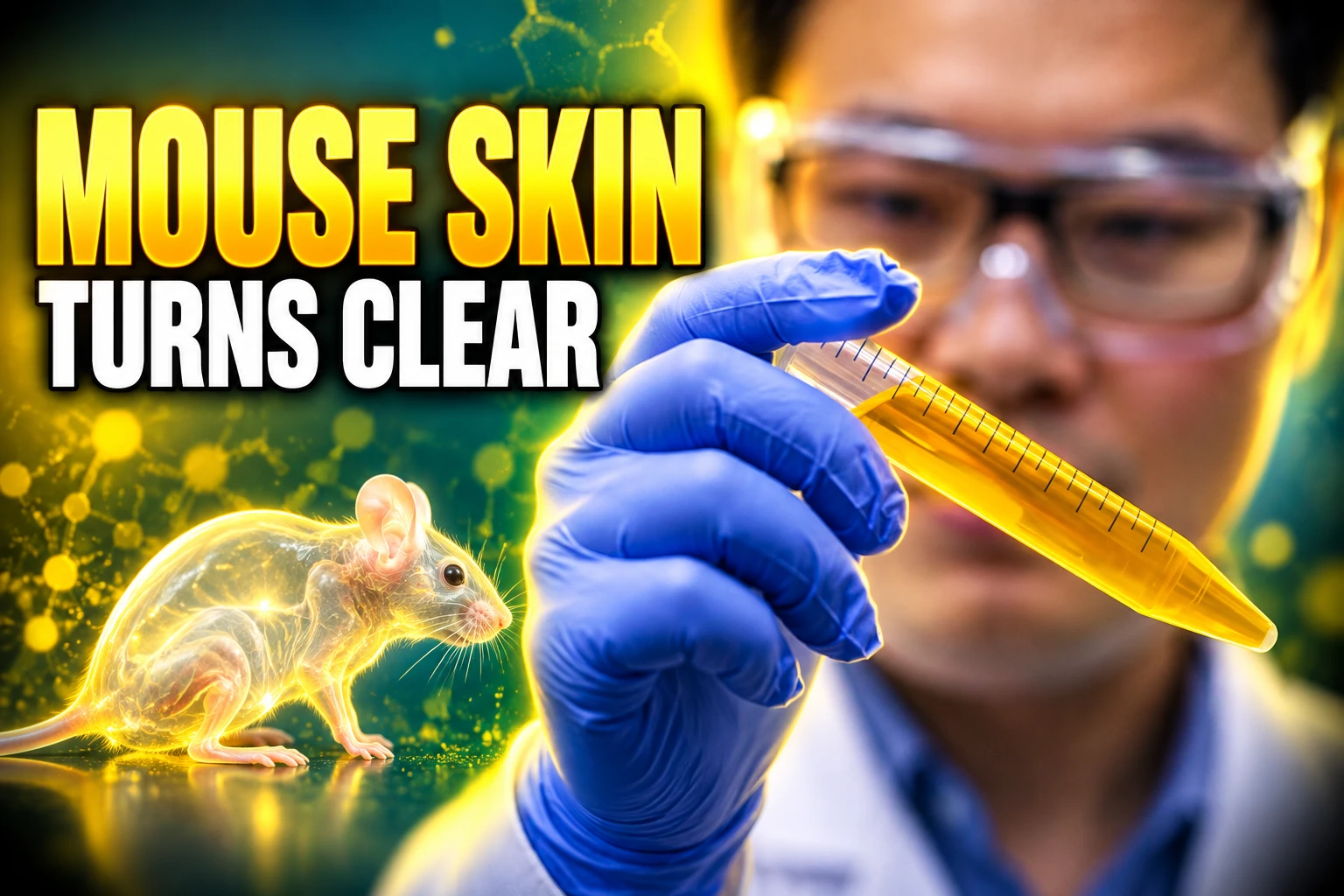
A Yellow Molecule That Clears Red Light
Skin looks opaque because water and fat do not bend light the same way. Water’s refractive index sits near 1.33 in visible light. Lipid- and protein-rich structures sit higher, about 1.40 to 1.50, so photons scatter at every interface.
Older clearing recipes either pull water out or strip lipids. Those steps kill the sample. Hong’s group used a different handle. Tartrazine soaks up near-ultraviolet and blue light, with peaks at 257 nm and 428 nm and almost no absorption past about 600 nm. Through the Kramers-Kronig link between absorption and refraction, that blue-end soak raises the index of the watery parts in the red, so red light stops bouncing as hard.
Hong put the surprise in plain terms. Mix blue ink in water and the glass goes darker. Dissolve more tartrazine in muscle or skin and the tissue goes clearer, but only in the red. First they dunked slices of chicken breast and watched them turn to a red jelly. Then they moved to live rodents. In tissue, scattering is 10 to 1000 times stronger than absorption, which is why matching the index matters more than bleaching the sample.
A September 2024 preprint pushed back, arguing the original images had cleared dead outer skin rather than live cells, and that abdominal organs showed through only in newborns. Hong’s lab later posted a Nature Protocols recipe, dated May 13, 2025, that walks through abdomen and hindlimb windows on live mice, including a 23-day-old 9.8 g C57Bl/6J female with an orange-red belly patch after the dye was absorbed and the excess wiped off.
What Other Labs Built on the 2024 Recipe
The snack-dye paper did not stay a one-off demo. Hong’s lab wrote the mouse steps down so other groups could repeat the belly and leg windows, then other optical teams started putting the same dye under their own cameras.
THE METHOD’S PAPER TRAIL
| Date | What landed | Who |
|---|---|---|
| Sept. 6, 2024 | Live mouse skin, muscle, and connective tissue go clear in red light | Ou, Hong, Brongersma, Science |
| May 13, 2025 | Step-by-step abdomen and hindlimb protocol for live mice | Keck and colleagues, Nature Protocols |
| Aug. 26, 2025 | Ampyrone opens the full visible band for YFP and GCaMP through scalp and skull | Keck and colleagues, PNAS |
| July 3, 2026 | Review of dye-based live clearing, plus dose and delivery limits | Crunkleton and Hong, Communications Biology |
| July 15, 2026 | Deeper label-free scans through mouse belly skin, 1.5 to 2 times baseline depth | Callaway, Hong, Robles, Optics Letters |
Victoria Crunkleton and Hong’s July 3, 2026 mini-review in Communications Biology collects follow-on uses in optical coherence tomography, photoacoustic microscopy, and laser speckle imaging through cleared skull. It also notes later tests in which even an isotonic 75 mM mix, about 4 percent by weight, still cleared tissue, and work that imaged embryos through a pregnant mouse’s abdominal skin.
The Georgia Tech collaboration is the cleanest outside check. Jacob Callaway, Francisco Robles, and Hong rubbed a tartrazine-agarose gel on mouse belly skin and ran quantitative oblique back-illumination microscopy, a label-free 3D method that reads refractive-index contrast. After the dye came off, depth fell back to baseline, so the gain was the temporary window, not a lasting change in the skin.
A U.S. application, US20250367330A1, published Dec. 4, 2025, and a 2022 WIPO filing sit behind the physics. Both are pending. Stanford listed the work as optical clearing enabled by the Kramers-Kronig relation, aimed at live tissue rather than fixed, solvent-soaked samples.
Ampyrone Lets Them Watch a Brain Grow
Tartrazine’s gift is also its limit. It blocks short-wavelength photons, so the window is reddish. Green and yellow fluorescent proteins, the workhorses of mouse neuroscience, sit in the blocked band.
On Aug. 26, 2025, the same Stanford group reported color-neutral and reversible tissue transparency with ampyrone, a compound that soaks up ultraviolet light and then drops off sharply, leaving the whole visible spectrum open. They imaged yellow fluorescent protein and the calcium sensor GCaMP through intact scalp and skull in live mice, including repeat sessions on the same animals over days.
HOW FAR THE 2025 WINDOW REACHES
- Scalp: About 150 micrometers of skin go clear enough for two-photon light to pass.
- Skull: About 100 micrometers of young bone still sit in the path; juvenile skulls stay thin enough until about four weeks of age.
- Cortex: About 400 micrometers of brain were imageable in those reconstructions.
- Behavior: Awake mice could be imaged during a puff of air on the whiskers, and histology plus blood chemistry showed little acute or chronic damage from the rub.
Hong called it a literal window onto how circuits form. Brongersma framed the animal as a bag of water mixed with biomaterials, and said the surprise was that the optics, chemistry, and biology lined up at all. That paper is the real sequel to the snack-dye clip: not a human scan, a way to watch one mouse’s brain across development without implanting a glass cranial window.
Johns Hopkins Listed a Human Test, Then Withdrew It
The clinic file is thinner. Johns Hopkins University posted a healthy-volunteer protocol, NCT06800183, for topical tartrazine for improved skin structure visualization in dermatology. The intervention was a four-chamber tartrazine patch across three body sites. The record cites the 0.6 M rodent mix and lists an estimated start of May 11, 2026.
WHAT WE KNOW
- The listing: Johns Hopkins is the sponsor, with internal ID IRB00469443.
- The aim: Test whether a topical tartrazine patch can make healthy human skin more see-through for dermatology imaging.
- The status: ClinicalTrials.gov marks the study withdrawn, with a last update on Nov. 14, 2025.
WHAT IS UNCONFIRMED
- Why it stopped: The public record does not state a reason for withdrawal.
- Enrollment: No results and no posted headcount appear on the record.
- A later restart: Nothing in the registry shows a replacement human protocol from that group.
That withdrawn row is the second-order fact the 2024 coverage did not have. Labs kept publishing mouse windows. The one named human skin test never became a completed study.
Why Thicker Skin Still Blocks the Clinic
Ou said the physics does not forbid people, but the distances do. Human skin is about 10 times thicker than mouse skin, so a few minutes of diffusion in a mouse would become hundreds of minutes in a person, and the dose needed to cross that full thickness is still unknown.
Crunkleton and Hong’s review is frank about the remaining engineering. To raise the refractive index of water by about 0.12, enough to match lipid-rich tissue, tartrazine still wants that ~30 percent-by-weight load. The review flags hypertonic stress, irritation, and inflammation at those strengths. Almost every live-animal test is still a surface rub, so depth is capped by how far the molecules diffuse. Tartrazine, fluorescein, and indocyanine green are anionic, which makes transdermal delivery harder. Ampyrone, a neutral molecule, penetrates skin better, which is one reason it became the brain-window dye.
THE REMAINING BARRIERS
- Skin thickness: Mouse windows form in minutes; Ou’s scaling puts human diffusion on the order of hundreds of minutes.
- Dose: Index matching still leans on a hypertonic, high-weight-percent mix, even if weaker isotonic tests can partly clear tissue.
- Allergy: Drug labels must warn that FD&C Yellow No. 5 may cause allergic-type reactions, including bronchial asthma, in susceptible people.
- Food-dye politics: On April 22, 2025, HHS and the FDA announced a plan to phase out petroleum-based synthetic dyes from the food supply, even as 21 CFR 74.705 still lists Yellow No. 5 for coloring foods under good manufacturing practice.
An April 2026 preprint from Hong’s lab, not yet peer reviewed, found that densely packed human embryonic kidney cells in a dish lost phase contrast up to a medium index of 1.41 in tartrazine, with little shape change or death for 30 minutes even near 1200 mOsm/kg. That is a dish result, not a volunteer’s forearm. The European Food Safety Authority’s oral no-adverse-effect figure of 2 g per kilogram of body weight, cited in the Science paper, also does not map onto a concentrated skin gel.
Hong’s group has a Nature Protocols recipe, an ampyrone paper for green and yellow light, and a pending U.S. application on Kramers-Kronig clearing. The Johns Hopkins tartrazine patch study is withdrawn. No completed human skin test has been posted.
Disclaimer: This article is news reporting on published animal studies, a public trial listing, and agency dye rules. It is informational only and is not medical advice, a safety finding, or a recommendation to put tartrazine, ampyrone, food coloring, or any optical-clearing mix on human skin. Anyone considering a dye, patch, or imaging agent for diagnosis or treatment should talk with a licensed physician or dermatologist first. Doses, trial statuses, and color-additive rules follow the papers and agency pages named above and can change as those records are updated.

Clay Moulds From the Blyth Hoard Fit Peebles Fittings

Treasury Yields Hit a 24-Year High as AI Joins the Queue

Crew-12 Leaves the ISS With Fedyaev and Adenot Aboard

The Graziers Recall Puts the 60-Day Cheese Rule on Trial

Hugo Chavez’s Hollywood Welcome Meets a Film About Escape

Sons of Behemat Add a Witch and a Middle Rank

Canada Still Clears Mazatlán as the Cartel War Arrives

The FTC Suit That Targets Amazon’s Hidden Ad Floor

Samsung Leads Mistral’s Record European Sovereignty Round

Laepple Automotive Bets on a Vacant Detroit Die Shop
-
 GAMING2 months ago
Sons of Behemat Add a Witch and a Middle Rank
-
 NEWS2 years ago
Canada Still Clears Mazatlán as the Cartel War Arrives
-
 BUSINESS2 months ago
The FTC Suit That Targets Amazon’s Hidden Ad Floor
-
 NEWS2 months ago
Samsung Leads Mistral’s Record European Sovereignty Round
-

 NEWS2 months ago
Apple’s Foldable iPhone Event Revives the Fingerprint Button
-
 AUTO2 years ago
Laepple Automotive Bets on a Vacant Detroit Die Shop
-
 LIFESTYLE2 years ago
The Unstoppable Rise of Hot Honey: Are Food Trends Making UK Restaurant Menus All the Same?
-

 AUTO2 years ago
Tamil Nadu Auto Keeps Growing Inside a Climate Red Zone