
NEWS
Depotcharge Turns Idle Truck Chargers Into a Haulier Club
Depotcharge raised €2.7 million and launched BGL Charge, copying a Swiss association model that turns idle truck depot chargers into a private freight network.

Depotcharge raised €2.7 million in pre-seed funding and launched BGL Charge with Germany’s road haulage lobby, so member yards can sell idle electric-truck bays to other fleets. High-Tech Gründerfonds led the round, with xdeck Ventures, Kopa Ventures, Prequel Ventures and angels from logistics, e-mobility and energy.
The cheque is small on purpose. The company, a product of Munich’s Evolve Energy GmbH, does not pour concrete or hang megawatt plugs. It bills, unlocks gates and white-labels a closed club that associations already know how to run.
€2.7 Million for Chargers That Already Sit Idle
Joscha Specks, chief executive and co-founder, built the pitch after years at Digital Charging Solutions, the roaming firm behind several car-brand charge cards. Co-founder Julius Wilhelm runs product and technology. Their claim is blunt: depots already buy chargers for their own trucks, those bays sit empty for hours, and public sites charge more for the same kilowatt-hour.
Depotcharge’s site now lists more than 150 companies and 180 truck sites, plus more than 500 electric trucks. Names already on the board include DPD, Gebrüder Weiss, Repower, Roll, Stöhr and Voigt. Operators keep prices, hours and guest lists. The platform handles access, invoices and payouts, and it talks to ordinary OCPP chargers without a hardware swap.
THE PRE-SEED CHEQUE
- The round: €2.7 million, pre-seed, led by High-Tech Gründerfonds.
- The co-investors: xdeck Ventures, Kopa Ventures, Prequel Ventures, plus sector angels.
- The spend: product work, international expansion, and hooks into booking and transport software.
- The parent: Evolve Energy GmbH, founded in 2024, selling Depotcharge as the marketplace brand.
HTGF, the public-private seed fund set up in 2005, says it has backed more than 790 startups and recorded 200 exits. Kopa writes climate-tech cheques in energy and mobility. Prequel is a Berlin supply-chain fund. None of them is financing a motorway hub. They are financing software that sits on chargers other people already paid for.
The marketing numbers are the company’s own. It says depot hosts can lift revenue by up to 400 percent and take up to €50,000 extra per charge point per year, while guest fleets can cut charging costs by up to 50 percent. Those caps are sales copy until BGL Charge publishes German volumes.
Switzerland Already Sold This to Its Hauliers
Germany is the bigger lobby. Switzerland is the working shop. On 24 April 2026, Evolve Energy rolled Depotcharge into the Swiss heavy-duty market through UTOPIA, a project with Repower, DPD Switzerland, G. Leclerc Transport and Swiss Post, logged as a measure in the Swiss Federal Office of Energy’s 2030 e-mobility roadmap. Registration opened on 1 May 2026.
The same week, the Swiss road-transport association put a members-only skin on the same stack. The ASTAG Charge member charging network is not an open marketplace. It is a club: members offer bays to members, keep control of who rolls in, and let Depotcharge run the boring parts.
ASTAG’s own pages show how fast a closed club fills. A May kick-off put a little over 20 firms and about 260 electric trucks on the platform, with more than 50 further firms queued for beta. By early September, Depotcharge was repeating ASTAG’s later tally: 64 firms, about 400 vehicles, 126 charge points at 40 sites. The full member rollout is set for 10 November 2026 at the association’s conference in Thun. ASTAG still wants about 100 active firms and at least 500 vehicles on the network by the end of 2026.
FROM UTOPIA TO BGL CHARGE
- 2024: Specks and Wilhelm found Evolve Energy and start Depotcharge as a depot-sharing marketplace.
- 24 April 2026: UTOPIA and ASTAG Charge are unveiled on the same platform in Switzerland.
- 1 May 2026: Swiss logistics firms can register; the Swiss shared depot charging launch goes live.
- 19 May 2026: ASTAG signs the club live with a little over 20 firms and about 260 electric trucks.
- 1 September 2026: Marc Clausing, after 21 years at DB Schenker (now DSV), becomes chief commercial officer.
- 15 September 2026: Depotcharge closes €2.7 million and launches BGL Charge as the German association skin.
Repower’s Cornelia Eltrich said the utility has spent years helping build Swiss heavy-duty charge hubs, and that those assets only pay if the spare hours are sold. Ville Heimgartner, senior project and sustainability manager at DPD Switzerland, said the carrier wanted cheaper charging along its routes than the public network, and tours it can actually plan. That is the whole product, said without a pitch deck: hosts want a second shift on kit they already own, and guests want a depot tariff instead of a motorway one.
What BGL Charge Opens Inside German Yards
BGL Charge copies that club, not the open Swiss UTOPIA layer. The Bundesverband Güterkraftverkehr Logistik und Entsorgung, based in Frankfurt, speaks for about 7,000 haulage, logistics and waste firms through 15 state associations. Dirk Engelhardt is the board spokesman. Members can open unused depot points to other fleets and, in return, use bays at other participating yards. BGL Charge handles marketing, access, invoicing and payments. Each host still sets price, hours and who is allowed in.
E.L.V.I.S. AG is coming in as a demand pooler. The European Cargo Association of International Forwarders is a Europe-wide alliance of mid-size transport firms that already bundles buying power, part-loads and back-office tools. Inside BGL Charge it will plug its partners into extra sites and push extra sessions onto their own depots. That is the hidden balance sheet. A pre-seed software firm does not need to sign Germany truck by truck if a lobby and a purchasing club walk in with the address book.
The idea behind Depotcharge is simple: logistics companies share their charging infrastructure with one another and unlock economic value across the sector. This principle translates ideally to associations, by members, for members, with a clear benefit for everyone involved.
Joscha Specks, CEO and co-founder, Depotcharge
BGL Charge has not published a German site count. Treating the ASTAG figures as a German forecast would be a guess. The association model is the bet. The Swiss club grew from a pilot of about 20 firms to 64 in a few months because the users already sit in the same membership file, the same insurance conversations and the same trade-fair halls.
A Drive-Through Bay Near the A6 Sets the Price
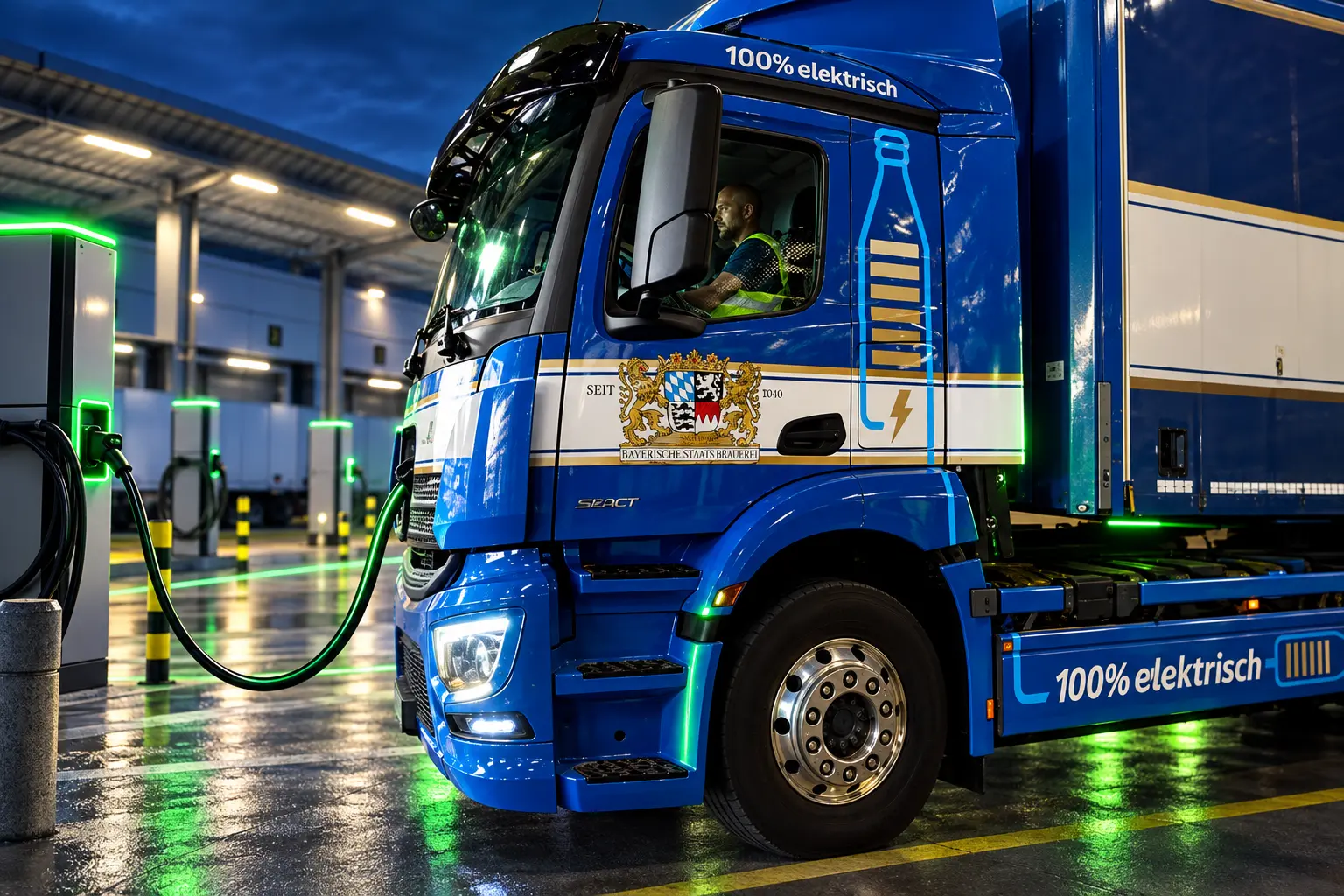
The platform is already more than a landing page. At roll Firmengruppe in Crailsheim, IO-Dynamics runs load management for three Volvo FH 540 Electric trucks, eight cars and two vans across six DC points. One of those points is listed on Depotcharge as a drive-through bay that does not need the trailer unhitched, at 240 kW, priced at 32.9 euro cents per kilowatt-hour plus a 2 cent service fee. The yard sits near the A6 and A7 interchange, which is the point: a host can sell a spare hour to a fleet that was going to pass anyway.
Access is RFID or MAC address. Billing is automatic. Payouts are monthly. Specks told IO-Dynamics that firms putting money into chargers should be able to wring the extra hours out of them once their own trucks are fed. The guest still needs a usage deal with the host. This is not a fuel-card roam across every public plug in the country.
HOW A DEPOT PUTS A BAY ON THE CLUB
- Keep the hardware: The stack is built for common OCPP chargers, with no cabinet swap required.
- Set the rules: The host picks prices, opening hours and which fleets may enter the yard.
- Connect the gate: Depotcharge says a live site can be wired in one to two weeks.
- Hand off the paper: The platform runs access, reservation, invoicing and payout; the host keeps the tariff.
A closed club solves a social problem that open public sites never had. A dispatcher will send a truck into another firm’s yard only if the gate rules, the turning circle and the invoice are known before the driver leaves. Association membership is a crude trust layer. It is also a way to keep the cheap depot kilowatt-hour inside the trade, rather than on a motorway price list.
Public Megawatt Parks Are Still a Thin Map
The public map is still short, which is why a private club has room. The German Association of the Automotive Industry, citing the National Centre for Charging Infrastructure, said in late August that Germany had 88 sites with 355 charging points for heavy commercial vehicles as of July 2026. Across the EU, the same note, citing the European Alternative Fuels Observatory, counted only 730 exclusive heavy-duty points above 350 kW.
The official motorway answer is still being built. The National Centre’s truck-network plan lists 351 planned motorway truck charging sites, 227 of them staffed rest areas and 124 unstaffed, with about 1,800 megawatt-charging points and about 2,400 CCS points. Autobahn GmbH awarded the unstaffed lots on 30 June 2026. VDA president Hildegard Müller still calls public charging the bottleneck, and the association wants about 4,000 public MCS points in Germany by 2030, more than double the MCS count in that initial motorway plan.
GERMANY’S PUBLIC HGV CHARGING LEDGER
| Item | Figure | As of / source |
|---|---|---|
| Public HGV sites in operation | 88 | July 2026, National Centre via VDA |
| Public HGV charge points in operation | 355 | July 2026, National Centre via VDA |
| Exclusive EU heavy-duty points above 350 kW | 730 | July 2026, EAFO via VDA |
| Planned German motorway sites | 351 | National Centre truck-network concept |
| Planned MCS / CCS points on that network | about 1,800 / about 2,400 | National Centre truck-network concept |
| VDA’s 2030 MCS call for Germany | about 4,000 public MCS points | 31 August 2026 VDA note |
Depot sharing does not make those motorway hubs pointless. Long-haul trucks still need a high-power stop inside a legal break, and the first German public MCS point, at Lipperland Süd on the A2, only opened on 29 September 2025 at up to 1.2 MW. The international MCS specification, IEC TS 63379, was published on 9 February 2026. Professor Markus Lienkamp has estimated that depot charging could cover around 85% of energy demand, because most electric trucks run under 300 kilometres a day and return to base. A Transport & Environment study on depot charging likewise treats the yard as the core of battery-truck energy, and notes that a grid hook-up in Germany often takes years.
That split is the second market. Public MCS is for the minority of energy that cannot wait at the fence. Shared depots are for the rest, sold at a host’s price, on a host’s timetable, to a guest the association already knows. If the club works, some of the kWh that motorway operators hoped to sell at rest-area tariffs will clear inside industrial parks instead.
Funding Goes to Booking and Dispatch Hooks
The new money is aimed at making a spare bay look like a planned stop, not a favour. Depotcharge wants reservations, open interfaces and links into the transport-management systems dispatchers already live in. ASTAG Charge has already shipped a driver app that shows live status, layout and access notes for member sites. Clausing’s job, from 1 September 2026, is to sell that commercial layer across Europe after two decades in contract logistics at Schenker and DSV.
Specks, Wilhelm and Clausing are in Hannover from 15 to 17 September 2026 for IAA Transportation, the same window as the funding note. Their list for the fair is where shared depot charging goes next in Europe, who wants to shape it, and how a host turns an idle point into revenue without giving up the gate. The public argument on X is almost empty. The buyers are in the halls, and in the membership mailings of groups that already pooled diesel, tyres and part-loads.
BGL Charge still has to prove German yards will open the barrier. Grid delays, tight yards and a fear of strangers on the forecourt can keep bays private even when the software is free to join. The Swiss club shows the format can fill when the users already share a letterhead. The €2.7 million is the budget to print that letterhead in German, then plug the invoice into the same screen that plans the next load.

Clay Moulds From the Blyth Hoard Fit Peebles Fittings

Treasury Yields Hit a 24-Year High as AI Joins the Queue

Crew-12 Leaves the ISS With Fedyaev and Adenot Aboard

The Graziers Recall Puts the 60-Day Cheese Rule on Trial

Hugo Chavez’s Hollywood Welcome Meets a Film About Escape

Sons of Behemat Add a Witch and a Middle Rank

Canada Still Clears Mazatlán as the Cartel War Arrives

The FTC Suit That Targets Amazon’s Hidden Ad Floor

Samsung Leads Mistral’s Record European Sovereignty Round

Women, Gym, and Affairs: A Complex Intersection
-
 GAMING1 month ago
Sons of Behemat Add a Witch and a Middle Rank
-
 NEWS2 years ago
Canada Still Clears Mazatlán as the Cartel War Arrives
-
 BUSINESS2 months ago
The FTC Suit That Targets Amazon’s Hidden Ad Floor
-
 LIFESTYLE2 years ago
Women, Gym, and Affairs: A Complex Intersection
-
 NEWS1 month ago
Samsung Leads Mistral’s Record European Sovereignty Round
-

 NEWS2 months ago
Apple’s Foldable iPhone Event Revives the Fingerprint Button
-

 AUTO2 years ago
Laepple Automotive Bets on a Vacant Detroit Die Shop
-

 AUTO2 years ago
Tamil Nadu Auto Keeps Growing Inside a Climate Red Zone