
AUTO
Japan Fights to Keep Thailand’s Auto Factories From China
Japanese car brands hold 62.8% of Thai registrations in 2026 as China takes the EV lane and Tokyo pushes a second energy-industry talk.

Japan’s trade minister sat with three Thai ministers on September 22, 2026, to push more auto investment and a second Energy and Industry Dialogue. The meeting landed almost two years after Tokyo first asked Bangkok to keep Japanese car plants at the centre of Thailand’s industry.
Japan Still Wants the Factory Floor
Ryosei Akazawa, Japan’s minister of economy, trade and industry, met Deputy Prime Minister and Finance Minister Akniti Nitithanprapas, Industry Minister Warawut Silpa-archa, and Energy Minister Aknat Phromphan. Akniti said afterward that Japanese private firms remain long-standing investors and that the talks focused on expanding the car industry, industrial waste handling, and cleaner fuels, including biodiesel.
Warawut’s readout went further on the product mix. Thailand and Japan, he said, should move the car industry along a multi-pathway line that covers hybrid cars, mild hybrids, and battery EVs, and they should prepare a second Energy and Industry Dialogue on modern vehicles, parts links, and biofuels.
Two days earlier, Prime Minister Anutin Charnvirakul had arrived in Tokyo on the same file. Japan is Thailand’s third-largest trading partner, with bilateral trade of US$53.2 billion, and the largest source of cumulative foreign investment. The Board of Investment approved 248 Japanese projects worth 67.16 billion baht in 2025. Anutin also rejected claims that Japanese makers were pulling all production out of Thailand. He said Japan’s ambassador had already dismissed a full withdrawal, even if some spending had slowed or changed shape as the car market shifted toward EVs and as Chinese brands pressed in.
That is the split the September meetings were built around. Chinese brands now sell a large share of the new cars Thais register. Japanese firms still run most of the old factory system, and they want the rulebook written so those plants stay busy.
The Dialogue Ishiba Asked For
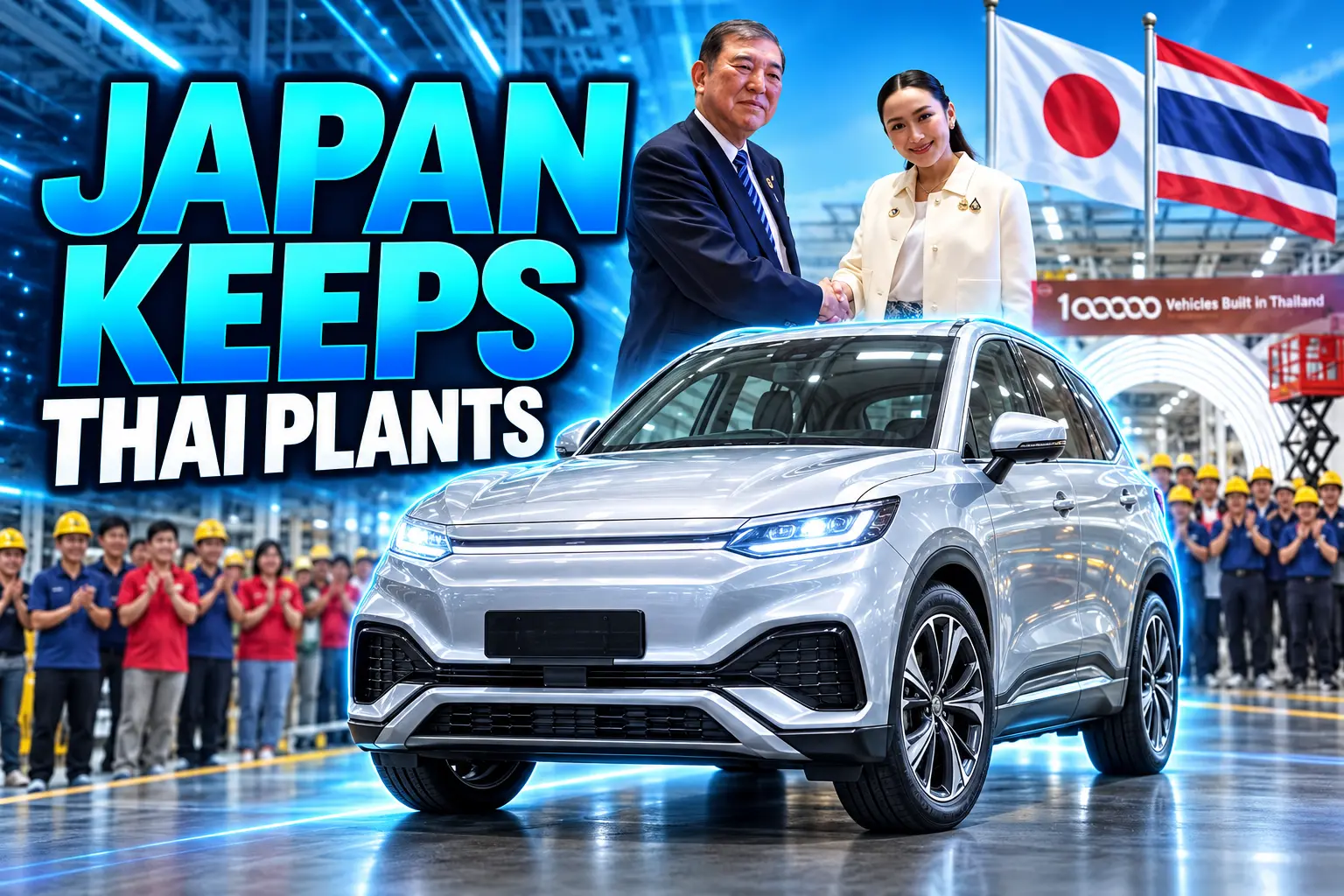
On October 11, 2024, then Prime Minister Shigeru Ishiba held brief informal talks with then Thai Prime Minister Paetongtarn Shinawatra on the sidelines of ASEAN meetings in Vientiane. The Prime Minister’s Office of Japan recorded that Ishiba hoped to launch an Energy and Industry Dialogue as soon as possible and promote cooperation in the automotive industry and other areas, and that he also wanted closer security work. Paetongtarn agreed and said Thailand’s policy remained unchanged.
Ishiba and Paetongtarn have both left office. The channel they agreed to open is the one Tokyo is still using.
THE PATH FROM VIENTIANE TO BANGKOK
- October 11, 2024: Ishiba and Paetongtarn meet in Vientiane and agree to open an Energy and Industry Dialogue and work together on cars.
- January 15, 2025: METI, the Japanese embassy, and JETRO hold a public-private automotive business forum in Bangkok for about 700 people, billed as preparation for the dialogue.
- April 29, 2025: Ministers open the First Energy and Industry Dialogue in Bangkok, issue a joint statement, and witness nine company memorandums.
- June 29, 2026: The separate 8th Japan-Thailand Energy Policy Dialogue meets in Tokyo. Isuzu and Thai partners table a test of 30% palm-derived biodiesel.
- September 20, 2026: Anutin arrives in Tokyo to talk Japanese investment, with cars high on the list.
- September 22, 2026: Three Thai ministers meet Akazawa and say a second Energy and Industry Dialogue is being prepared.
At the January forum, METI minister Yoji Muto and Thai Foreign Minister Maris Sangiampongsa sent video remarks that called for the energy and industrial dialogue to be held early. Vice-Minister Takehiko Matsuo told the room that Japan’s car strategy sits on a multi-pathway line, using EVs, fuel-cell cars, hybrids, biofuels, and synthetic fuels rather than a single bet. Board of Investment Secretary General Narit Therdsteerasukdi spoke for the Thai side.
The April meeting made that language official. Muto co-chaired with then Deputy Prime Minister and Finance Minister Pichai Chunhavajira, with Industry Minister Akanat Promphan in the room. The joint statement set three tracks: multi-pathway vehicles, a circular economy, and competitive parts networks and workers. METI also recorded that Japan’s car industry has built plants and parts ties in Thailand for more than 60 years.
Japanese Brands Fall Below 70 Percent
The political track held. The showroom did not. Syntax Partners, using full-year 2025 figures, put combined Japanese brand share at 69.3%, the first time it had dropped below 70%. Observer Research Foundation’s series shows Japanese brands above 85% through the 2010s and at 77.8% in 2023. Chinese brands had 3.2% of the Thai market in 2020 and 21.2% in 2025.
First-half 2026 registration tallies compiled by Syntax Partners put the Japanese share at 62.8%, with Chinese brands at 26.5%. In January 2026, helped by a rush before an EV 3.0 subsidy deadline, Chinese brands out-registered Japanese brands in a single month for the first time. The Federation of Thai Industries counted 621,166 domestic sales in 2025, up 8.47%, including 120,301 battery EVs, or 19.37% of the market. First-half 2026 sales reached 346,966 units, up 14.6%.
HOW THE THAI CAR MARKET SPLIT
| Period or slice | Japanese brands | Chinese brands |
|---|---|---|
| 2010s market | Above 85% | Barely present |
| 2020 market | Not stated | 3.2% |
| 2023 market | 77.8% | Not stated |
| 2025 market | 69.3% | 21.2% |
| First half 2026 registrations | 62.8% | 26.5% |
| Motor Show bookings, 2026 | 27.3% | 68.1% |
| Hybrid passenger cars, first half 2026 | 97.8% | Not stated |
| Battery EV passenger cars, first half 2026 | Not stated | 90.0% |
| One-ton pickups, 2025 | 91.2% | Not stated |
At the Bangkok International Motor Show, held March 25 to April 5, 2026, JETRO’s tally by nationality of capital gave Chinese brands 68.1% of 132,951 vehicle bookings and Japanese brands 27.3%. Bookings are not the same as registrations, but they show where shoppers were pointing. Toyota remained the top brand. BYD rose to fourth.
Hybrids Stay Japanese, Battery Cars Do Not
The cleaner split is by powertrain. On JETRO’s tally of January to June 2026 registrations, Chinese makers held a combined 90.0% of battery-EV passenger-car registrations, while Japanese makers held 97.8% of hybrid passenger-car registrations. Rhodium Group, in a July 23, 2026 paper, put Chinese makers at 89% of Thailand’s EV market by the end of 2025. The one-ton pickup, still the country’s work vehicle, stayed Japanese at 91.2% in 2025.
That is why Japanese share of all vehicles is still higher than Japanese share of passenger cars alone. Krungsri Research found Japanese passenger-car brands at 55.8% of new passenger registrations in the first seven months of 2026, down from 86.6% in 2021, before the EV support measures. Chinese passenger-car brands rose from 6.9% to 37.7% over the same comparison. Pickups and hybrids are carrying the Japanese total. Battery cars are not.
A battery EV also uses a different parts list. Thailand’s auto sector still runs through more than 2,400 firms and over 700,000 people, many of them tied to engines, transmissions, and the metal that hybrids and pickups still need. Treat those plants as permanent while the showroom tilts to China, and the payroll that made Thailand an export hub starts to look optional.
Honda Shrinks a Plant While Others Pledge Cash
Japanese groups are not leaving as a bloc. They are cutting some lines and writing new cheques on others, often on hybrids, pickups, and export models rather than on a pure battery bet.
WHAT JAPANESE FACTORIES ARE DOING
- Honda Ayutthaya: Vehicle assembly ended in 2025 and moved into the Prachinburi plant, which Honda lists at 120,000 units a year, with Ayutthaya kept for parts.
- Honda’s new cash: The Board of Investment’s September 2026 roundup said Honda pledged an extra 12 billion baht by 2029 and would build eight models in Thailand, the only such Honda base outside Japan.
- Suzuki: The company closed its Pluak Daeng vehicle plant by the end of 2025.
- Mitsubishi: Thai government spokesperson Lalida Perisvivatana said on July 24, 2026, that Mitsubishi plans 16 billion baht by 2030 for the energy shift, including study of pickup and electric Pajero output for export; Mitsubishi had also planned to halt production at one of its three Thai plants in 2027.
- Isuzu: The pickup specialist has put forward about 15 billion baht to upgrade its Thai base, while a June 2026 energy dialogue listed a 30% palm biodiesel test with Thai farm and fuel partners.
Chinese plants are no longer a side show. BYD’s Thailand factory, opened in July 2024 with a designed capacity of 150,000 vehicles a year, built its 100,000th vehicle on September 21, 2026, a white Atto 3. BYD said about 95% of the plant’s staff are Thai and that locally sourced parts are around 50%. Cumulative deliveries in Thailand, including imports, had already passed 130,000 by July. Rhodium lists eight Chinese carmakers that have announced Thai assembly plants: BYD, Great Wall, Changan, SAIC, Chery, Hozon, GAC, and Wuling.
Local content is the jobs argument. Rhodium found Chinese plants reporting local content between 40% and 60%, against 70% to 80% at most Japanese plants that have been in the country for decades. Neta, which could not meet offset rules after its parent ran into trouble in China, was sued in January 2026 as Bangkok tried to claw back 2 billion baht paid since 2022.
Why Bangkok’s EV Rules Favored Chinese Imports
Thailand still posts an 80% tariff on many imported finished cars. Japan-made cars enter at 20% under the Japan-Thailand Economic Partnership Agreement. Under the 2003 China agreement, China-made EVs face no tariffs at all. EV 3.0 and EV 3.5 then added buyer subsidies and excise cuts, with local-production offsets that did not bite on day one. Chinese exporters used that window. Rhodium, citing Krungsri, recorded price cuts through the 2024 and 2025 show seasons and, as of May 2026, gaps of up to 50% between Chinese and non-Chinese EVs.
Japan’s answer is not a matching pure-EV dump. It is a rulebook that still counts hybrids, fuel-cell cars, and cleaner liquid fuels as part of the transition, so the plants and parts books already in Thailand do not become stranded. After the April 2025 dialogue, Muto put that to reporters in one line.
We shared the recognition that there is a need for multi-pathway measures instead of focusing solely on electric vehicles.
Yoji Muto, then minister of economy, trade and industry, to reporters in Bangkok
Ambassador Masato Otaka made the same demand in public on July 16, 2026, calling for a level playing field to protect Thailand’s car-making base. Japanese brands still want credit in tax and investment rules for hybrids and for the local content those cars carry. Chinese brands still want the EV lane open. Bangkok is trying to collect both sets of factories.
The Board of Investment said Thailand had secured 198 projects in the EV supply chain worth 137 billion baht ($4.1 billion), spanning battery EVs, hybrids, cells, parts, and charging. That pile includes Japanese hybrid money and Chinese battery-EV money. It does not settle which side keeps the showroom.
A Second Energy Talk Is Being Lined Up
The first Energy and Industry Dialogue was supposed to be followed within a year. Working-level talks were to feed a second ministerial meeting. On September 22, 2026, Thai ministers said that second meeting is now being prepared, with modern vehicles, parts links, and biofuels on the docket. No date was posted.
The cash already on the table is mixed. Honda is putting 12 billion baht more into Thailand through 2029 while running fewer assembly sites. Mitsubishi is posting 16 billion baht through 2030 while it had planned to idle a plant in 2027. Isuzu is spending on pickups and testing a 30% palm biodiesel blend, a fuel path that fits diesel trucks better than city battery cars. BYD’s Rayong line has now turned out 100,000 vehicles, with local parts still around 50%.
Anutin’s line in Tokyo was that Japanese firms will keep investing, and that the ambassador had already knocked down a story of total flight. Akazawa’s line in Bangkok was more investment in cars, waste handling, and clean energy. Japanese brands still sell most of the pickups and almost all of the hybrids. Chinese brands sell nine in ten of the new battery passenger cars. The second Energy and Industry Dialogue is where those two facts get written into policy, or do not.

Clay Moulds From the Blyth Hoard Fit Peebles Fittings

Treasury Yields Hit a 24-Year High as AI Joins the Queue

Crew-12 Leaves the ISS With Fedyaev and Adenot Aboard

The Graziers Recall Puts the 60-Day Cheese Rule on Trial

Hugo Chavez’s Hollywood Welcome Meets a Film About Escape

Sons of Behemat Add a Witch and a Middle Rank

Canada Still Clears Mazatlán as the Cartel War Arrives

The FTC Suit That Targets Amazon’s Hidden Ad Floor

Samsung Leads Mistral’s Record European Sovereignty Round

Laepple Automotive Bets on a Vacant Detroit Die Shop
-
 GAMING2 months ago
Sons of Behemat Add a Witch and a Middle Rank
-
 NEWS2 years ago
Canada Still Clears Mazatlán as the Cartel War Arrives
-
 BUSINESS2 months ago
The FTC Suit That Targets Amazon’s Hidden Ad Floor
-
 NEWS2 months ago
Samsung Leads Mistral’s Record European Sovereignty Round
-
 AUTO2 years ago
Laepple Automotive Bets on a Vacant Detroit Die Shop
-
 NEWS2 months ago
Apple’s Foldable iPhone Event Revives the Fingerprint Button
-

 LIFESTYLE2 years ago
The Unstoppable Rise of Hot Honey: Are Food Trends Making UK Restaurant Menus All the Same?
-

 LIFESTYLE2 years ago
Women, Gym, and Affairs: A Complex Intersection