
BUSINESS
Russia Makes Factory Owners Buy Air Defense They Cannot Run
Moscow now bills factory owners for air defenses the army still runs, and can seize plants that fail to stop Ukrainian drones.

Alexei Mordashov put an air-defense system on Severstal’s biggest mill outside Moscow after a Ukrainian drone hit the steelmaker earlier in 2026. People familiar with the matter said Russia’s richest businessman paid for cover the army no longer supplied as a matter of course. Other owners now face the same bill, with a seizure threat attached if they stall.
Private plants are leasing batteries, hiring gunners, and rewriting guard jobs because Ukrainian drones now reach mills, refineries, and parcel hubs far from the front. The state still holds the triggers.
A Steel Mill on Moscow’s Edge Bought Its Own Cover
Severstal’s move was a rich man’s answer to a hole in the national shield. The mill sits on the capital’s outskirts, inside the zone Moscow has spent years ringing with missiles, guns, and new rooftop towers. A drone still got through.
People close to Russia’s business elite and defense sector said other firms are now copying the model in two ways. Some pay the Defense Ministry a monthly fee to rent a system. Others hire engineers from defense plants to assemble cheaper copies, including interceptors modeled on Ukraine’s P1-SUN design from Skyfall.
Job ads ask for gunners who can knock drones out of the sky. The work is spreading into ordinary roles. Security staff and, on paper, some postal employees are being folded into the same cheap layer of defense.
Geography that once helped Russia wait out invaders is now a liability. The landmass is too large for a finite stock of batteries to sit on every tank farm and warehouse, so the Kremlin has shifted the cost, and much of the blame, onto the owners.
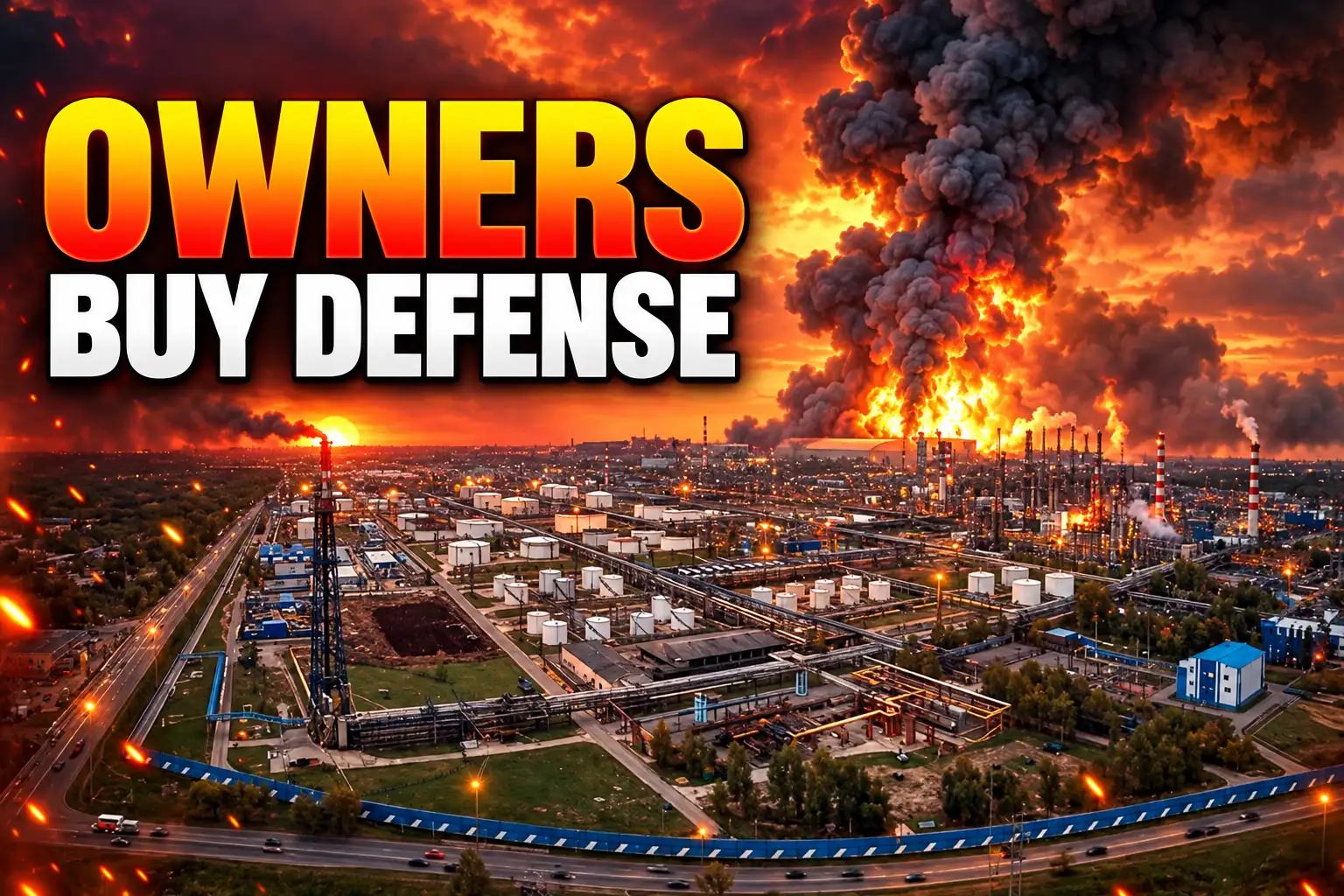
What the Decree Lets Moscow Take
On August 24, 2026, President Vladimir Putin signed an executive order on the security of critical infrastructure. If an owner fails to protect a listed site in time, or fails to restore it on the government’s timetable, the state may impose temporary administration over company property, covering all or part of the movable and immovable assets.
The order’s map is wide. It names fuel and energy plants, industrial sites, communications, utilities, transport and logistics complexes, nuclear facilities, and other places judged vital to security, economic stability, and daily life. Almost any large physical asset can be argued into that net.
Kremlin spokesman Dmitry Peskov put the burden on the owners. “We are facing an obvious threat of drone attacks on critical infrastructure facilities, and business owners often don’t pay proper attention to security measures,” he said.
First Deputy Prime Minister Denis Manturov told reporters the step is not a change of ownership. “I want to stress that this is not about nationalization or a change in the form of ownership: the decree implies the state stepping into management of a company to address specific security tasks,” he said. He added that it is not meant for mass use, and that some owners still do not treat the safety of sites and staff as a priority.
No public takeover under the new order has been announced. Manturov later said several firms had already been warned over weak security and slow repairs. “I won’t name them, but their issues will be addressed first,” he said.
THE LEGAL CLOCK ON OWNERS
- May 2026: Alexander Shokhin, head of the Russian Union of Industrialists and Entrepreneurs, asks Putin to let companies buy heavier weapons than light rifles, plus electronic warfare gear, and to keep reservists posted at plants.
- August 24, 2026: Putin signs the executive order that ties missed defenses and slow rebuilds to temporary state administration.
- September 3, 2026: The government amends the 2005 postal-weapons rules, and Putin tells the Eastern Economic Forum that refinery owners now have spending duties they lacked before.
- September 19 to 20, 2026: Ukraine launches its largest combined strike package on the Moscow region, and the capital’s own rings again fail to keep every drone out.
A fuel-industry source has already flagged the gap the order does not close: it never splits the duty to stop a drone between the owner and the Defense Ministry. The company writes the check. The ministry still decides how the guns are run.
Companies Pay for Guns the Ministry Still Runs
At the Eastern Economic Forum on September 3, Manturov said large industrial companies were being folded into the Defense Ministry’s air-defense net. “It is important to understand that there cannot be any separate systems for detecting, warning, and repulsing attacks outside the Ministry of Defense, this would be both ineffective and unsafe,” he said.
Owners can pay for nets, cages, concrete, and detection kits they actually control. The live weapons are a different category. After Shokhin’s May appeal, authorities approved a path for firms to buy anti-aircraft guns, turrets, radar, and jammers, with those systems passed to military units and reservists rather than to a company militia.
Putin used the same forum to describe the new duty in cash terms. Refinery owners, he said, had not been obliged to spend on air defense. The August order created that duty. One large company, he said, was already in for a sum he would not treat as a rounding error.
There were no such obligations. Given this executive order, such obligations have emerged. I’ll say this: only one of our large companies, I spoke with them yesterday and the day before yesterday, we are talking about tens of billions of rubles.
Vladimir Putin, President of Russia, plenary meeting of the 11th Eastern Economic Forum
Public tenders do not show that kind of money. Tenderplan, a Russian procurement monitor, counted commercial anti-drone purchases of 441.3 million rubles ($5.25 million) in the first half of 2026, 6.6 times the figure a year earlier. Companies are not required to report all of this spending, and the gap between the public tally and Putin’s tens of billions of rubles is the private, off-tender layer around the biggest plants.
Russia’s Finance Ministry has said it is looking at tax relief to offset defense outlays and repair bills. That is a subsidy for a duty the state created, not a transfer of the batteries themselves.
Guards Now Get Paid to Watch the Sky
The expensive answer is a rented Pantsir and a ministry crew. The common answer is a man with a gun and a new job description. On Avito, Russia’s classifieds board, companies now seek guards who can patrol a site, watch the sky, spot a drone, and shoot it down.
One Moscow-region listing starts at 240,000 rubles a month, with signing and performance bonuses. Posts that protect the Crimean Bridge can pay more than twice as much. Some ads require a one-year contract with the Defense Ministry and promise the work will not mean a trip to the front.
THE NEW CIVILIAN DRONE WATCH
- Site guards: Listings now treat sky watch and drone engagement as part of the shift, not an extra skill.
- Hired gunners: Separate ads seek people whose main task is to bring drones down, at mill and depot wages far above ordinary security pay.
- Postal equipment: A September 3 government resolution adds counter-drone gear to the federal postal service’s allowed kit, without naming which staff get it.
- Ministry contracts: Some “warehouse security” roles are written as rear-area defense jobs tied to a one-year Defense Ministry contract.
Prime Minister Mikhail Mishustin signed Resolution 1125 on September 3, published the next day, amending a January 26, 2005, decree. The 2005 list already let postal security staff carry 9mm pistols, stun guns, and body armor, mainly for cash runs. The new text adds “special technical means of countering unmanned aerial, underwater and surface vessels and vehicles, autonomous land vehicles and other automated unmanned systems” to that postal counter-drone equipment list.
It does not arm every letter carrier. The kit stays optional, issued by role, for tasks such as guarding offices and escorting cash. The political signal is still the same. When the batteries are elsewhere, the state reaches for whoever already holds a permit to carry a gun.
Hardening work has become its own trade. Contractors now sell steel cages, nets over pipe racks, and detection kits, and they are learning in public which of those layers actually holds when a second wave arrives. That market will outlast any single raid. It will not replace a magazine of missiles.
Even Moscow’s Rings Let Drones Through
The capital is supposed to be the exception. It is the most heavily defended city in the country, with layered long-range batteries and a growing inner ring of short-range vehicles, some of them lifted onto roofs and highway ramps. Ukrainian drones have still reached a refinery about 15 kilometers from the Kremlin, more than once.
On the night of September 19 to 20, 2026, the Institute for the Study of War recorded Ukraine’s largest combined missile and drone package against strategic targets in Moscow Oblast, including 450 drones on Moscow approaches. Mayor Sergei Sobyanin said air defenses downed more than 1,600 drones across the defensive lines from September 19, 450 of them on the way into the city. Ukraine’s General Staff said the package hit the Gazprom Neft Moscow Oil Refinery in Kapotnya and damaged primary processing units.
The International Energy Agency, in a September 17 commentary, said Russia has 32 major refineries and about 6.5 million barrels a day of installed capacity. In June, throughput fell to 3.8 million barrels a day, the lowest in more than 20 years and roughly 30 percent below a year earlier. Gasoline output was down 20 percent from 2025 levels, and diesel was down nearly 30 percent, which pushed the government to curb fuel exports.
In the first eight months of 2026, the agency said, a Russian refinery was hit on average once every three days. Waves of drones are used to swamp nets and other passive cover. On July 7, Ukraine reached Gazprom Neft’s Omsk plant, Russia’s largest, at about 450,000 barrels a day and roughly 2,500 kilometers from the Ukrainian border. Some plants closer to Ukraine have been attacked as many as 15 times since 2022. As of late August, only five major refineries had not been hit, all of them 3,500 to 6,500 kilometers away in eastern Siberia or the Far East.
The Moscow refinery, about 250,000 barrels a day, was so badly damaged in the June attacks that the agency said it was expected to stay offline until early 2027. Putin, speaking on September 3, cited his energy minister as saying about 10 percent of repair work remained at 10 percent of the enterprises. Those two figures describe leftover work and a slice of the plant list, not a clean bill of health.
THE INDUSTRIAL HIT LIST
| Measure | Figure | Window |
|---|---|---|
| Refinery hits (IEA) | Average of one every three days | First eight months of 2026 |
| Crude throughput | 3.8 million barrels a day | June 2026 |
| Refinery strikes (Rochan Consulting) | Some 200 | Since March 2026 |
| Logistics centers hit | At least 36, including Ozon and Wildberries | Since March 2026 |
| Commercial anti-drone tenders | 441.3 million rubles | First half of 2026 |
Rochan Consulting’s strike count and the IEA’s hit rate are not the same series. One tallies raids on refineries since March. The other measures how often a plant was actually struck, on average, from January through August. Both point the same way. The rear is now a target set, not a sanctuary.
One Owner Can Spend Tens of Billions
Mordashov can buy a battery for a mill on Moscow’s edge. A regional warehouse operator cannot. The August order does not care about that difference. It asks whether the site was protected and whether it was rebuilt on time.
WHO WRITES THE CHECK
- The oligarch layer: One large company, Putin said, is already spending tens of billions of rubles on kit and specialist crews.
- The public tender layer: 441.3 million rubles, 6.6 times higher than a year earlier, shows up in open commercial purchases of nets, sensors, jammers, and unarmed interceptors.
- The wage layer: 240,000 rubles a month for a Moscow-region guard who will watch the sky, with Crimean Bridge jobs paying more than twice that.
- The seizure layer: Warnings already issued, names withheld, with temporary administration still unused in public.
Independent refiners and private regional firms are the obvious pressure points, especially in the south. A company that rebuilds a cracked unit and is hit again two weeks later has little commercial reason to keep writing checks. The order is designed to remove that choice. Spend, or let a state administrator step in.
Airport closures and mobile-internet blackouts now halt civilian life on nights when most drones are stopped. The intercept is counted as a success. The grounded flights and dark phones are the bill that never appears in a Defense Ministry communique.
Fuel Queues Outlast the Night Raids
The campaign’s economic residue is already in the pumps. Export bans on gasoline, diesel, and jet fuel were used to protect the domestic market after the June drop in throughput. Plants that still run are being told to stretch maintenance and, in some cases, to turn out lower-grade product. That is a policy patch over missing distillation units, not a new air-defense doctrine.
Logistics parks proved as brittle as tank farms. Rochan’s tally of at least 36 logistics centers includes hubs of Ozon and Wildberries, the country’s largest online retailers. A warehouse full of palletized goods burns fast. Nets do not change that math once a warhead is inside the shed. Those sites now sit inside the same legal definition of critical infrastructure as a refinery, which means a missed repair can become a governance problem, not only an insurance claim.
Steel is in the same vice. Specialty heats for armor plate and missile bodies are booked months ahead and cannot simply move to the next mill. A strike on a furnace that feeds the defense plants is a strike on the war’s own supply chain. Asking that mill’s owner to lease a short-range battery, then leaving the crew under ministry command, does not restore the lost heat.
The arrangement is tidy for the Kremlin and expensive for everyone else. The owner pays. The ministry keeps the radar picture. The guard on the night shift is told to look up. If the drone still lands, the paperwork is already written for a temporary administrator to walk through the gate.
Mordashov could write that check. The next warehouse owner on the list may find that the only system on offer is a shotgun, a net, and an order that treats both as if they were a missile battery.

Clay Moulds From the Blyth Hoard Fit Peebles Fittings

Treasury Yields Hit a 24-Year High as AI Joins the Queue

Crew-12 Leaves the ISS With Fedyaev and Adenot Aboard

The Graziers Recall Puts the 60-Day Cheese Rule on Trial

Hugo Chavez’s Hollywood Welcome Meets a Film About Escape

Sons of Behemat Add a Witch and a Middle Rank

Canada Still Clears Mazatlán as the Cartel War Arrives

The FTC Suit That Targets Amazon’s Hidden Ad Floor

Samsung Leads Mistral’s Record European Sovereignty Round

Laepple Automotive Bets on a Vacant Detroit Die Shop
-
 GAMING1 month ago
Sons of Behemat Add a Witch and a Middle Rank
-
 NEWS2 years ago
Canada Still Clears Mazatlán as the Cartel War Arrives
-
 BUSINESS1 month ago
The FTC Suit That Targets Amazon’s Hidden Ad Floor
-
 NEWS1 month ago
Samsung Leads Mistral’s Record European Sovereignty Round
-
 AUTO2 years ago
Laepple Automotive Bets on a Vacant Detroit Die Shop
-

 AUTO2 years ago
Tamil Nadu Auto Keeps Growing Inside a Climate Red Zone
-

 LIFESTYLE2 years ago
Women, Gym, and Affairs: A Complex Intersection
-

 LIFESTYLE2 years ago
The Unstoppable Rise of Hot Honey: Are Food Trends Making UK Restaurant Menus All the Same?