
NEWS
Greek Islands Hit Record Tourism and Run Out of Workers
Santorini’s 8,000-a-day cruise cap has not freed homes for staff, as Greek islands tourism still supplies 13% of GDP.

Tourism poured €32.4 billion into Greece in 2025, 13% of GDP. The islands that earn the largest share now struggle to house the workers, teachers and doctors the season needs.
Three years after residents on Santorini, Mykonos and Paros warned that visitor growth was hollowing out daily life, the national books are still rising. The shortage that matters is not a missing berth. It is a missing long-term key.
Tourism Now Supplies 13% of Greek GDP
The Institute of the Greek Tourism Confederation, INSETE, put the sector’s €32.4 billion direct contribution at 13% of output in 2025, up 7.3% from €30.2 billion in 2024. ELSTAT’s first estimate of GDP that year was €248.4 billion, up 4.9%.
Count the knock-on spend and INSETE’s range runs from €71.3 billion to €85.9 billion, or 28.7% to 34.6% of GDP. In 2024 that wider band was €66.4 billion to €80.0 billion. Each euro of tourism take, the institute said, lifts GDP by €2.20 to €2.65.
2025 TOURISM IN THE GREEK BOOKS
- Direct take: €32.4 billion, 13% of GDP, after €30.2 billion in 2024.
- Arrivals: 38.0 million inbound visitors excluding cruise, 43.3 million once ships are counted.
- Receipts: €22.6 billion without cruise, €23.6 billion with it.
- Peak jobs: up to 750,659 posts, 17% of employment, on INSETE’s high-season estimate.
Inbound trips excluding cruise rose 5.6% from 36.0 million in 2024, and INSETE’s English study records 38.0 million inbound arrivals for the year. With cruise passengers the total is 43.3 million, up 6.4% from 40.7 million. Receipts excluding cruise rose 9.8% from €20.6 billion; including cruise they rose 9.4% from €21.6 billion. Against 2019, arrivals are up 21.2% and receipts 27.9% on the non-cruise measure.
The South Aegean took 29% of inbound receipts, Crete 19%, the Ionian Islands 8% and Central Macedonia 7%, 64% of the pot between them. INSETE said 74% of inbound receipts were earned outside Attica, and that inbound money still covers 70% of the goods-trade gap.
The labour table did not keep pace. Average tourism employment was 400,250, down 0.2%, even as Q3 hit a record 475,167 in the Labour Force Survey. Rooms lost 896 posts, down 0.8%, while food service added 163, up 0.1%. Ilias Kikilias, INSETE’s director general, said 2025 confirmed the sector’s weight but that the result is not guaranteed, pointing to tax loads, weak town management, and shortages of ports, roads and people.
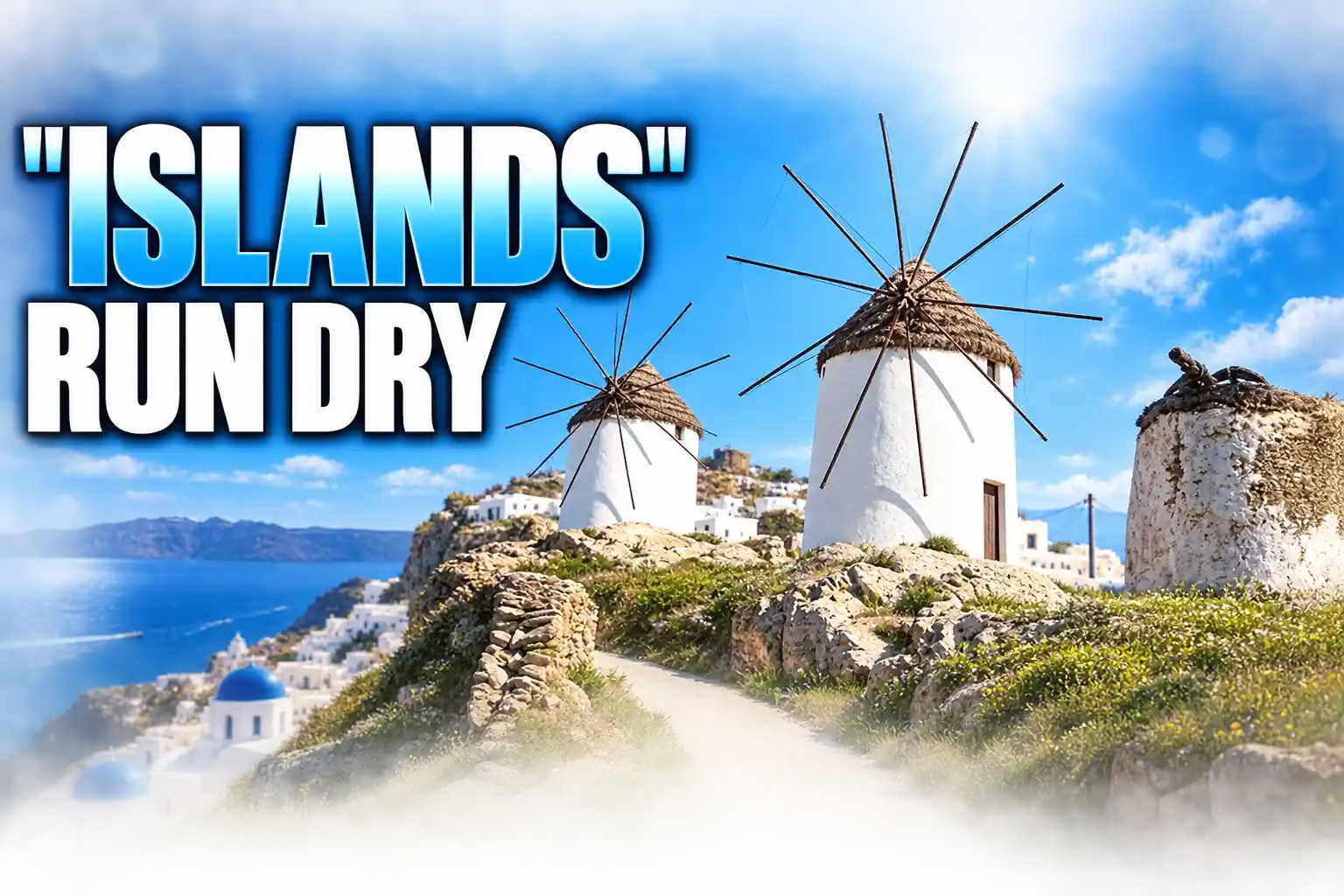
The Rooms That Used to Be Homes
Prosperty, a property-data firm, counted 24,946 active short-term listings across the Aegean. Santorini leads with 5,306, then Rhodes with 3,913, Mykonos with 3,506 and Paros with 3,453. Those first three islands hold 12,725 listings, just over half the Aegean stock.
AEGEAN SHORT-TERM LISTINGS
| Island | Active listings | Average daily rate | Est. yearly take |
|---|---|---|---|
| Santorini | 5,306 | €327 | €20,000 |
| Mykonos | 3,506 | €723 | €18,800 |
| Paros | 3,453 | €322 | €20,300 |
Mykonos posts the dearest night at €723, with Antiparos at €476. Paros leads estimated yearly take per listing at €20,300, just ahead of Santorini’s €20,000. Prosperty said real take is about 43% higher once every platform is counted.
The fill rates are annual, not July snapshots, and they show why a packed August can sit beside a shut winter. Milos leads at 27.1% occupancy across the year. Santorini is at 24.3%. About three nights in four, those Santorini listings are empty, held for the season rather than let to a nurse on a winter contract.
Valuation firm GEOAXIS, in its 2025 island survey, put median asking prices for luxury summer homes at €16,000 per square metre on Mykonos, €13,292 on Santorini and €9,499 on Paros, an eighth straight year of rises and a 3.8% median gain. Ordinary summer homes still cleared €2,854, €2,286 and €2,275 per square metre on the same three islands. Foreign buyers dominate those deals.
Santorini Now Packs Harder Than Attica
The Sustainable Tourism Observatory of the Aegean, at the University of the Aegean, compared beds, holiday homes and residents against land area. Yiannis Spilanis, the emeritus professor who directs it, presented the third report in May 2026 for the Hellenic Society for the Environment and Cultural Heritage.
The European Environment Agency’s mark for tourism pressure is 100 beds per square kilometre. Much of the Aegean and Ionian already sits above it.
HOW HARD THE ISLANDS ARE PACKED
| Island | Beds plus residents per km² | Hotel and short-term beds per km² |
|---|---|---|
| Santorini | 1,164.4 | 863.4 |
| Salamina | 1,103.8 | n/a |
| Mykonos | 759 | 611.4 |
| Skiathos | 589 | 381.5 |
Add vacant homes used as lets or second houses and Thira, Santorini’s municipality, reaches 964 beds per square kilometre and Mykonos 634.3. With short-term lets included, Mykonos has 4.9 beds per resident, Thira 4.3 and Koufonisi 4.1. On a four-month high season, the observatory found daily visitor counts on Mykonos and Santorini can run more than three times the resident population.
Second homes now outweigh hotels on several famous rocks: 90% of Mykonos’s bed mix, 77% on Thira, 43% on Paros, 99.8% on Salamina. Built-up land is 24.3% of Mykonos and 20.2% of Santorini, against a national 2.95%. In 2024, 27% of the floor area of new buildings in Greece went up in island regional units that hold 19% of the country’s land.
The census story is not a simple emptying. Only 11 islands gained people over the last decade, and Santorini, Mykonos, Rhodes and Paros are among them, because tourism still pulls in workers and owners. Corfu and Thasos, which also live off visitors, were among the steepest losers. Average declared income is €19,494 on Mykonos, €18,062 on Thira and €16,915 on Paros, against a national €13,962, yet only seven islands beat that national mean. Poverty risk is 30.4% in the North Aegean and 27.7% in the Ionian Islands, above the 26.1% national rate.
Santorini recorded 1,298,968 arrivals by sea in 2023, against 742,553 in 2014. Mykonos took 1,192,822 cruise visitors, Corfu 667,182 and Rhodes 453,832. In the Dodecanese, 33.9% of gross value added comes from rooms and food, against 4.5% in Attica, so a thin winter still shows up as jobless rates that can sit above 20% in the first quarter and below 5% at the peak.
The 8,000-Passenger Cap and the €20 Fee
The state did move, just not on housing. Santorini’s daily cruise cap stays at 8,000 passengers for 2026, the same ceiling as 2025. The change is in the maths: ports now count each ship at 100% of berths, against 80% last year, so a 3,000-berth vessel uses 3,000 slots instead of 2,400.
HOW THE CRUISE RULES LANDED
- 2014: Santorini records 742,553 arrivals by sea.
- 2023: Sea arrivals on Santorini reach 1,298,968.
- 2024: Law 5162/2024 sets a cruise sustainability fee, with the rates fixed in a later ministry decision.
- 21 July 2025: The fee takes effect after seismic unrest near Santorini delayed the original 1 July start.
- 2026 season: The 8,000 cap remains, with ship loads counted at 100% occupancy.
A ministry decision published for operators sets the peak €20 cruise passenger levy for anyone going ashore at Mykonos or Santorini from 1 June to 30 September, and €5 at every other Greek port. Shoulder months, April, May and October, cost €12 and €3. From 1 November to 31 March the rates fall to €4 and €1. A summer call at both trophy islands is €40 a head before any other stop.
Mykonos has the levy and no matching hard cap. The fee is billed when passengers step off, and it is not subject to VAT. Prime Minister Kyriakos Mitsotakis had said cruise calls had burdened the two islands and that part of the take would go back into local works. Kikilias still lists destination management among the gaps. A ceiling on ships does not reopen a school flat that now clears €327 a night.
Why Teachers Sleep in Cars on Mykonos
Public staff and seasonal crews are the people the postcard does not show. RE+D Magazine’s 2025 review of island lets found teachers sleeping in cars and doctors turning down postings because rent sits above pay. Substitute teachers who refuse a placement over housing can be kept off the national hiring list for two years. Eurostat has ranked Greece first in the EU for housing-cost burden for at least six years.
In 2025 listings, a 35-square-metre flat in Kanalia, Mykonos, was offered at €10,000 for the season, water and internet included, power extra. A 25-square-metre house on Santorini, built in 2015, was about €7,000 for the season. In Aliki, Paros, a 48-square-metre flat listed at €8,500. Owners often want the whole season, or the whole year, paid up front. Many leave units empty from October to May so the short-term market can start again around Easter.
Hotel pay does not meet those asks. On 1 January 2026 the Panhellenic Federation of Food and Tourism Workers, POEET, published new tables after a 3% rise in the sector deal. Category A posts (front desk, head cook, night porter) moved to €1,030 a month. Category B is €1,010. Category C, including room attendants and waiters’ assistants, is €990. Ten thousand euros for that Mykonos studio is about 9.7 months of Category A pay, before tax, for a single season on 35 square metres.
Crews who do come pack in. Five or six staff in one small room is a common pattern, and some rooms fail basic housing standards. A few employers still board people. Others watch staff commute by ferry or walk away.
WHAT THE 25 FEBRUARY STRIKE ASKED FOR
- Winter pay: Unemployment benefit for seasonal staff at 80% of the normal rate, with no extra hurdles.
- Retirement lump sum: Restore the old payment after 20 years of service.
- New food-service deal: Higher wages, a five-day 40-hour week, and extra pay for a sixth day.
- Inspectors: Bodies that can actually check wages, hours, and health and safety.
POEET struck for 24 hours on 25 February 2026 and rallied at 11:00 outside the Ministry of Labour. Union officials said thousands of seasonal staff had filed for winter benefit in late October or November and were still waiting. The row is national, but it bites hardest where a room that could house a waiter now sells by the night.
Paros Is Copying the Same Build-Out
Paros is the island that still markets itself as the calmer cousin, and it is repeating the same sequence at speed. Kriton Arsenis, a former Member of the European Parliament, said the island has been overbuilt at a dramatic pace.
In the past five years alone, it has topped the Cyclades in new building permits, surpassing even Mykonos and Santorini.
Kriton Arsenis, former Member of the European Parliament
A driver on the island put it in plainer words: building is eating the coast, and Greeks can no longer buy. A shopkeeper in a quiet inland village pointed at villas on former fields and at the planned airport upgrade, due in 2030, and said locals would be priced into an island of money and concrete. Prosperty already ranks Paros first for yearly take per listing at €20,300, with a €322 average night, evidence that the money arrived before the new runway.
Naoussa’s harbour now reads like a small Mykonos, and the backstreets fill with new boutique rooms. Paros still has more year-round grain than Santorini, which is why the permits matter. Once the long-term stock flips, teachers and nurses face the same seasonal maths the trophy islands already failed to solve.
Planners Want a Hard Line on New Concrete
On 24 September 2026, Spilanis warned that planning breaches and uncontrolled building now risk lasting change in the Cyclades, and he called for a hard red line on urban rules and a turn back toward a more local visitor mix. Kikilias, speaking for the industry’s own research shop in May, asked for a single national plan, working local management, and enough ports, pipes and staff to match the arrival numbers.
Those are not the same ask. One wants a stop on the concrete. The other wants the state to service the growth. Neither opens, on its own, the 5,306 Santorini listings to a winter tenant.
August still produced the image the island now sells. Visitors queued for an hour at 2 p.m. in hard sun for the blue-dome photograph in Oia, the same frame that filled the boats. The product is a picture. The people who used to live behind that wall cannot make Category A pay cover a seasonal lease.
Bank of Greece figures show the cash is still coming: July travel receipts rose 7.2% even as non-resident arrivals that month fell 3.1%, and receipts for January to July were up 12.0%. The July travel surplus was €4,314.4 million; the seven-month surplus was €11,243.1 million. Peak cruise rates run through 30 September. After that the listings wait for Easter, and the €1,030 hotel wage stays where it is.

Clay Moulds From the Blyth Hoard Fit Peebles Fittings

Treasury Yields Hit a 24-Year High as AI Joins the Queue

Crew-12 Leaves the ISS With Fedyaev and Adenot Aboard

The Graziers Recall Puts the 60-Day Cheese Rule on Trial

Hugo Chavez’s Hollywood Welcome Meets a Film About Escape

Sons of Behemat Add a Witch and a Middle Rank

Canada Still Clears Mazatlán as the Cartel War Arrives

The FTC Suit That Targets Amazon’s Hidden Ad Floor

Samsung Leads Mistral’s Record European Sovereignty Round

Laepple Automotive Bets on a Vacant Detroit Die Shop
-
 GAMING2 months ago
Sons of Behemat Add a Witch and a Middle Rank
-
 NEWS2 years ago
Canada Still Clears Mazatlán as the Cartel War Arrives
-
 BUSINESS2 months ago
The FTC Suit That Targets Amazon’s Hidden Ad Floor
-
 NEWS2 months ago
Samsung Leads Mistral’s Record European Sovereignty Round
-
 AUTO2 years ago
Laepple Automotive Bets on a Vacant Detroit Die Shop
-

 NEWS2 months ago
Apple’s Foldable iPhone Event Revives the Fingerprint Button
-

 AUTO2 years ago
Tamil Nadu Auto Keeps Growing Inside a Climate Red Zone
-

 LIFESTYLE2 years ago
The Unstoppable Rise of Hot Honey: Are Food Trends Making UK Restaurant Menus All the Same?