
ENTERTAINMENT
Paramount Gets Warner Bros and a Five-Year Movie Quota
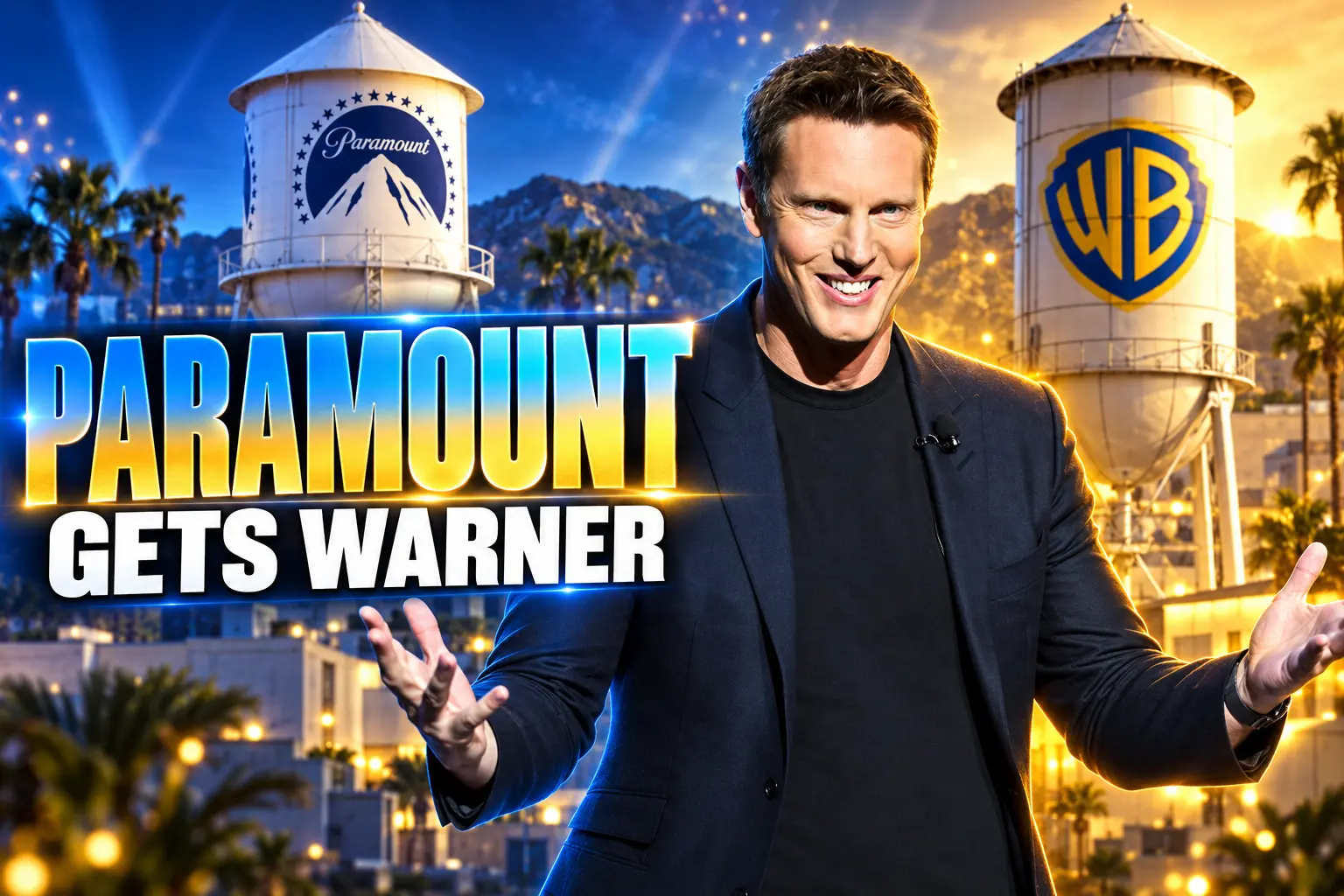
A U.S. judge cleared Paramount’s Warner Bros. Discovery merger for an October 6 close, but only after a five-year movie quota and U.S. production floor.

A federal judge on September 30 approved Paramount’s antitrust settlement with 12 states, clearing its Warner Bros. Discovery merger to close on October 6.
Paramount Skydance pays $31 a share in cash, plus a daily tick after September 30. It gets two Hollywood studios, HBO, CNN, and a five-year court order on how many movies it must put in theaters.
A Federal Judge Clears the October 6 Close
Paramount Skydance and Warner Bros. Discovery said the merger contemplated by their February 27, 2026 agreement is expected to close on October 6, subject to customary conditions. U.S. District Judge Araceli Martínez-Olguín, sitting in the Northern District of California, entered the consent decree the same day. She wrote that the proposed decree represents a reasonable factual and legal resolution of the dispute and that the parties reached it after highly contested, if brief, litigation and several rounds of talks.
Each WBD common share converts into $31.00 plus $0.00277778 for every calendar day after September 30 through the closing date, capped at $0.25 per 90-day stretch. If closing lands on October 6, that price is $31.01666668. Paramount’s unaudited pro forma statements put cash due to WBD common stockholders at an amount estimated at $78.0 billion, using shares outstanding as of July 23, 2026. About $1.1 billion more is estimated for vested WBD equity awards. The companies have financed and described the purchase as a $110 billion acquisition, with Paramount as the accounting acquirer and WBD surviving as a wholly owned subsidiary.
THE CHECK AT CLOSE
- Cash per share: $31.01666668 if the merger closes on October 6.
- Cash to common holders: $78.0 billion in Paramount’s October 6 pro forma case.
- Debt on the books: about $80 billion at the combined company.
- Promised savings: $6 billion in run-rate cost synergies.
Paramount Class B shares are slated to leave Nasdaq around October 5 and begin trading on the New York Stock Exchange the morning of the close. The combined company’s new name has not been announced.
Paramount Must Ship 30 to 32 Films a Year
That close is the headline. The operating manual is the consent decree California and 11 other states extracted on September 21 and the judge signed on September 30. David Ellison had already pledged a heavy theatrical slate. The states put the pledge in a five-year court order, with money penalties and forced sales if the company misses.
Washington Attorney General Nick Brown’s office, one of the plaintiffs, said the merged company must release 30 films a year in the first two years, then 32 a year in years three through five, and that more than 100 of those titles have to be wide releases on at least 2,000 screens.
WHAT THE DECREE REQUIRES
| Rule | Years 1-2 | Years 3-5 |
|---|---|---|
| Theatrical films | 30 a year | 32 a year |
| Wide releases (2,000-plus screens) | 20 a year | 21 a year |
| Independent films | At least 4 a year | At least 4 a year |
| U.S. production add-on | $300 million above 2025 spend | $300 million above 2025 spend |
| Theatrical window | 45 days, then 90 days off streaming | 45 days, then 90 days off streaming |
| Missed-film penalty | $30 million per title, plus a Miramax sale | $30 million per title, plus a Miramax sale |
At least half the counted films must be produced or jointly produced by the combined company. At least 20 percent of the slate has to be tentpole titles with budgets over $50 million. The five-year U.S. production add-on totals $1.5 billion on top of 2025 domestic spending, a floor, not a cap. Brown’s office said around 5 percent of Paramount’s production is in the United States now.
If Congress passes a federal film tax credit of at least 20 percent, the U.S. share of production has to rise to 20 percent in the first two years and 30 percent in the next three. If California or New York also passes an uncapped credit, that share rises to 40 percent. The company cannot sell or close the Paramount lot in Hollywood or the Warner Bros. lot in Burbank during the term. It has to keep a free ad-supported streaming service in the mold of Pluto TV. Cable talks for the Paramount channels and the Warner channels have to stay separate; a breach can force sales of BET, VH1, Comedy Central, Smithsonian, Destination America, and Science Channel. An independent monitor watches all of it.
The 45-day window and the 90-day holdback are the terms a streamer-first buyer would have fought. Paramount signed them to get out of a Clayton Act case before the October ticking fee ran, and to put two classic studios under one parent that still has to feed theaters like a 1990s major.
An $80 Billion Tab Meets a $6 Billion Cut Target
The combined company is expected to carry about $80 billion in debt. Paramount has told investors it will take $6 billion out of the cost base. Those two figures now sit beside a court order that forbids shrinking the theatrical slate and forbids selling the lots that look like easy assets.
Banks finished syndicating a roughly $52 billion financing package on October 1: $30 billion of U.S. dollar investment-grade bonds, about $12.4 billion of junk bonds, and $9.46 billion of loans. The longest blue-chip note, due in 2066, was sold at a yield of almost 9 percent. Apollo Global Management, Bank of America, and Citigroup led the sale after lawsuits had kept the company from printing the debt in the summer, when rates were lower.
The equity side is family money plus a syndicate. Affiliates of the Lawrence J. Ellison Revocable Trust committed up to $46.7 billion, with $250 million from RedBird Capital Partners. Those subscription rights were assigned to a group that includes the Public Investment Fund, an Abu Dhabi vehicle under L’Imad Holding, a Qatar Investment Authority vehicle, and LionTree. The new Paramount Class B shares issued to that group are nonvoting. Ordinary Class B holders as of an assumed October 5 record date are in line for a 10-year warrant, exercisable at a price set between $12.00 and $16.02.
Gerry Cardinale, RedBird’s founder and one of the deal’s architects, told a conference on October 1 that the idea that $6 billion of synergies means mass firings is outdated. He said most of the savings sit in non-labor spend, starting with one streaming tech stack as the HBO system is folded into the Paramount+ and Pluto setup the company has already combined, and with real estate Paramount already owns and had not fully used.
That notion that $6 billion of cost-related synergies means you’re firing all these people is just completely antiquated.
Gerry Cardinale, founder, RedBird Capital, Bloomberg Screentime, October 1, 2026
The decree still sets aside $47.5 million over five years to train workers displaced by the merger, and it tells the company to honor existing union contracts and bargain in good faith. Executives can call the cuts a software problem. The states budgeted for people who lose their jobs anyway.
Netflix Took the Studio, Then Ellison Bought Everything
Netflix had a signed path to Warner’s studio and streaming businesses and left the cable networks out. Paramount bid for the whole company in cash, won the board, then spent the summer in court with states that said the combination would cut output and raise prices.
HOW THE BIDDING TURNED INTO A DECREE
- December 2025: Netflix agrees to buy Warner’s studio and streaming arms in a cash-and-stock deal valued at about $72 billion, or about $82.7 billion including debt, and leaves the cable networks aside.
- February 26, 2026: Netflix declines to match Paramount’s raised cash bid for the entire company.
- February 27, 2026: Paramount, Prince Sub, and WBD sign the merger agreement at $31.00 a share, plus the later ticking fee.
- April 2026: WBD shareholders approve the Paramount deal.
- June 2026: Federal regulators under the Trump administration clear the transaction without forcing a breakup.
- July 2026: California Attorney General Rob Bonta leads 12 states into court under Section 7 of the Clayton Act.
- September 21, 2026: The states and Paramount announce the consent decree, joined in parallel by a Writers Guild of America settlement.
- September 30, 2026: Judge Martínez-Olguín enters the decree. The companies set October 6 as the anticipated close. Ellison names his co-CEO.
The 12 states are California, Arizona, Colorado, Connecticut, Massachusetts, Minnesota, Nevada, New Jersey, New Mexico, New York, Oregon, and Washington. Netflix would have taken the film studio and HBO Max without CNN, without the basic-cable stack, and without a court order to ship 32 theatricals. Paramount wanted the entire map, including sports on CBS and TNT, the news brands, and the lots. The states made that map expensive to operate for five years.
Kreiz Takes Operations as Streaming Command Shifts
Minutes after the order landed, Paramount said Ellison had named former Mattel chairman and chief Ynon Kreiz as Co-CEO of the combined company at closing. Kreiz starts at Paramount on October 5, joins the board at close, and is 61. He ran Mattel from 2018 and took Barbie to Warner Bros. Ellison stays chairman and CEO, with strategy, creative direction, talent relationships, partnerships, technology, and capital allocation. Kreiz runs day-to-day operations and the integration. The businesses report to both.
In Ynon, I’m adding a partner with strong leadership and the operating firepower this integration demands. It’s a division of labor built on our complementary strengths, with clear reporting lines and it lets me focus where I can contribute most: long-term strategy, the company’s overall creative direction, talent relationships, strategic partnerships, technology and capital allocation.
David Ellison, chairman and CEO, Paramount Skydance, September 30, 2026
Cindy Holland, who had run Paramount’s streaming group, left in late September. HBO chief Casey Bloys is in line to run the combined streaming business. The decree also requires a five-member editorial independence board of experienced journalists for CBS News and CNN. That board is the states’ answer to a political fight the movie quota does not touch. Ellison has separately moved to keep CNN’s current chief, Mark Thompson, in the job after closing.
The talent fight is not closed either. Actors who spent the summer calling a two-studio combination a jobs problem have not signed the decree. Ellison still has to fill a court-ordered slate with an industry that tried to stop the deal, and the easy reply from outside the guilds has been to look past those names and hire new people. That is not a production plan. It is a reminder that legal peace and a working lot are different jobs.
California Locked In Production, Not a Breakup
Bonta led the coalition and still said, at the September 21 announcement, that he does not think the two companies should merge. What the states took instead is a five-year court enforceable commitment on output, domestic spend, cable talks, and worker funds, after federal regulators had already let the deal through in June with no breakup.
WHO TOOK WHAT FROM THE SETTLEMENT
- The 12 states: a five-year output floor, split cable negotiations, an independent monitor, and a newsroom board at CBS and CNN.
- U.S. production: $1.5 billion above 2025 domestic film spend, with tax-credit triggers that can push the U.S. share as high as 40 percent.
- Theaters: a 45-day exclusive window and a 90-day delay before counted films hit subscription streaming.
- Guild health funds: $30 million per missed film, directed to WGA, IATSE, DGA, Teamsters, and other plans, plus the Motion Picture & Television Fund and a national attorneys general antitrust pot. Paramount also agreed to pay $17.5 million to the Writers Guild-Industry Health Fund after closing.
- Displaced workers: a $47.5 million training fund over five years, and a $5 million-a-year independent film purchase fund ($25 million in all).
- Ellison’s backers: nonvoting Class B stock for the Gulf and institutional slice of the $46.7 billion equity line, and control of a combined slate that still has to clear a court monitor.
Brown put the federal-state split in one line: federal regulators, he said, ignored the harm to consumers and labor, and the states secured the concessions. Bonta was blunter about the merger itself.
I don’t think these two companies should merge, but that’s not something that we are focused on with our resolution here.
Rob Bonta, California attorney general, Los Angeles press conference, September 21, 2026
If the remaining conditions hold, October 6 puts Paramount Pictures, Warner Bros. Pictures, HBO, CNN, CBS, two Los Angeles lots, about $80 billion of debt, and a five-year movie quota under one parent. The quota ends when the decree ends. The debt and the integration do not.

The NFL Hits Jed York With the 2014 Irsay Penalty

Run Hide Fight Infidels Hits the Paywall, Not Hollywood

Samsung Raises Galaxy S26 Prices After Its Phone Unit Goes Red

Eurozone Inflation at 3.8% Tests Lagarde’s Yield Argument

Paramount Gets Warner Bros and a Five-Year Movie Quota

Sons of Behemat Add a Witch and a Middle Rank

Canada Still Clears Mazatlán as the Cartel War Arrives

The FTC Suit That Targets Amazon’s Hidden Ad Floor

Apple’s Foldable iPhone Event Revives the Fingerprint Button

Samsung Leads Mistral’s Record European Sovereignty Round
-
 GAMING4 weeks ago
Sons of Behemat Add a Witch and a Middle Rank
-
 NEWS2 years ago
Canada Still Clears Mazatlán as the Cartel War Arrives
-
 BUSINESS1 month ago
The FTC Suit That Targets Amazon’s Hidden Ad Floor
-
 NEWS1 month ago
Apple’s Foldable iPhone Event Revives the Fingerprint Button
-

 LIFESTYLE2 years ago
Women, Gym, and Affairs: A Complex Intersection
-
 NEWS4 weeks ago
Samsung Leads Mistral’s Record European Sovereignty Round
-

 LIFESTYLE2 years ago
The Unstoppable Rise of Hot Honey: Are Food Trends Making UK Restaurant Menus All the Same?
-

 ENTERTAINMENT2 years ago
SetonFest Grew From a 1981 Picnic Into Carmel’s Carnival