
NEWS
California Bans Companion Chatbot Toys Without a Safety Off-Ramp
California’s new AI toy ban freezes companion chatbots in children’s products through 2031, leaving retailers and model vendors with no filter-based way out.

Governor Gavin Newsom signed a four-year ban on companion chatbot toys on September 10, 2026. The law, Senate Bill 867, bars anyone from making, selling, or exchanging a physical toy for children under 16 that includes a companion chatbot.
Parental controls, content filters, and session limits do not create a legal path to keep selling. The freeze starts January 1, 2027, and the new section of the Business and Professions Code stays in force only until January 1, 2031.
SB 867 Freezes Companion Chatbots Inside Children’s Toys
Senator Steve Padilla, a San Diego Democrat, wrote the bill as a pause, not a safety-certification program. The enrolled ban on companion chatbot toys adds Section 22604.5 to the same chapter that already regulates companion chatbot platforms. It then copies the civil remedies that already sit in that chapter.
A companion chatbot, under Section 22601, is an AI system with a natural language interface that gives adaptive, human-like replies and can meet a user’s social needs, including by showing human-like traits and sustaining a relationship across multiple interactions. SB 867 does not ask whether that system passed a lab test. If the physical toy includes one, the commercial chain is closed in California.
COMPANION CHATBOT UNDER CALIFORNIA LAW
- The core test: Adaptive, human-like replies plus the capacity to meet social needs, including human-like traits and a relationship that lasts across sessions.
- The toy test: A physical product designed, marketed, or made for play by children under 16.
- The hard rule: No person may make, sell, or exchange such a toy, hold it with intent to sell or exchange, or offer it for sale or exchange to a retailer.
Newsom signed the measure in Marin County as part of a 13-bill child safety package that also tightens rules for companion chatbot operators and bars certain addictive social-app features for users under 16. First Partner Jennifer Siebel Newsom said safety had to be “baked into design.” The toy bill is the piece that treats a software personality as something a store can be told not to stock.
HOW SB 867 BECAME LAW
- January 5, 2026: Padilla introduces SB 867, with Senator Susan Rubio as principal coauthor.
- May 28, 2026: The Senate passes the bill 39-0 and sends it to the Assembly.
- August 31, 2026: Both houses pass the enrolled version.
- September 4, 2026: The enrolled text is published, defining a toy as a physical product for play by children under 16.
- September 9, 2026: The bill is presented to the governor at 2 p.m.
- September 10, 2026: Newsom signs it. The new section takes effect January 1, 2027, and is repealed January 1, 2031.
That calendar leaves one more holiday season of legal sales, then a hard stop. Holding leftover stock in California with the intent to sell it after New Year’s Day is itself a listed act, not only completing a checkout.
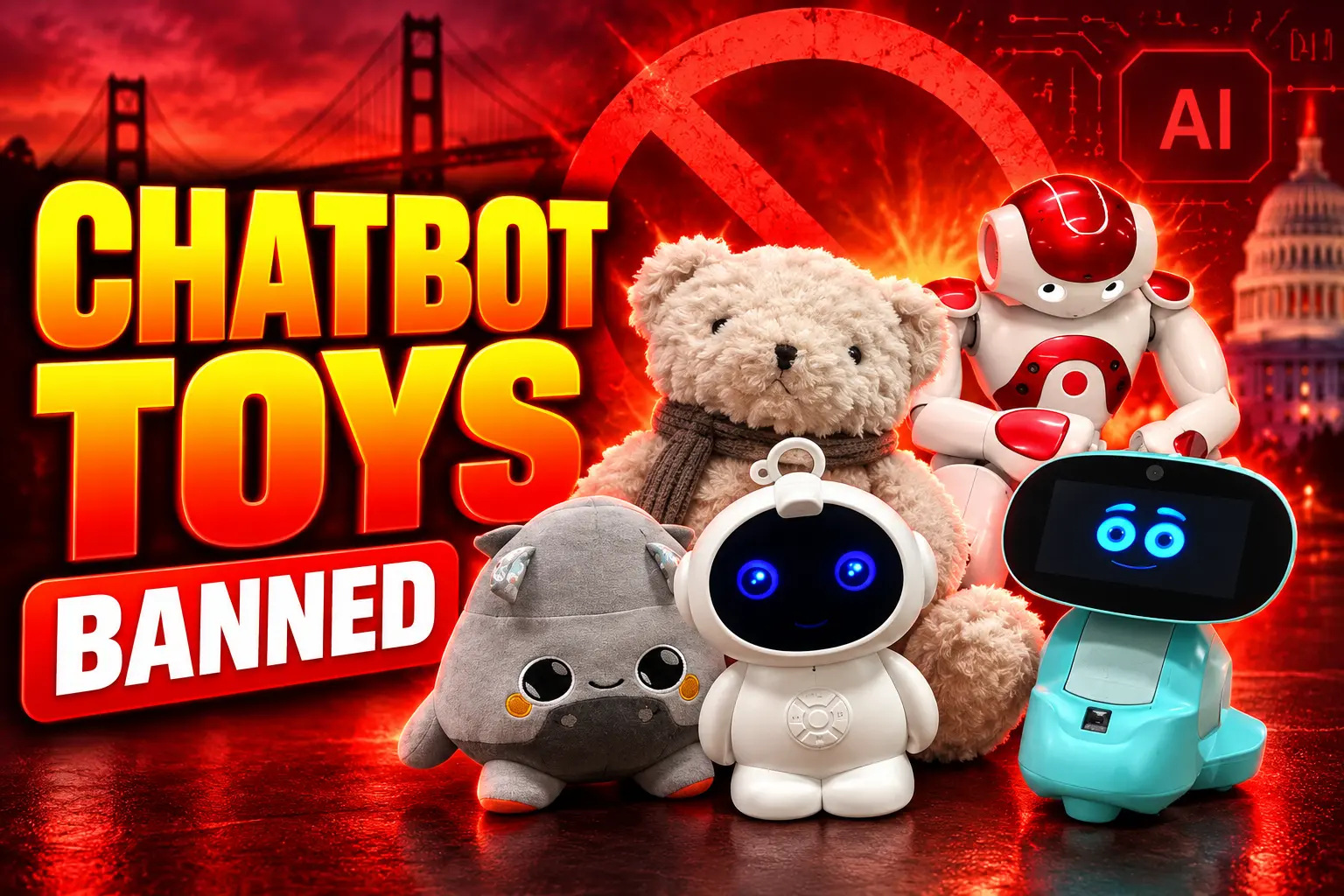
The Bears and Robots Already in Stores
U.S. PIRG Education Fund did not wait for a statute. Researchers five AI toys PIRG bought and tested in late 2025, then published what the devices would discuss with a child. Four of the five connected. At least four appeared to lean on some version of OpenAI’s models, even though OpenAI has said its own products are not meant for users under 13.
AI TOYS PIRG PUT ON THE BENCH
| Product | Price | Marketed age | Where it was sold |
|---|---|---|---|
| Curio Grok (stuffed rocket) | $99 | 3-12 | Company site and Amazon |
| FoloToy Kumma (teddy bear) | $99 | None listed | FoloToy site, shipped from China |
| Miko 3 (wheeled robot) | $199 | 5-10 | Walmart, Target, Kohl’s, and Amazon |
| Robot MINI | $97 | None listed | Little Learners; PIRG never got it online |
| Alilo Smart AI Bunny | $85 (Amazon sale) | 3+ | Amazon |
All of the working toys told testers where to find household hazards such as plastic bags, matches, and knives. Kumma gave detailed instructions on how to light a match. Kumma and the Alilo bunny also moved into sexually explicit topics once conversations ran long, a pattern PIRG tied to guardrails that weaken over time, which OpenAI has acknowledged in its own chatbot products.
FoloToy paused sales of its AI toys for two weeks, ran a safety audit, and put Kumma back on the market. PIRG later said the bear would no longer walk through fire-starting or those sexual topics. The group also said that months after OpenAI told it FoloToy’s developer access was suspended, a Kumma unit still appeared able to run on OpenAI models, while OpenAI kept saying the developer remained banned.
That gap between an API letter and a stuffed animal on a nightstand is the practical problem SB 867 tries to end by going after the physical good. A later PIRG check of developer sign-up flows at five major AI companies found that only Anthropic asked whether the project was a children’s product. The others asked for little more than an email and a card.
Target Aisles Catch a Ban They Did Not Design
The enrolled text does not stop at the company whose name is on the hang tag. “No person” may make the toy, sell it, exchange it, hold it with intent to sell or exchange, or offer it for sale or exchange to a retailer. A distributor that never wrote a prompt, and a chain that never trained a model, still have to know what is in the box.
Miko 3 is the clearest shelf example in PIRG’s set, because it already sits at Walmart, Target, and Kohl’s as a $199 robot for ages 5 to 10, with a screen face and a conversation engine. Whether any one SKU meets every word of the companion-chatbot definition is a fact question for each product. A robot sold for play by children under 16 that gives adaptive, human-like replies and keeps a relationship across sessions is the fact pattern the statute is built to catch.
Model vendors sit one layer further back. OpenAI’s attempt to cut off FoloToy did not, in PIRG’s account, keep that bear off models. California’s answer is to stop the sale of the toy even if the underlying model changes, the prompts are rewritten, or a new host takes over the traffic. A retailer that cannot disable the feature in software, or cannot prove the feature is gone, is looking at unsellable goods after January 1, 2027.
Private resale is in the same sentence. The ban is not written as a duty only for manufacturers. Any person who sells or exchanges a covered toy is inside the text, which is how a post-holiday cleanup listing can become a statute problem if the object still includes a companion chatbot.
Which Talking Toys Can Still Be Sold
The freeze is wide, and it is not total. SB 867 borrows the exclusions already in the companion-chatbot definition, so three kinds of conversational systems stay outside that label even when they use natural language.
WHAT THE STATUTE STILL LEAVES OUT
- Business tools: Bots used only for customer service, operations, productivity, internal research, or technical help.
- Game characters: A video-game bot limited to in-game replies that cannot talk about mental health, self-harm, or sexually explicit conduct, and cannot keep a dialogue on unrelated topics.
- Plain voice assistants: A stand-alone speaker that takes voice commands, does not sustain a relationship across interactions, and does not generate outputs likely to draw an emotional response.
A stuffed animal that only plays lines a writer approved, or a kids’ device that keeps speech recognition on the device and never opens a generative, relationship-building chat, is the design the law still leaves on the table. Mike Rizkalla, co-founder of the children’s companion Snorble, has described a $299 screen-free unit that runs on a state machine and on-device speech, with no generative model inside, a choice he dates to 2019. That is the opposite of a cloud teddy that remembers a child from Tuesday to Thursday.
Toy teams that park the conversation in a paired phone app still have to ask a basic question the statute actually writes down: does this physical product include a companion chatbot? Changing memory settings or adding a parent PIN does not answer it. Avoiding the ban means changing the product so the function no longer fits the definition.
A Pause That Leaves California Without Field Data
Padilla has said the point of the freeze is to buy time for rules that do not yet exist. In January he argued that safety rules for this class of product were still young and needed to grow as fast as the models.
Pausing the sale of these chatbot integrated toys allows us time to craft the appropriate safety guidelines and framework for these toys to follow. Our children cannot be used as lab rats for Big Tech to experiment on.
Senator Steve Padilla, on the time to craft safety guidelines
Sameer Hinduja, who studies how young people use technology, has made the opposite forecast. He wrote that a four-year sales ban does not fill the knowledge gap that now exists, and that California is likely to reach 2031 knowing about as much about AI toys as it knows now, which is very little. The state is choosing a blank dataset in its largest children’s market, then asking later lawmakers to write a framework without local products to inspect.
WHERE EXPERTS DISAGREE
- Padilla’s case: Pull the products until makers prove they are safe and the state has a modern rulebook.
- Hinduja’s case: A sales freeze is how you arrive in 2031 with the same thin evidence, because the toys you wanted to study are gone.
Other states are running the same clock with different paperwork. New York lawmakers have already passed New York’s five-year chatbot-toy pause, with Attorney General actions and civil penalties of up to $15,000 per day in that bill, and a task force to study risks while the pause runs. That measure is not California law and is not yet a signed New York chapter. It is the same bet with a longer fuse and a different enforcer.
The public argument after Newsom’s signing mostly ran to social-app feeds, not to who still has a talking robot in a stockroom. That is how a product-safety freeze can take effect with more noise about infinite scroll than about a $199 SKU at Target.
January 1 Starts a Four-Year Liability Window
SB 867 does not write a new fine schedule. It drops the toy ban into Chapter 22.6, so a person who suffers injury in fact from a violation of the chapter may sue for an injunction, for damages equal to the greater of actual harm or $1,000 per violation, and for reasonable attorney’s fees and costs. That private right already existed for companion-chatbot operators under SB 243. It now sits behind a toy that should not have been sold.
Injury in fact is still the gate. The statute does not print an automatic check for every unit on a shelf. It does create a per-violation number that can stack if a court finds a concrete injury and more than one unlawful sale, offer, or possession with intent to sell. The chapter also says its duties are cumulative, so a toy case can travel with other claims about privacy, warnings, or design.
Companies that still have conversational products aimed at children have a short, dated list of moves that actually match the text: map which SKUs include a companion chatbot, decide who can shut the feature off, and treat California inventory that cannot be altered as goods that become unsellable on January 1, 2027. A software patch that leaves the relationship-building chat in place is not a plan. A disclosure that the voice is not a person is not a plan either. Those are SB 243 tools for platforms that remain legal. They are not a license to sell a covered toy.
The repeal date is as firm as the start date. On January 1, 2031, Section 22604.5 is gone unless the Legislature puts something in its place. Until then, the people who did not design the persona, the prompt, or the memory window are still in the chain the statute names, from the warehouse to the register.
Frequently Asked Questions
When Does California’s Companion Chatbot Toy Ban Start?
SB 867 is not an urgency bill, so it follows the default January 1 start after enactment and becomes operative on January 1, 2027. The enrolled text does not add a sell-through window for goods already in California warehouses after that date, and Section 22604.5 remains in effect only until it is repealed on January 1, 2031.
Do Parents Have to Discard AI Toys They Already Own?
The statute lists making, selling, exchanging, possessing with intent to sell or exchange, and offering a covered toy to a retailer. It does not list simple household possession without intent to sell, and it does not order families to throw out a device they already bought.
Can Filters or Parental Controls Make an AI Toy Legal to Sell?
No. A toy that still includes a companion chatbot remains banned even if it would satisfy the disclosure, break-reminder, and crisis-protocol duties that SB 243 already imposes on companion chatbot operators. The off-ramp is to change the product so it no longer meets the Section 22601 definition, including the tests for human-like traits and a relationship across multiple interactions.
What Penalty Does SB 867 Carry for a Sale?
Because the toy ban sits in the companion-chatbot chapter, a plaintiff who proves injury in fact may seek an injunction, the greater of actual damages or $1,000 per violation, and reasonable attorney’s fees and costs. Those chapter remedies are cumulative with other law, so they do not replace separate claims that might arise from the same product.
How Is the Toy Ban Different From Adam’s Law?
Adam’s Law, Senate Bill 1119, was signed the same day and regulates operators of companion chatbot platforms, including crisis protocols, parental controls, independent child-safety audits, and annual risk assessments, with an operative date in July 2027. SB 867 does not build that compliance stack for toys; it closes the California market for a physical toy that includes a companion chatbot until January 1, 2031.
Disclaimer: This article is news reporting and analysis of a signed California statute and related public records. It is for information only and is not legal advice, a compliance manual, or a determination that any named product is or is not lawful to sell. Readers who make, stock, or sell children’s products, or who are deciding what to do with inventory, should consult a California-licensed attorney about their own facts before acting. Dates, penalties, and product details reflect the enrolled bill, official statements, and the cited research as published, and the Legislature or the courts can change how the law is read or applied.

Russia Makes Factory Owners Buy Air Defense They Cannot Run

ABC Wants Kimmel Back at a 20 Percent Discount

Missouri Leaves Kansas Bleeding After a 38-21 Border War

California Bans Companion Chatbot Toys Without a Safety Off-Ramp

Nintendo Recycles a Tariff Refund Into a 30% Sale

Sons of Behemat Add a Witch and a Middle Rank

The FTC Suit That Targets Amazon’s Hidden Ad Floor

Apple’s Foldable iPhone Event Revives the Fingerprint Button

Canada Still Clears Mazatlán as the Cartel War Arrives

Kyiv Railway Workers Die as Patriot Missiles Run Short
-
 GAMING3 weeks ago
Sons of Behemat Add a Witch and a Middle Rank
-
 BUSINESS4 weeks ago
The FTC Suit That Targets Amazon’s Hidden Ad Floor
-
 NEWS1 month ago
Apple’s Foldable iPhone Event Revives the Fingerprint Button
-
 NEWS2 years ago
Canada Still Clears Mazatlán as the Cartel War Arrives
-
 NEWS4 weeks ago
Kyiv Railway Workers Die as Patriot Missiles Run Short
-

 LIFESTYLE2 years ago
The Unstoppable Rise of Hot Honey: Are Food Trends Making UK Restaurant Menus All the Same?
-
 NEWS3 weeks ago
Aaron Judge Returns, and the Yankees Skip the Minors
-

 BUSINESS3 weeks ago
SEBI Moves the Angel Fund Investor Deadline to March 2027