
BUSINESS
Brent Holds Above $100 as Backup Oil Routes Fail
Brent crude held at $101.10 after U.S.-Iran tanker attacks, as the Red Sea workaround that replaced Hormuz came under fire too.

Brent crude held at $101.10 a barrel on Thursday after the United States and Iran staged their largest tanker attacks of a six-month war. U.S. West Texas Intermediate was at $96.24, up 0.2%, at 0256 GMT.
The print is not a one-day scare premium. Dated Brent, the spot benchmark used to price roughly two-thirds of world supply, has sat above $100 since September 3, and the backup path that was supposed to replace the Strait of Hormuz is being shot at as well.
Tit-For-Tat Hits the Tanker Lane
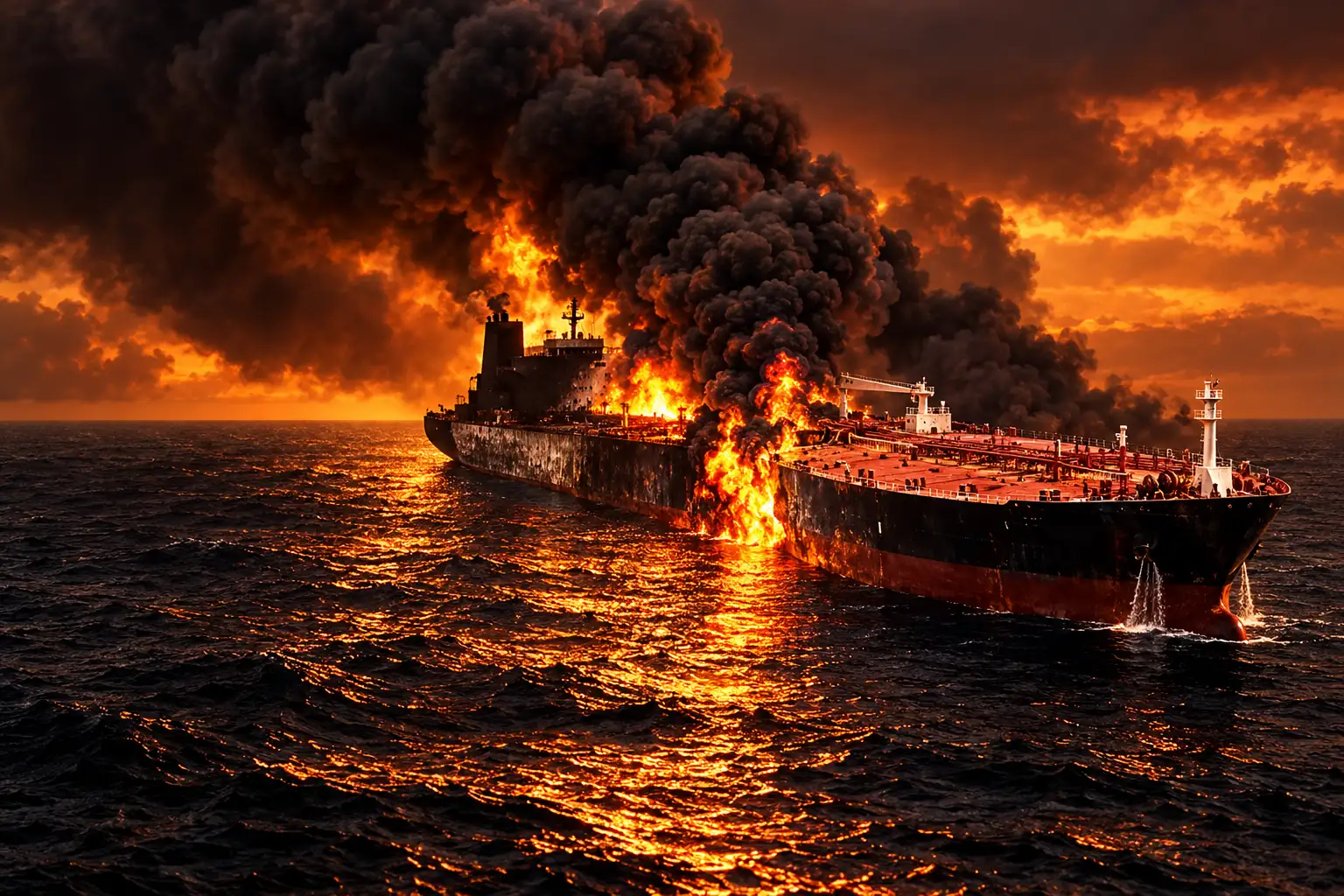
U.S. Central Command said its forces destroyed five Iranian crude oil carriers on September 8 after Iran’s Islamic Revolutionary Guard Corps fired ballistic missiles at a Navy warship twice in two days. The warship evaded both attacks, and no American personnel were harmed, CENTCOM said.
The ships named were M/T Kaviz, M/T Charminar, M/T Horizon 1 and M/T Riesco in the Gulf of Oman, plus M/T Derya near Kharg Island. Crews were told to leave before the strikes. On September 5, the same command said it had already destroyed three Iranian crude carriers after the Guards tried to hit an aircraft carrier and a destroyer.
Iran said on Wednesday it had attacked 10 ships near Hormuz, two of them U.S. vessels and eight of them oil tankers. CENTCOM said those attempted attacks on U.S. ships failed. Secretary of State Marco Rubio, speaking in Colombia, put the new U.S. rule in one line.
Iran continues to try to hit U.S. naval ships, and for every time they do that or try to do that, they’re going to lose tankers.
Marco Rubio, U.S. Secretary of State, in Colombia
The human cost showed up off Dubai and in Iraqi waters. Peninsula, the charterer of the products tanker Hercules Star, said one seafarer was killed and another was missing while the ship sat at anchorage. Two Iraqi port officials said the tanker New Andros, carrying 2 million barrels of fuel oil, caught fire after a drone strike. Iran also fired on a U.S. base in Jordan; Jordan said it intercepted 18 of 20 missiles and that the other two fell in empty ground, with no deaths recorded.
THE ATTACK WEEK
- February 28, 2026: The U.S.-Iran war begins and tanker traffic through Hormuz collapses.
- September 5, 2026: CENTCOM destroys three Iranian crude carriers after failed strikes on a U.S. carrier and destroyer.
- September 8, 2026: CENTCOM destroys five more Iranian crude carriers in the Gulf of Oman and near Kharg Island.
- September 9, 2026: Iran says it hit 10 ships; Brent settles at $101.21, up $3.29, after a high of $101.58.
- September 10, 2026: Brent holds $101.10 in early trade as shippers wait on the next round.
Daniel Hynes, an analyst at ANZ, told clients the exchange of blows means Persian Gulf oil flows are likely to stay impaired for the foreseeable future. That is the paper-market reading. The tighter bind is on the routes that were meant to make Hormuz optional.
The Red Sea Escape Hatch Is Closing
Before the war, EIA figures put 20.9 million barrels a day through Hormuz in the first half of 2025, about 20% of world petroleum liquids use and about a quarter of seaborne oil. Bypass pipes were never built for that load. The International Energy Agency has put spare overland capacity at only 3.5 to 5.5 million barrels a day.
Saudi Arabia moved first. The IEA said the kingdom pushed crude through its East-West line to the Red Sea port of Yanbu, lifting Yanbu exports above 5 million barrels a day in early June from about 2 million before the fighting. The UAE used a 1.8-million-barrel-a-day line to Fujairah, on the Gulf of Oman, and raised total exports to 4.3 million barrels a day in early June from 1.9 million in March, about 85% of its pre-war pace.
Then the second gate slammed. On July 20, Iran-aligned Houthi forces in Yemen declared a maritime embargo on Saudi-linked shipping through the Bab el-Mandeb, the southern mouth of the Red Sea. Ship-tracking firm Kpler found Saudi seaborne exports fell to 3.2 million barrels a day in August, the lowest in at least 13 years, and that only two Saudi cargoes used the Bab el-Mandeb in the week before September 9.
THREE DETOURS, EACH WORSE
- Hormuz itself: The old main road, now a combat zone with dark sailings, escorts, and disputed barrel counts.
- Yanbu then south: The East-West pipeline to the Red Sea, which worked until Houthi attacks made the Bab el-Mandeb a second chokepoint.
- North then around Africa: Cargoes sent up to Egypt’s SUMED line and on via Suez or the Cape of Good Hope, a 54-day run to South Korea against 24 days through Bab el-Mandeb.
Kpler put SUMED crude at about 1.9 million barrels a day in August, up from fewer than 650,000 barrels a day in June, with most of that oil Saudi. The long way keeps some barrels moving. It does not replace 20 million barrels a day, and it lands those barrels in Asia a month late.
Why Dated Brent Never Came Back Below $100
Futures spent months trading the next ceasefire rumor. The cargo market did not. Dated Brent has been above $100 a barrel since September 3, according to LSEG, which is why Wednesday’s futures break felt late rather than sudden. Sparta Commodities put September dated Brent at $109 a barrel, with the dated-to-futures gap near $9.
David Fyfe, chief economist at price agency Argus, said the physical tape is already “incredibly tight” and that the diesel market is “screaming shortage.” Front-month Brent futures settled Wednesday at $101.21, the highest close since May 22, after a high of $101.58, and had last traded above $100 in late July. Since the war began on February 28, the contract has traded as high as $126.41, on April 30. Prices are up nearly 30% from the early-August lows that followed a pause in the fighting that never became a lasting ceasefire.
Christopher Wong, an analyst at OCBC, said uncertainty over actual Hormuz volumes, plus the extra shipping hits, is keeping physical markets tight and holding a geopolitical premium in the price. Dennis Kissler, senior vice president of energy trading at BOK Financial, said near-term supplies have turned much tighter and that the back-and-forth strikes now look like a mainstay, with any peace deal further out.
Shut-Ins Climb While Officials Argue Over the Count
The U.S. Energy Information Administration’s September Short-Term Energy Outlook, released September 9 from a model locked on September 3, is already stale relative to this week’s sinkings. It still shows why $100 can hold. Global stocks have fallen by 400 million barrels so far in 2026, the agency said, and it expects further draws through year-end.
Middle East crude shut-ins rose to 6.7 million barrels a day in August from 5.0 million in July, a 1.7 million barrel-a-day worsening the EIA tied in part to attacks on Saudi exports through the Bab el-Mandeb and a slump in sailings from Yanbu. It sees shut-ins averaging about 5.7 million barrels a day in the fourth quarter, with regional output staying below pre-war averages until the second quarter of 2027.
HOW THE CHOKEPOINTS SHIFTED
| Route | Before the war | After the war |
|---|---|---|
| Strait of Hormuz | 20.9 million b/d in 1H25 (EIA) | 4.9 million b/d in 2Q26 (EIA); IEA put Mar-May at 2.7 million b/d |
| Bab el-Mandeb | 5.4 million b/d in 4Q25 (EIA) | 8.1 million b/d in 2Q26 as Saudi oil moved west, then southbound Saudi sailings stalled |
| Overland bypass spare | 3.5 to 5.5 million b/d (IEA) | Cannot replace a 20-million-barrel strait; UAE Fujairah line is 1.8 million b/d |
Kpler, using satellites, transponders, and port logs, put August Hormuz crude flows at about 4.3 million barrels a day and the first six days of September at nearly 5 million. Energy Secretary Chris Wright said more than 17 million barrels moved on August 31 under Navy watch, a figure Kpler put nearer 6 million that day; Wright later said flows were averaging more than 9 million barrels a day. President Donald Trump said on September 3 that 18 million barrels a day were passing. The cargo market is not giving those high prints the benefit of the doubt, and the dated price shows it.
The IEA in June put cumulative lost Middle East supply at more than 1.3 billion barrels. Atlantic Basin barrels filled part of the hole: U.S. crude and product exports hit a record 13.1 million barrels a day in May. That surge has already faded as Gulf dribs returned and U.S. stocks tightened, which is why a second closed gate in the Red Sea matters more now than it would have in April.
An Extra $8 Hangs on Each Barrel
Even a successful transit is no longer a cheap one. David Osler, a marine insurance editor, said war-risk cover is adding $7 to $8 to a barrel of crude, with extra premiums for high-risk zones up to 10% of a ship’s value. A very large crude carrier is worth about $140 million, which puts a 10% additional premium at $14 million for one voyage. Claims since the conflict began have run about $2 billion across more than 70 cases, he said, citing a senior market source.
Roughly $7 or $8 on the price of a barrel of crude is now down to war-risk insurance alone.
David Osler, marine insurance editor, on an industry call
Insurers have also stretched the listed high-risk zone about 800 kilometers north along the Red Sea, so the Saudi northbound detour still pays war rates. That is the hidden line item inside $101 Brent: the barrel that gets out is an insured barrel, and the barrel that does not get out never reaches the dated window at all.
Who Pays When Both Straits Narrow
Asian importers take the first hit because that is where Hormuz oil used to go. A 30-day extra voyage to Korea, China, or India is a working-capital tax as much as a freight tax, and it arrives on top of pump prices that have already reset. The EIA’s 2026 outlook puts U.S. retail gasoline at $3.84 a gallon and retail diesel at $5.07, up 4.4% from the prior diesel forecast of $4.85, with U.S. distillate stocks seen dropping below 100 million barrels in September.
Gulf producers pay in shut-in fields. Saudi Arabia can still move oil north through Egypt, but 3.2 million barrels a day of exports is not a kingdom running its normal program. Iran pays in hulls: eight named crude carriers destroyed in four days, on top of a U.S. blockade that had already throttled its shadow fleet. U.S. shale and other Atlantic producers get a price, not a free pass, because the EIA still has 2026 U.S. crude output only at 13.8 million barrels a day, a thin add on a 6.7-million-barrel hole.
THE EIA SNAPSHOT
- 2026 Brent average: $91 a barrel in the spot market, with the second half seen around $90 even before this week’s attacks.
- 2027 Brent average: $74, once the agency assumes flows recover and stocks rebuild.
- August price: $91 a barrel, $7 higher than July, already the base the EIA thinks will persist near term.
- WTI 2026 average: $84.65, a nearly 5% upgrade in the same outlook.
Households see it in diesel first. Distillate is the product the Middle East used to export in bulk through Hormuz, and the EIA has the U.S. distillate crack at $0.94 a gallon this year. Jet and gasoil were the grades that blew out in the spring, when North Sea Dated printed $144 a barrel in early April on the IEA’s tally, and those cracks are the channel through which a tanker war becomes a freight and food problem.
Chinese Buying Is the Only Soft Ceiling Left
The reason the screen is at $101 and not $144 again is demand, and most of that story is China. Kpler estimates Chinese crude intake 18 percent below year-ago levels in June and July, at 12.5 to 12.6 million barrels a day, a 2.8 million barrel-a-day gap. The firm says refiners there are not rebuilding stocks, margins are compressed, and that weight is why a broad prompt rally keeps stalling even while Yanbu barrels have to be reshuffled.
Kpler has also flipped its second-half 2026 balance from a 1.5 million barrel-a-day surplus to a deficit of nearly 2 million barrels a day, and it raised a 12-month North Sea Dated forecast to $81 from $73 on the view that the U.S.-Iran fight is now the market’s setting through year-end. That $81 is a path, not this week’s cargo. The IEA still sees 2026 world oil demand down 1.1 million barrels a day, the first annual drop since 2020, which is the other lid on the price.
None of those lids erased the new floor. The EIA’s September run does not include market events after September 3, so the eight Iranian hulls, Iran’s claimed 10-ship reply, and Wednesday’s $101.21 settlement sit outside an outlook that had already lifted 2026 Brent to $91. The barrels that used to leave Yanbu for Asia in 24 days are on a 54-day detour, and the strait that used to carry 20.9 million barrels a day is a combat zone whose true flow no two official counts agree on.
Brent at $101.10 on Thursday is the market refusing to wait for that argument to end.
Disclaimer: This article is news reporting and analysis of oil prices, shipping, and energy-agency outlooks, and it is for information only. It is not investment advice, a recommendation to buy or sell crude, fuels, tanker stocks, or any other security, and it is not a forecast you should trade on. Speak with a licensed financial adviser or commodity broker before making any investment or hedging decision tied to oil prices. Figures and statuses reflect the agency data, company statements, and market prints cited here as of September 10, 2026, and live prices, flow counts, and military claims can change without notice.

Clay Moulds From the Blyth Hoard Fit Peebles Fittings

Treasury Yields Hit a 24-Year High as AI Joins the Queue

Crew-12 Leaves the ISS With Fedyaev and Adenot Aboard

The Graziers Recall Puts the 60-Day Cheese Rule on Trial

Hugo Chavez’s Hollywood Welcome Meets a Film About Escape

Sons of Behemat Add a Witch and a Middle Rank

Canada Still Clears Mazatlán as the Cartel War Arrives

The FTC Suit That Targets Amazon’s Hidden Ad Floor

Samsung Leads Mistral’s Record European Sovereignty Round

Laepple Automotive Bets on a Vacant Detroit Die Shop
-
 GAMING1 month ago
Sons of Behemat Add a Witch and a Middle Rank
-
 NEWS2 years ago
Canada Still Clears Mazatlán as the Cartel War Arrives
-
 BUSINESS2 months ago
The FTC Suit That Targets Amazon’s Hidden Ad Floor
-
 NEWS1 month ago
Samsung Leads Mistral’s Record European Sovereignty Round
-
 AUTO2 years ago
Laepple Automotive Bets on a Vacant Detroit Die Shop
-

 LIFESTYLE2 years ago
Women, Gym, and Affairs: A Complex Intersection
-

 NEWS2 months ago
Apple’s Foldable iPhone Event Revives the Fingerprint Button
-

 AUTO2 years ago
Tamil Nadu Auto Keeps Growing Inside a Climate Red Zone