
BUSINESS
Houthis Hold the Bab al-Mandeb Gate on Africa’s Doorstep
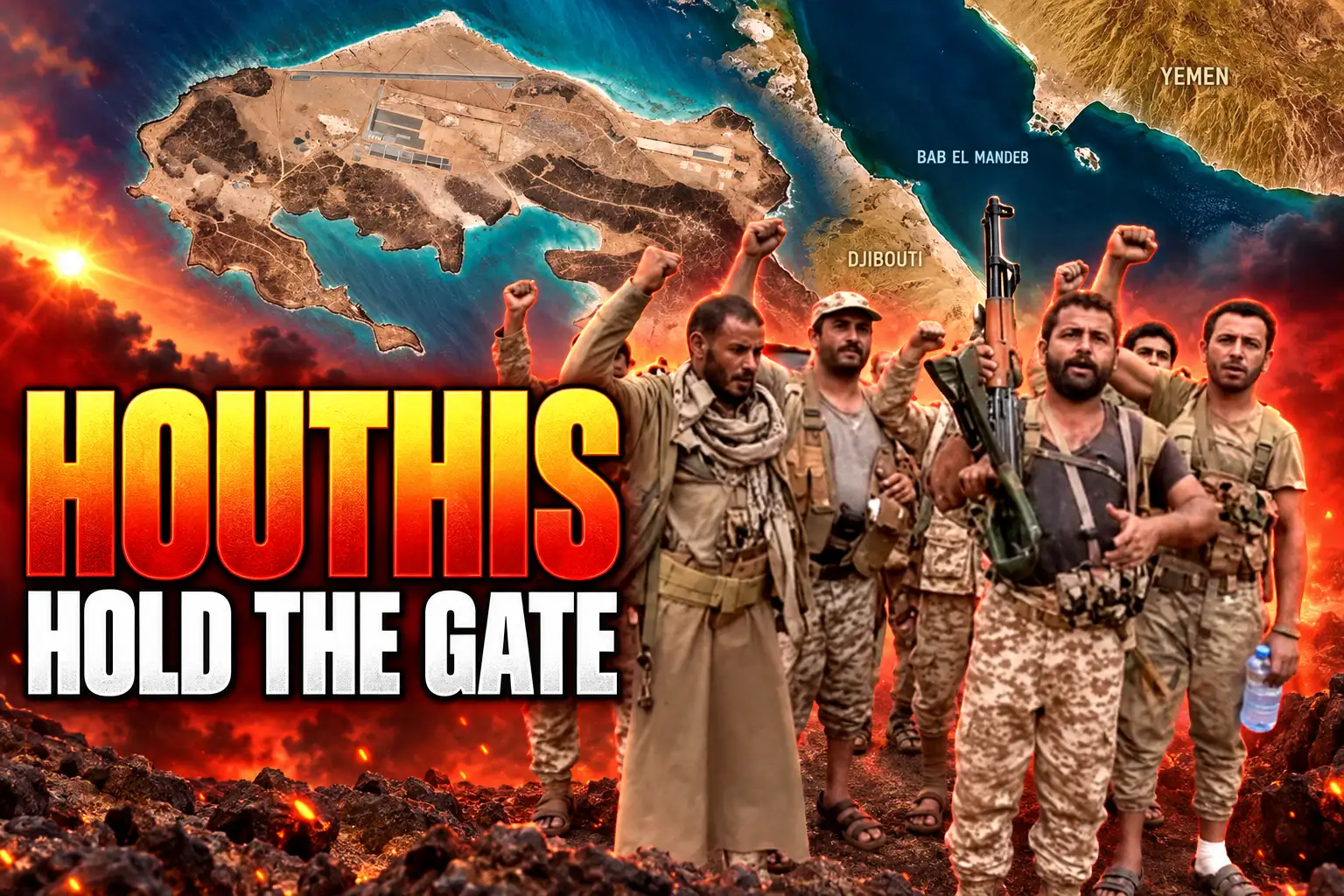
Houthi fighters occupy Perim Island in the Bab al-Mandeb, 20 kilometres from Djibouti, leaving Egypt, Eritrea and Djibouti to carry the cost.

Houthi fighters took Yemen’s last stretch of Red Sea coast in 36 hours, seizing the port of Mocha on Thursday, September 10, and Perim Island the next day. They now sit about 20 kilometres from Africa and hold both sides of the Bab al-Mandeb strait, the southern gate of the Suez route.
Oil and boxes have already been leaving this lane for more than a year. The new bill lands on Djibouti, Egypt and Eritrea, the African states that share the water with a new landlord.
Mocha Fell in 36 Hours With No Air Cover
Until Thursday morning, Mocha was held by the National Resistance Forces of Tareq Saleh, a vice president in Yemen’s internationally recognised government. Houthi units came in waves, with ballistic missiles behind them, and by nightfall the port that gave mocha coffee its name was gone.
More than 100 US military advisers were in Saudi Arabia to pass intelligence and targeting data, part of a presence one US official put at about 200 personnel. CENTCOM commander Admiral Brad Cooper was in the kingdom that day for coordination meetings. A senior Yemeni officer who called Central Command was told Saudi air support was coming. It never arrived.
Saudi Crown Prince Mohammed bin Salman spoke twice with US President Donald Trump on Thursday and asked for strikes. Trump declined. The White House said Washington would protect freedom of navigation and leave regional partners to lead the fight on the ground.
THE 36-HOUR SWEEP
- Thursday, September 10: Houthi fighters take Mocha after government units fail to hold the port.
- Friday, September 11: Government forces leave Perim, also called Mayyun, and lose Dhubab on the mainland opposite the island.
- Friday, September 11: Greater Hanish, Lesser Hanish and Zuqar, the last government islands in the strait, fall as well.
- Saturday, September 12: Houthi caretaker prime minister Mohammed Ahmed Miftah appears in Sanaa after 210 prisoners are freed.
The ground fight was thinner than the maps implied. A Western official with knowledge of the Mocha units said battalion lists were padded with ghost names, people paid but not present, and that real strength was about 20 percent of the paper figure. Analyst Mohammed Al Basha said the anti-Houthi camp still had no single chain of command. Mocha did not fall to a surprise raid. It fell to a force that had been built for years, against units that existed mainly on payrolls.
Two Channels and One Volcanic Island
Perim is a volcanic slab of about 13 square kilometres in the mouth of the strait. It splits the water into a western channel of about 26 kilometres, the lane used by international traffic, and a shallow eastern channel of about 3 kilometres for local boats. Whoever stands on the hills can watch every ship that wants Suez.
The United Arab Emirates had been building an airbase on the island before it left the Yemen war. Saudi-led forces said they were on Perim in 2021. On Friday the garrison withdrew by boat, and Houthi fighters walked onto the airstrip. Witnesses described armed men driving the Bab al-Mandeb shore in military vehicles.
Hazem al-Assad, a Houthi politburo member, said “freedom of navigation and international trade in the Red Sea and Bab al-Mandeb are safe and orderly.” Military spokesman Yahya Saree said traffic was safe for all except Saudi vessels, and that the group would answer Riyadh’s blockade of Houthi-held Yemen with a “siege for siege.” Between November 2023 and mid-2025 the same movement attacked more than 100 commercial ships, some with no clear Israeli link. Insurers will not parse the distinction for long.
Djibouti Takes In the First 2,000
The African bank is not a backdrop. It is a small state of about a million people that already hosts the densest cluster of foreign bases on the continent, and it is now the nearest dry ground for Yemenis running from the coast.
Djibouti’s economy and finance minister, Ilyas Moussa Dawaleh, said 1,400 people arrived from Yemen in 24 hours on Saturday, after about 500 were pulled from boats that ran out of fuel on Friday. On Sunday the International Organization for Migration said 85,818 people displaced inside Yemen, of whom 82,164 had fled since the start of September, and that over 2,000 had reached the northern coast near Obock.
🚨 BREAKING: Displacement continues to rise in #Yemen.⁰⁰More than 85,000 people have now been forced from their homes as fighting continues. More than 2,000 people have also fled to #Djibouti.⁰⁰IOM is monitoring the situation and responding to urgent humanitarian needs.
— IOM – UN Migration 🇺🇳 (@UNmigration) September 13, 2026
THE OBOCK LANDINGS
- Sunday count: Over 2,000 people have landed near Obock and been moved to the Markazi site for water, biscuits and hot meals.
- Taiz: Hardest hit inside Yemen, with 9,280 households, nearly 56,000 people, leaving districts that include Mawza and Al Wazi’iyah.
- Lahj and Hodeidah: 3,225 households, over 19,000 people, in Lahj, and 1,374 households, over 8,000 people, in Al Hodeidah, mostly from Hays.
- Aden: 424 households, over 2,500 people, are being hosted in the southern city.
IOM Director General Amy Pope said families are crossing with nothing because they have no other choice, and that many have already been pushed from their homes more than once in 12 years of war.
Behind every number is a family who’s lost everything. Many have been displaced multiple times. People are crossing the sea with nothing because they have no other choice left.
Amy Pope, IOM Director General, Geneva statement, 13 September 2026
UNHCR figures from March 2026 already put more than 36,000 registered refugees and asylum seekers in Djibouti, most of them Somali, Ethiopian and Yemeni. Dawaleh has described geography as the country’s main resource. In 2017 he put the annual rent at $65 million from the United States, $30 million from France, $20 million from China, and a little more than $3 million each from Italy and Japan. Camp Lemonnier, the only permanent US base in Africa, holds more than 4,000 personnel beside the airport. China, France, Japan and Italy sit within a few miles of that fence. None of those leases was written for a Houthi artillery line 20 kilometres away, or for a new camp at Markazi filling by the hour.
Why Egypt Will Not Fight for Suez
Bab al-Mandeb normally carries about 12 percent of world trade. The energy numbers are already a year out of date. US Energy Information Administration tables show oil flows through Bab el-Mandeb at 9.3 million barrels a day in 2023, then 4.1 million barrels a day in 2024, and 4.2 million in the first half of 2025, more than half gone. LNG through the same gap went from 4.2 billion cubic feet a day in 2023 to zero in 2024 and stayed at zero in the first half of 2025.
OIL ON THE SOUTHERN GATE
| Route | 2023 | 2024 | First half of 2025 |
|---|---|---|---|
| Bab el-Mandeb oil (million b/d) | 9.3 | 4.1 | 4.2 |
| Suez Canal and SUMED (million b/d) | 8.8 | 4.8 | 4.9 |
| Cape of Good Hope (million b/d) | 6.2 | 9.3 | 9.1 |
The Cape of Good Hope took the missing barrels, rising from 6.2 million barrels a day in 2023 to 9.3 million in 2024. Kpler counted 30 ship crossings of Bab al-Mandeb on Thursday and 15 on Friday, the day Perim changed hands. Suez Canal Authority chairman Osama Rabie said canal revenue in the 2023/24 fiscal year fell to $7.2 billion from $9.4 billion, with transits down to 20,148 ships from 25,911. Egypt’s central bank later put 2024/25 canal receipts at $3.6 billion, a 45.5 percent drop on its own prior-year figure.
Badr Hassan Al-Shafei, a professor of African studies, said Cairo’s line has not moved since the Gulf war in Yemen in 2015: Egypt will not send forces into that fight, even after missiles toward Israel and even after the canal’s hard currency shrank. Saudi-linked ships have been hit again in recent weeks. The southern door of the canal is now held by a group Egypt has spent a decade refusing to fight.
Eritrea Collects Leverage Without Firing
Across the same water, Eritrea sits on a long Red Sea coast that President Isaias Afwerki has treated as a scarce asset. Al-Shafei’s reading is blunt: Afwerki pretends to stand apart from Yemen, and he gains from the disorder in the strait. A US State Department note in May said Washington would lift Biden-era sanctions, a thaw aides tied to the Red Sea after the Iran war that began on February 28 closed the Strait of Hormuz. Trump had written to Afwerki on July 30, 2025, promising to reverse what he called the damage of the previous administration.
Egypt signed a maritime transport pact with Eritrea in late May, putting Massawa and Assab back on a regular line as shippers looked for ports that were not Djibouti and not Suez. Ethiopia, landlocked since 1993, still wants Assab. Israel’s ambassador in Addis Ababa, Avraham Neguise, said on September 12 that Israel backs Ethiopia’s bid for Red Sea access, a line Egyptian Foreign Minister Badr Abdelatty rejected the same week. Eritrea’s foreign minister, Osman Saleh, accused the UAE of “port imperialism” and said Asmara had refused an Emirati-Israeli base in the Dahlak islands. The Houthis did not consult Asmara. They still handed it a better seat at a table it did not have to fight for.
How Close the Guns Sit to the Lane
Maritime analyst Alexandru Cristian Hudisteanu, a former naval officer, said the new ground does not transform Houthi magazines overnight, but it makes targeting simpler than it was from the northern coast. Wolfgang Pusztai, a security and defence analyst, went further.
The Houthis’ advance and seizure of the whole of Yemen’s Red Sea coast means the group now has the real capability to shut down any maritime traffic through Bab al-Mandeb if they want to.
Wolfgang Pusztai, security and defence analyst
Pusztai said crews would now face shorter-range missiles rather than long-range artillery, “a very risky endeavour to pass through the strait if the Houthis don’t allow it.” The Institute for the Study of War said the new coast and island seats put the group in range of tactical drones and hexacopters that can drop explosives, weapons it previously had to loft from farther north. Andreas Krieg of King’s College London said the Houthis can hold Perim in the short term because they own the mainland opposite, but that the island is hard to defend against a later amphibious assault, itself a high-risk job. The key, he said, is the coastal hinterland, which they now have.
NEW HOLDS ON THE STRAIT
- Mocha: The last major government port on the Red Sea coast before the strait, taken on September 10.
- Dhubab: The mainland town that looks straight at Perim, lost on September 11.
- Perim / Mayyun: The 13 square kilometre island that splits the two shipping channels.
- Zuqar and the Hanish islands: The remaining government islands in the southern Red Sea, taken in the same push.
Speaking in Ireland after the island fell, Trump said the Houthis “called us” and “don’t want to fight us.” He added that they are “letting most ships go through” and that “there’s just one country that they’re not too happy with and we’ll get that straightened out.” Farea Al-Muslimi of Chatham House said the coastal run serves Houthi aims at home and Iran’s hand with Washington “on other files, not just Yemen.” Ahmed Nagi of the International Crisis Group said the group can now better shield itself from any ground push that used to come from this shore. Preliminary Kpler counts already show traffic folding in half on the day Perim fell.
The Ships in Port Cannot Rewrite Their Orders
Djibouti is the logistics town for the US, China, France, Japan, Italy and two European Union naval missions. EUNAVFOR Atalanta, launched in 2008, and EUNAVFOR Aspides, launched in February 2024, both have mandates running to February 28, 2027. A March 30 Council decision added watch duties on undersea cables and training for Djiboutian forces. It did not give either fleet a free hand against a Houthi battery on Perim. Hudisteanu’s warning was that ships under those flags cannot step outside a written mission without a slow rewrite, and that delay itself is a signal.
European Council on Foreign Relations analysts wrote in July that Atalanta was created to combat piracy off Somalia, while Aspides was built as a defensive escort against Houthi attacks. Both were designed for a different threat than an occupied island in the lane. Hudisteanu said the pivot of hulls toward Hormuz and Bab al-Mandeb during the Iran war has already opened water off Somalia, where pirate groups have moved back into the gap.
WHERE ANALYSTS SPLIT
- Pusztai: The Houthis now have the means to close Bab al-Mandeb if they choose.
- Hudisteanu: The gains do not recast overall Houthi firepower, but they make a shot at a passing ship simpler than it was.
- Krieg: Perim is holdable now from the mainland, and brittle later against a serious landing.
At Markazi, IOM and Djiboutian navy, army, police and health teams are still meeting boats. Pope asked donors to fund both the new arrivals and the Obock towns receiving them. On the far bank, Houthi guns look at a strait that already lost more than half its oil and all of its LNG, while Egypt’s canal accounts show the cost of a door it will not fight to reopen, and Eritrea, unsanctioned and newly courted, sits on the same water without having fired a round.

Run Hide Fight Infidels Hits the Paywall, Not Hollywood

Russia Makes Factory Owners Buy Air Defense They Cannot Run

Trump’s Fed Chair Prepares a Hike as Yields Top 5%

Saudi Red Line at Mecca Meets a Pact Still Forming

Meta Builds Camera-Free Glasses for Rooms That Ban Recording

Sons of Behemat Add a Witch and a Middle Rank

Canada Still Clears Mazatlán as the Cartel War Arrives

The FTC Suit That Targets Amazon’s Hidden Ad Floor

Apple’s Foldable iPhone Event Revives the Fingerprint Button

Samsung Leads Mistral’s Record European Sovereignty Round
-
 GAMING4 weeks ago
Sons of Behemat Add a Witch and a Middle Rank
-
 NEWS2 years ago
Canada Still Clears Mazatlán as the Cartel War Arrives
-
 BUSINESS1 month ago
The FTC Suit That Targets Amazon’s Hidden Ad Floor
-
 NEWS1 month ago
Apple’s Foldable iPhone Event Revives the Fingerprint Button
-
 NEWS4 weeks ago
Samsung Leads Mistral’s Record European Sovereignty Round
-

 LIFESTYLE2 years ago
The Unstoppable Rise of Hot Honey: Are Food Trends Making UK Restaurant Menus All the Same?
-

 LIFESTYLE2 years ago
Women, Gym, and Affairs: A Complex Intersection
-

 ENTERTAINMENT3 years ago
The Flying Monkeys in Wizard of Oz