
NEWS
Saudi Red Line at Mecca Meets a Pact Still Forming
Saudi air defences destroyed a Houthi drone south of Mecca, called the city a red line, and left a new Mecca defence pact unused.

Saudi air defences destroyed a Houthi drone south of Mecca at 18:50 on Tuesday, the kingdom’s Yemen coalition said, and called the city’s security a red line. The Iran-backed group denied aiming at the holy city at all.
Forty days earlier, Saudi Arabia, Turkey and Pakistan had signed a mutual defence pact in Mecca itself. By Wednesday, that clause still had not been called in.
Saudi Air Defences Stop a Drone South of Mecca
Maj. Gen. Turki Al-Malki, spokesman for the Coalition to Restore Legitimacy in Yemen, said Royal Saudi Air Defense Forces intercepted and destroyed a hostile drone at 18:50 local time on Tuesday, 15 September 2026, before it entered prohibited airspace over Mecca. The wreckage fell south of the city, he said in a statement carried by the Saudi Press Agency.
Al-Malki called the flight the second Houthi attempt to target Mecca, after a ballistic missile on 27 July 2017. He said the latest launch was meant to frighten Umrah pilgrims at the Grand Mosque and to harm citizens and residents, and to provoke Muslims far beyond Saudi Arabia. More than 1.7 million pilgrims, most of them from overseas, visited Mecca for hajj in 2026, according to Saudi government data.
The security of the Two Holy Mosques and the Umrah performers is a red line.
Maj. Gen. Turki Al-Malki, coalition spokesman, statement carried by the Saudi Press Agency
He said the Joint Forces Command would take what he called necessary and deterrent measures. Sirens had already sounded on Tuesday across parts of the kingdom, including Mecca. A day earlier, Al-Malki said Houthi missiles and drones against Khamis Mushait, Abha and Taif had injured 13 civilians, damaged seven homes and wrecked two vehicles.
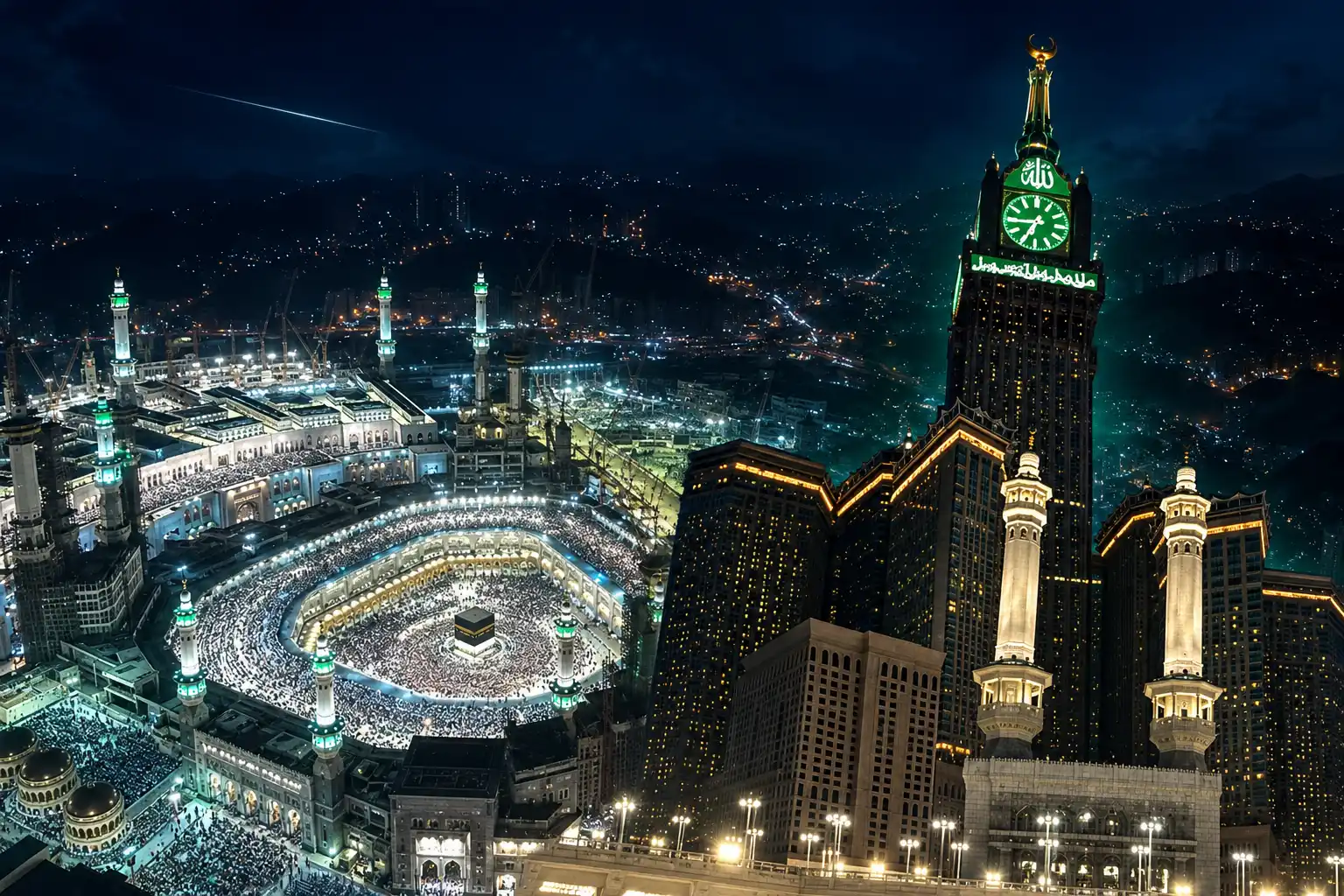
A Worn-Out Lie, Say the Houthis
Hazem al-Assad, a Houthi spokesman, rejected the Mecca charge on Wednesday. “The claims about targeting Mecca are a worn-out lie that has been used before and no longer fools anyone,” he wrote.
Military spokesman Yahya Saree went further. He said there was no threat from Yemen to the holy sites, and that Houthi operations aim at oil plants and military bases far from those places. He said the launches were payback for Saudi air strikes that he put at as many as 450 over the past week, and he claimed Houthi forces had shot down a Saudi F-15 over Marib with a locally made missile. Riyadh had not answered the jet claim by Wednesday afternoon.
Saree also said F-15 and Typhoon jets flying from Khamis Mushait and Taif had hit Taiz, Al-Jawf, Al-Bayda, Saada and Amran, and he put one 24-hour tally at 52 strikes. Those figures are the Houthis’ own. A clip shared with the intercept claim showed the green dome of the Prophet’s Mosque in Medina, not the Grand Mosque in Mecca, which made the holy-city shock easier to wave away for anyone who watched the pictures before the statement.
Has the Mecca Defence Pact Been Triggered?
No. Saudi Arabia has not formally invoked the mutual defence clause in the Mecca Joint Defence Agreement, the pact signed on 7 August 2026 at Al Safa Palace by Crown Prince Mohammed bin Salman, Turkish President Recep Tayyip Erdogan and Pakistani Prime Minister Shehbaz Sharif. Ministers in Pakistan and Turkey said they had not received a request from Riyadh for support against the Houthi escalation, and both capitals have said the pact is still being built.
The unpublished text, as described by the signatories, says an armed attack on one member will be regarded as an attack on all three. That is the line that drew NATO comparisons in August. The Institute for National Security Studies, in an 20 August briefing, argued the live question is whether the partners would actually fight for Saudi Arabia, given Pakistan’s role as a mediator with Iran and Turkey’s mixed ties with Tehran. The full treaty has not been released.
FROM THE BLOCKADE TO THE MECCA ALERT
- Mid-July 2026: Houthis declare a naval blockade on Saudi shipping after fighting around Sanaa airport, ending a calm that had held since a 2022 ceasefire.
- 7 August 2026: Saudi Arabia, Turkey and Pakistan sign the Mecca Joint Defence Agreement at Al Safa Palace.
- 31 August 2026: Foreign ministers meeting in Istanbul name it the Mecca Defence Alliance, place a secretariat in Riyadh, and give Pakistan the secretary-general’s post for three years.
- 14 September 2026: Coalition says 13 civilians are injured in strikes on Khamis Mushait, Abha and Taif.
- 15 September 2026, 18:50: Saudi air defences destroy a drone south of Mecca, the coalition says.
- 16 September 2026: Al-Malki calls Mecca security a red line; Sharif and the OIC issue condemnations; the pact clause stays uninvoked.
Hakan Fidan, Turkey’s foreign minister, said in Istanbul that the three states had only begun work on the alliance’s staff and that the pact does not replace Turkey’s NATO duties. Pakistan’s foreign ministry said in September that expansion is not on the table until the foundations are solid, and that operationalisation remains at an early stage.
WHAT THE AUGUST PACT ACTUALLY SET DOWN
- The clause: An armed attack on Saudi Arabia, Turkey or Pakistan is to be treated as an attack on all three.
- The work: Intelligence sharing, joint training, logistics and defence-industry cooperation, with no standing joint army announced.
- The office: A secretariat in Riyadh, with a Pakistani secretary-general for the first three years, agreed on 31 August.
Defence Minister Khawaja Asif had said an unprovoked attack on the kingdom, or a spillover from Yemen, would make the pact operational, and that there should be no doubt about that. Foreign Office spokesman Sajjad Haider Khan then said there was no military action under discussion. “I don’t think we should be discussing this topic in the context of its operationalisation,” the Foreign Office said after Asif spoke.
Pakistan Already Keeps Jets on Saudi Bases
The force that is actually in the kingdom sits under an older deal. In April 2026, Saudi Arabia’s defence ministry said a Pakistani contingent with fighter and support aircraft had arrived at King Abdulaziz Air Base in the Eastern Region under a bilateral strategic defence agreement signed in September 2025. The Mecca text was built on that pact after more than two years of talks, according to the Turkish foreign minister as cited by INSS.
THE FORCE IN THE KINGDOM VERSUS THE ALLIANCE ON PAPER
| Arrangement | What is in place | After the Mecca drone |
|---|---|---|
| September 2025 Saudi-Pakistan defence pact | Troops, fighters and air defences on Saudi bases, Saudi-funded, Pakistani-run | Still the live military track |
| May 2026 deployment described by security officials | About 8,000 troops, around 16 aircraft mostly JF-17s, two drone squadrons, a Chinese HQ-9 system, on top of thousands already stationed | No public combat order tied to the drone |
| 7 August Mecca Joint Defence Agreement | Mutual defence clause; treaty text still unpublished | Not formally invoked |
| 31 August Mecca Defence Alliance | Name, Riyadh secretariat, Pakistani secretary-general for 3 years | Still being stood up |
One official who said he had seen the confidential bilateral pact told colleagues in May that it allowed for as many as 80,000 Pakistani troops to help hold Saudi borders. INSS noted that Pakistan refused to join the Saudi-led Yemen war in 2015, did not send a direct military reply after the 2019 attacks on Saudi oil plants, and in 2026 deployed in strength only after a ceasefire and a further Saudi funding pledge. The pattern is help on Pakistan’s clock, not an automatic war trigger.
Sharif still moved fastest with words. In a Wednesday statement he condemned “the dastardly and heinous attempted drone attack against the Holy Site of Makkah Al-Mukarramah,” praised Saudi crews, and said Pakistan stands unwaveringly, shoulder to shoulder with the kingdom for its sovereignty and for the Two Holy Mosques. He also told every party to use maximum restraint and to step back, saying dialogue remains the only lasting path. Field Marshal Asim Munir and Saudi Foreign Minister Prince Faisal bin Farhan had already spoken with Iranian Foreign Minister Abbas Araghchi, with Islamabad passing a Saudi message that Iran should rein in the Houthis.
The Red Sea Gate in Houthi Hands
The drone sat on top of a land-and-sea shift that already threatens Saudi oil that can no longer count on the Strait of Hormuz. Houthis have seized parts of Yemen’s Red Sea coast and highly strategic islands in the Bab al-Mandeb strait, the passage between the Red Sea and the Gulf of Aden. A lightning push, including the taking of a strategic island, has given them control of that chokepoint. They say they are not closing the sea to all traffic, only to Saudi-linked ships. Other captains still have reason to stay away.
An attack blamed on Iran-aligned fighters in Iraq forced a temporary halt on Saudi Arabia’s East West pipeline, the inland route used to move crude when Hormuz is shut. Together with tanker fire in the Red Sea, that hit the backup path as well. Talks in Oman that would have brought Iran and Gulf states together on Hormuz were postponed after the strikes. The United States and Iran have been at war since 28 February 2026. Saudi Arabia had tried to stay out of that fight. The Houthi front now pulls it in from the south.
Riyadh asked Washington for help against the Houthis and was turned down. President Donald Trump said on Saturday, 12 September, “The Houthis called us, and they don’t want to fight with us.” Crown Prince Mohammed bin Salman hosted the US Central Command chief, Adm. Brad Cooper, in Jeddah on 14 September, two days before the Mecca alert.
Washington Tells Travellers to Reconsider the Kingdom
The US State Department kept Saudi Arabia at Level 3, reconsider travel, and kept the Yemen border at Level 4, do not travel. A notice posted through the US embassy on 16 September cites Iranian drone and missile risk to American interests, armed conflict, terrorism, exit bans and local rules on social media. It says Houthis have threatened to attack Saudi Arabia again, and that falling debris from intercepted drones and missiles is itself a hazard, especially near energy plants and bases.
THE US MAP OF SAUDI RISK
- Kingdom-wide: Level 3, reconsider travel, with no change to the overall grade in the 16 September update.
- Yemen border: Level 4, do not travel, because armed groups have hit Saudi border towns with drones, missiles and rockets.
- Staff rule: US government employees in the kingdom may not travel within 20 miles of the Yemen border, and they need special leave for Jizan, Asir, Najran and Qatif.
- Families: Relatives may join employees again as of 30 August 2026, after an earlier ordered departure.
The Organisation of Islamic Cooperation, the 57-member bloc, condemned “heinous attacks” by Houthis against Mecca and the Madinah region and the wider campaign against Saudi Arabia. The General Secretariat said the acts instill fear in civilians, violate holy sites and mosques, and run against Islamic values and international law, and it backed Saudi measures to deter them. The OIC statement treated the coalition’s account as given. The Houthis still call that account a lie.
July 2017 Left the Same Charge Unsettled
Al-Malki’s 2017 date is doing political work. The coalition says a Houthi ballistic missile was aimed at Mecca on 27 July 2017, and that Tuesday’s drone was the second try. The Houthis denied a holy-city target then, as they do now. Nine years apart, the charge and the denial have the same shape: Riyadh names Mecca, Sanaa names oil and bases, and neither side produces a wreck that the other will accept.
Saudi Arabia has led a coalition against the Houthis since 2015. That war went quiet under the 2022 ceasefire and came back when the blockade was declared in July. The new element is not the accusation about Mecca. It is an alliance named for the city, signed in the city, staffed on paper in Riyadh, and still waiting for a request that Wednesday’s ministers said had not arrived. Sharif’s message praised the crews who stopped the drone, asked the region to step back, and promised to stand with the kingdom. Riyadh has not formally invoked the clause that would turn that promise into a war order.

Clay Moulds From the Blyth Hoard Fit Peebles Fittings

Treasury Yields Hit a 24-Year High as AI Joins the Queue

Crew-12 Leaves the ISS With Fedyaev and Adenot Aboard

The Graziers Recall Puts the 60-Day Cheese Rule on Trial

Hugo Chavez’s Hollywood Welcome Meets a Film About Escape

Sons of Behemat Add a Witch and a Middle Rank

Canada Still Clears Mazatlán as the Cartel War Arrives

The FTC Suit That Targets Amazon’s Hidden Ad Floor

Samsung Leads Mistral’s Record European Sovereignty Round

Laepple Automotive Bets on a Vacant Detroit Die Shop
-
 GAMING2 months ago
Sons of Behemat Add a Witch and a Middle Rank
-
 NEWS2 years ago
Canada Still Clears Mazatlán as the Cartel War Arrives
-
 BUSINESS2 months ago
The FTC Suit That Targets Amazon’s Hidden Ad Floor
-
 NEWS1 month ago
Samsung Leads Mistral’s Record European Sovereignty Round
-

 NEWS2 months ago
Apple’s Foldable iPhone Event Revives the Fingerprint Button
-
 AUTO2 years ago
Laepple Automotive Bets on a Vacant Detroit Die Shop
-

 LIFESTYLE2 years ago
The Unstoppable Rise of Hot Honey: Are Food Trends Making UK Restaurant Menus All the Same?
-

 LIFESTYLE2 years ago
Women, Gym, and Affairs: A Complex Intersection