
NEWS
The First Adult T. Rex Trackway Matches a Walking Gait
The first adult T. rex trackway in North Dakota records a 3.5 to 4.5 mph walk, matching slow-gait models without proving top speed.

A four-print trail in North Dakota is the first trackway likely left by an adult Tyrannosaurus rex. The 7-meter sequence, described on September 8, 2026 in the Journal of Vertebrate Paleontology, records a walk at about 1.5 to 2 meters per second (about 3.5 to 4.5 mph).
That pace sits with slow-gait models built from muscle and tail physics, and it leaves top speed unmeasured. The animal was moving, not posing, across Hell Creek mud about 66.5 million years ago.
A Teacher Texted His Dig Boss a T. Rex Print
Kent M. Hups, a teacher at Northglenn High School in Colorado, found the first stone in 2025 while volunteering on a Denver Museum of Nature & Science dig near Marmarth. He was coming off knee-replacement surgery and looking for an easier path out of a rocky valley when three giant toes stopped him.
Hups texted Tyler Lyson, senior curator of vertebrate paleontology at the Denver museum, “Hey just found a t Rex footprint!!!!!!” Lyson, who grew up in these hills and was digging a few miles away, asked for a photo and stayed skeptical. Scientists had only two confirmed adult T. rex prints on Earth, each sitting alone.
The next day Hups took the crew back. Lyson said he wanted a pattern, not a lucky rock, and marked where a third print should be if the first two were a walk. The pick hit stone. A fourth print followed. Peter L. Falkingham of Liverpool John Moores University and the Denver team then described the four-print Hell Creek trackway as likely an adult T. rex, with Hups as a co-author.
As a teacher, I’m always telling my students that science starts with curiosity, passion and careful observation. I never imagined that could lead me to a discovery like this.
Kent M. Hups, teacher, Northglenn High School, in the Denver museum announcement
The site is Denver Museum locality 21732 on Dakota Prairie Grasslands land administered by the U.S. Forest Service in Slope County, about 4 kilometers northwest of Marmarth. It sits about 33 meters below the Hell Creek/Fort Union contact, close enough to the end of the Cretaceous that this walk is among the last T. rex steps anyone can still follow.
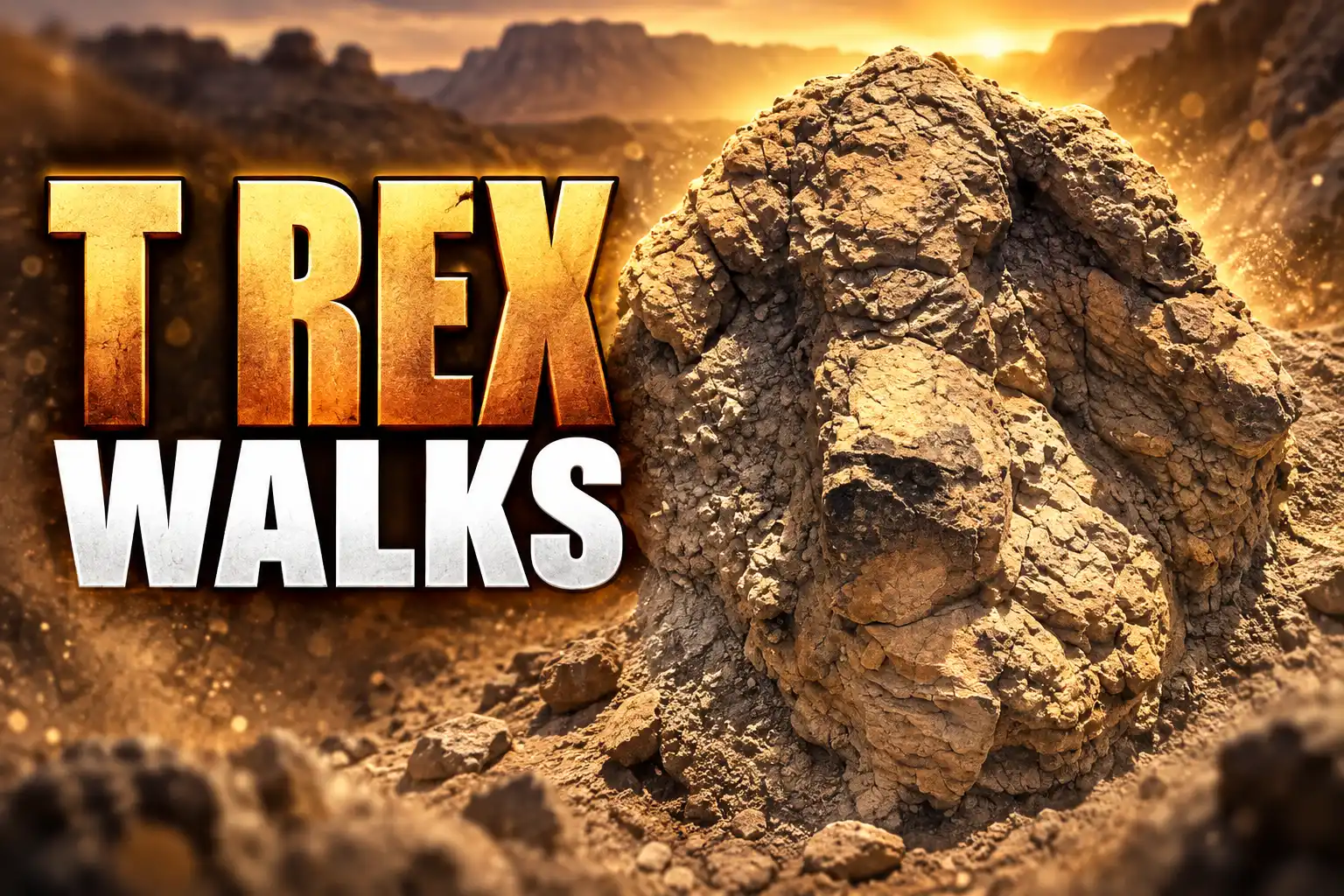
Four Prints, a 4-Meter Stride and a Human Pace
The trail is 7 meters long, about 23 feet, with two left prints and two right. Each track is about 0.9 to 1 meter long, about 3 feet. The stride, the gap between successive prints of the same foot, is about 4 meters, about 13 feet.
The clearest slab, labeled R2, is 0.96 meters long and 0.8 meters wide. Digit impressions on that print measure 34, 47, and 30 centimeters. The team scanned the site with an Artec Leo, covering about 14 square meters, and measured a pace angulation near 167 degrees, then 164 degrees, a nearly straight theropod walk.
THE HELL CREEK WALK IN NUMBERS
| Measure | Value |
|---|---|
| Trackway length | 7 meters (about 23 feet) |
| Print count and sides | 4 (2 left, 2 right) |
| Print length (range) | 0.9 to 1 meter |
| Clearest print (R2) | 0.96 m long, 0.8 m wide |
| Stride | about 4 meters (about 13 feet) |
| Estimated hip height | about 4 meters (about 13 feet) |
| Walking speed | 1.5 to 2 m/s (about 3.5 to 4.5 mph) |
Using stride and foot length, the authors got a hip height of about 4 meters and a speed of about 1.6 meters per second from the classic Alexander formula. If the living foot was closer to 80 centimeters than to the bloated stone, the figure rises toward 2 meters per second. They still say the animal was likely moving more slowly than that, because the casts are heavily weathered and a 2025 bird study led in part by Falkingham found that trackway speed math does not hold up on soft ground.
A 4-meter stride at a 4-meter hip is a walking ratio. It is not a run. Some write-ups treated the find as a running animal. The paper describes a straight walk and warns that four broken casts are a poor speedometer.
Two Lonely Prints Could Not Show a Walk
Bones of T. rex are relatively common in Hell Creek rock. Tracks are not. Until this trail, the adult record was two isolated prints that could not give stride, pace, or speed.
THIRTY YEARS OF T. REX TRACKS
- 1994: Martin Lockley and Adrian Hunt name Tyrannosauripus pillmorei from an 86-centimeter New Mexico tyrannosaur print in the Raton Formation, with a hallux mark.
- 2008: Phillip Manning, Christopher Ott, and Falkingham describe a 72-centimeter Montana Hell Creek print, large and three-toed, with no hallux.
- 2014: British Columbia’s Bellatoripes trackways, prints more than 50 centimeters, yield speeds of 1.8 to 2.4 meters per second for smaller tyrannosaurs walking together.
- 2014 to 2016: A South Dakota Hell Creek trail (Wakinyantanka, 55 to 60 centimeters) and Wyoming’s Glenrock trail (40 centimeters, 2.2 to 3.5 meters per second) are tied to smaller or younger animals.
- 2025 to 2026: Hups finds the Marmarth slabs; the paper, received January 23 and accepted July 13, publishes September 8 as the first adult T. rex trackway.
Falkingham has now stood at both ends of that adult record. He helped describe the lonely Montana print 18 years ago. He is lead author on the first connected walk, without ever seeing the North Dakota butte in person.
Canada and Wyoming already had tyrannosaur trackways. Those animals were smaller, younger T. rex or related species. The Marmarth feet are about twice as long as the Glenrock set and among the largest three-toed prints reported, which is why the authors pick an adult T. rex as the most likely maker.
What the Speed Debate Still Cannot Answer
For a generation the fight was not about walking. It was about whether a six-ton biped could sprint. John Hutchinson and Mariano Garcia argued in 2002 that the muscle mass needed to run fast would have been absurd in an adult of about 6,000 kilograms. Older claims had ranged from about 11 meters per second (about 25 mph) to about 20 meters per second (about 45 mph). Their model made the high end look impossible.
Walking got slower too. In 2021, Pasha van Bijlert and colleagues used tail resonance to estimate a preferred walking speed from tail frequency of 1.28 meters per second, about 2.9 mph, with a range of 0.80 to 1.64. They had to scale a smaller tyrannosaur trail to get step length, because no adult T. rex trackway existed.
Now one does. The Hell Creek walk at 1.5 to 2 meters per second sits near the top of that preferred-walk range, and the authors say the true pace was likely slower still. It is field data for the stroll, not a stopwatch for a chase.
WALKING FIGURES, NOT A TOP SPEED
| Estimate | Speed | What it measures |
|---|---|---|
| Van Bijlert et al., 2021 | 1.28 m/s (about 2.9 mph) | Preferred walk from tail frequency |
| This Hell Creek trackway | 1.5 to 2 m/s (about 3.5 to 4.5 mph) | One weathered adult walk |
| Wapiti tyrannosaurids, 2014 | 1.8 to 2.4 m/s | Smaller animals, longer trails |
| Glenrock trail, Ruiz 2018 | 2.2 to 3.5 m/s | 40 cm prints, not an adult |
| Hutchinson and Garcia, 2002 | 11 vs 20 m/s debate | Running ability, not this walk |
Lyson put the scientific value in behavior, not in a headline number.
Bones tell us an enormous amount about these animals, but footprints capture a moment of behavior. With a trackway, we can actually follow an animal as it moved across the landscape. That is incredibly rare for T. rex.
Tyler Lyson, senior curator of vertebrate paleontology, Denver Museum of Nature & Science
Hell Creek Mud Usually Wipes a Track
The formation preserves bones well because it was a wet floodplain. That same water usually erased footprints before they could harden. Large theropod tracks are uncommon here, and trackways are rarer. The Marmarth prints survived as a geological accident.
The living foot pressed into muddy overbank sediment. Calcium carbonate then cemented fine sandstone around those holes, building concretions harder than the rock around them. Erosion stripped the soft stuff and left the casts standing in positive relief, more like stone feet than sunken molds. R2 is worn enough that the original footprint shows inside the concretion. Surfaces are fractured. Fine skin and pad detail is mostly gone.
THE CASE FOR AN ADULT T. REX
- Size: Prints about 1 meter long sit among the largest three-toed tracks reported, too big for the smaller tyrannosaur trails.
- Shape: Narrow digits and a long-over-wide outline fit a theropod better than a duck-billed dinosaur.
- Gauge: Pace angles near 164 to 167 degrees and a narrow path match other theropod trackways.
- Place and age: Hell Creek rock about 66.5 million years old, with T. rex bones common in the same hills, leaves no other matching giant theropod.
The authors still write “likely.” Footprints are not feet, and weathering stole anatomy. Hadrosaurs such as Edmontosaurus also left large three-toed tracks in this formation, but those tend to be wider than they are long, with broader toes. The Marmarth set fails that test.
Falkingham Walked the Site in Virtual Reality
Evan Tamez-Galvan of the Denver museum ran the field scans. Antoine Bercovici is on the author list. Lyson led the digging. Falkingham, a specialist in fossil locomotion, cleaned and measured the meshes in Blender and viewed them in VR from Liverpool.
He never stood on the butte. The digital copies let him work at the same resolution as the people with the scanner, then share models as supplemental data. That is how a track expert in England became lead author on a North Dakota walk.
It's big, it's tridactyl, and it's Hell Creek, so we reckon this is an adult Tyrannosaurus rex trackway.
Link to paper in the comments pic.twitter.com/WbQNK2Av02
— Peter Falkingham (@peterfalkingham) September 9, 2026
His public summary stayed modest: the prints are big, three-toed, and Hell Creek, so the team reckons they are an adult T. rex trackway. That hedging matches the paper. The identification rests on size, shape, age, and local bones, not on a perfect skin impression.
Three Slabs Head to Denver by Helicopter
Three of the four footprints are expected to come out by helicopter this fall and travel to the Denver Museum of Nature & Science. The museum says it will share recovery updates with visitors this winter. The work sits under U.S. Forest Service permit R1-DPG-LMG-FY24-001.
Jacketing a track is rock on rock, not rock on bone, and the butte is steep gumbo. Tracks that might lie farther back are under heavy cover. The paper says more digging is unlikely for that reason, so the fourth print may remain the one that still points along the hillside.
Lyson’s crew already knows this country. The same badlands produced the juvenile T. rex now in Denver, and they spent the 2025 season on a nearby Triceratops. Hups thinks more tracks will turn up once people know to look for stone toes instead of only bones. For now the adult record is still short: two old isolated prints, and one 7-meter walk at a human pace, caught in calcium carbonate before the floodplain could wipe it away.
Frequently Asked Questions
How Do Scientists Estimate Dinosaur Walking Speed From Tracks?
They use a 1976 formula from zoologist R. McNeill Alexander that links stride length to hip height, often taken as about four times foot length, then converts that ratio into speed. The North Dakota team got about 1.6 meters per second that way. A 2025 Biology Letters paper by Prescott, Griffin, and Falkingham found the same math fails to match real speeds of living birds on soft ground, which is why the new study treats 1.5 to 2 meters per second as a rough ceiling rather than a stopwatch reading.
What Is Tyrannosauripus Pillmorei?
It is the ichnogenus named in 1994 for the first print confidently tied to Tyrannosaurus rex, an 86-centimeter natural cast from the Raton Formation of New Mexico that preserves a posteromedial hallux, the dew-claw digit most Hell Creek casts lack. Later workers have treated it as the gold-standard adult mark because T. rex is the only theropod of that size in Maastrichtian North America.
Could a Duck-Billed Dinosaur Have Made the North Dakota Prints?
The paper tests that against Edmontosaurus annectens, the local giant hadrosaur, and rejects it. Hadrosaur tracks from Hell Creek tend to be wider than they are long, with blunt, broad digits, while the Marmarth casts are about 100 centimeters long by 80 centimeters wide, with narrow toes and a high pace angulation typical of theropods.
Why Are T. Rex Footprints So Rare in Hell Creek Rock?
Bones and tracks rarely form in the same places, because a living animal’s feet need wet mud while skeletons often bury in different sediment, and Hell Creek streams and swamps usually reworked the surface before a print could harden. The Marmarth trail survived only because calcium carbonate nucleated in the foot holes and built sandstone casts harder than the surrounding rock, the same process that makes the formation’s cylindrical “sandstone pipes.”

Run Hide Fight Infidels Hits the Paywall, Not Hollywood

Russia Makes Factory Owners Buy Air Defense They Cannot Run

Trump’s Fed Chair Prepares a Hike as Yields Top 5%

Saudi Red Line at Mecca Meets a Pact Still Forming

Meta Builds Camera-Free Glasses for Rooms That Ban Recording

Sons of Behemat Add a Witch and a Middle Rank

Canada Still Clears Mazatlán as the Cartel War Arrives

The FTC Suit That Targets Amazon’s Hidden Ad Floor

Apple’s Foldable iPhone Event Revives the Fingerprint Button

Samsung Leads Mistral’s Record European Sovereignty Round
-
 GAMING4 weeks ago
Sons of Behemat Add a Witch and a Middle Rank
-
 NEWS2 years ago
Canada Still Clears Mazatlán as the Cartel War Arrives
-
 BUSINESS1 month ago
The FTC Suit That Targets Amazon’s Hidden Ad Floor
-
 NEWS1 month ago
Apple’s Foldable iPhone Event Revives the Fingerprint Button
-
 NEWS4 weeks ago
Samsung Leads Mistral’s Record European Sovereignty Round
-

 LIFESTYLE2 years ago
The Unstoppable Rise of Hot Honey: Are Food Trends Making UK Restaurant Menus All the Same?
-

 LIFESTYLE2 years ago
Women, Gym, and Affairs: A Complex Intersection
-

 ENTERTAINMENT2 years ago
SetonFest Grew From a 1981 Picnic Into Carmel’s Carnival