
BUSINESS
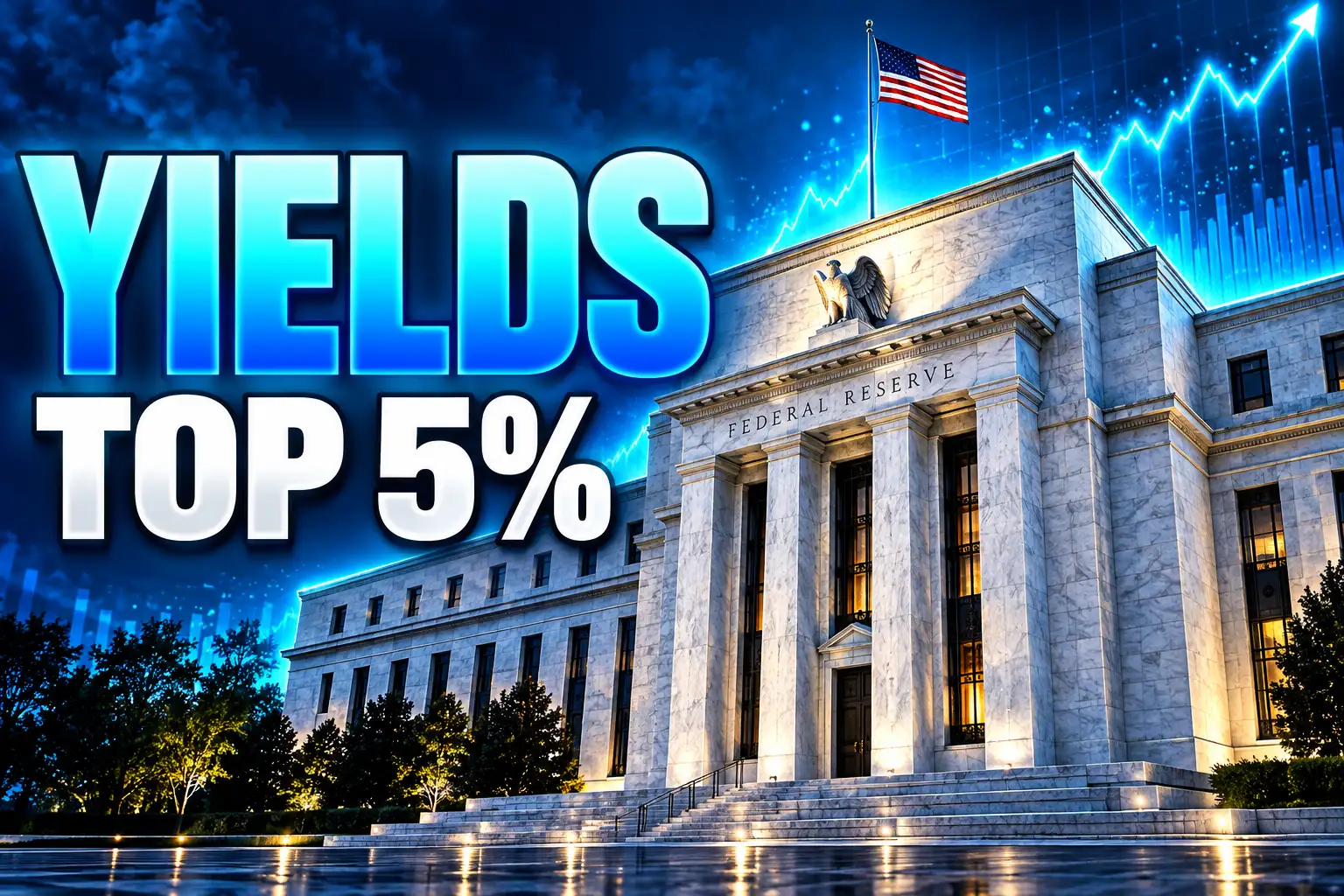
Trump’s Fed Chair Prepares a Hike as Yields Top 5%
The 10-year Treasury yield held above 5% as markets priced a 92.5% chance of a Warsh hike, defying White House calls for cuts.

The 10-year Treasury yield held at 5.004% early Wednesday, still above 5% after Tuesday’s highest print since July 2007. Futures in the CME FedWatch tool priced a 92.5% chance of a quarter-point hike at 2 p.m. ET, up from 33% a month earlier.
That would be the first increase since July 2023, from a chair President Donald Trump installed this spring. Trump has said rates should be 1% or 0.5%. The bond market is offering him 5% on the 10-year instead.
A 19-Year High on the 10-Year Note
At 4:30 a.m. ET on September 16, the 10-year was unchanged at 5.004%. The 20-year sat at 5.409% and the 30-year at 5.372%. One basis point is 0.01%, and yields and prices move in opposite directions.
Tuesday’s tape did the damage. The 10-year climbed 4.3 basis points and tagged 5.041%, the highest since July 19, 2007, before settling near 5%. The 30-year printed 5.401%, the highest since June 13, 2007. The 2-year, which tracks the path of policy, was near 4.68%.
WHERE YIELDS STOOD INTO THE MEETING
| Security | Latest yield | What moved |
|---|---|---|
| 10-year note | 5.004% Wednesday 4:30 a.m. ET | Tuesday high 5.041%, highest since July 19, 2007 |
| 20-year bond | 5.409% | Unchanged Wednesday morning |
| 30-year bond | 5.372% | Tuesday high 5.401%, highest since June 13, 2007 |
| Federal funds target | 3.50% to 3.75% | A 25 basis point hike would take it to 3.75% to 4.00% |
A $13 billion sale of 20-year bonds on Tuesday drew bids of 2.57 times the amount on offer, under a 2.73 average, a soft read on demand for long debt at these levels. The Nasdaq Composite fell 0.56% and the Dow Jones Industrial Average lost 0.29% as the 10-year broke 5%.
Gasoline Accounted for a Third of August’s Jump
Friday’s inflation report is why hike odds went from a coin flip to a near lock. The Bureau of Labor Statistics said the consumer price index rose 0.4 percent in August after a 0.1% gain in July. Over 12 months the all-items index was up 3.4%, the same annual pace as July and well above the Fed’s 2% goal.
AUGUST CPI IN FOUR LINES
- Headline: Up 3.4% year over year, and 0.4% on the month.
- Core (less food and energy): Up 2.4% year over year, and 0.3% on the month.
- Gasoline: Up 3.9% in August, more than a third of the monthly rise.
- Jobs backdrop: Unemployment 4.1% in August, with payrolls up 162,000.
The energy index rose 2.1% on the month. Shelter, still the slow-moving piece of the basket, rose 0.3% after 0.1% in July. Oil remaining above $100 a barrel is the supply shock sitting under those readings, after attacks on Saudi infrastructure and a wider Middle East war disrupted crude flows earlier this year.
The Fed’s preferred gauge, the personal consumption expenditures price index, was up 3.7% over 12 months in the latest full print. In late August, Chair Kevin Warsh also cited a six-month PCE pace of 4.1%. Core inflation is closer to target than the headline. Energy is not, and that is the number households see at the pump.
Warsh Called Inflation a Choice
Warsh was sworn in on May 22. At his first meeting as chair, on June 16 and 17, the Federal Open Market Committee held the funds rate at 3.50% to 3.75% and he framed the inflation miss as something the central bank had allowed. “Inflation is a choice,” he said then.
His Jackson Hole remarks on price stability on August 28, his 100th day in the job, left less room to wait. He dropped regular forward guidance as a habit and said short-term rates remain the main tool. He also put the inflation overshoot on the institution he now runs.
The responsibility for 65 months of sustained, elevated inflation sits squarely with the central bank, and that is where it belongs. Here is my standard: We must be confident that underlying inflation is moving to our objective, clearly and at sufficient speed. Otherwise, we have work to do.
Kevin Warsh, Chairman, Federal Reserve, Jackson Hole, August 28, 2026
Ed Yardeni, president of Yardeni Research, wrote that Warsh has been talking hawkishly since June and now has to deliver. “He promised to follow the financial markets’ lead. The 2-year and 10-year yields are clearly calling for a rate hike,” Yardeni said. That is the bind. A chair who said he would listen to markets is staring at 92.5% hike odds. Skipping the move would not look like patience. It would look like he ignored the tape he asked people to watch.
The White House Still Wants Rates at 1%
Trump spent the first year of his second term pressing for cheaper money, first at Jerome Powell, who is still a governor, and then at the board around Warsh. He has mostly spared Warsh the personal attacks he used on Powell. The policy demand has not changed.
On September 4, after the CPI report showed inflation was not slowing, Trump said the United States “should be paying the lowest interest rate in the world.” He added, “We should be at 1% or a half a percent. We shouldn’t be at 4%.” A later social post put it in capital letters: “A STRONG COUNTRY MEANS A LOWER INTEREST RATE.”
Kevin Hassett, director of the National Economic Council, said Trump “100% respects the independence of Kevin Warsh,” then argued in a separate interview that the Fed should stay out of the way of elections. The midterms are about seven weeks after this meeting. That is the political calendar sitting on a rate call the bond market has already made.
Brent Wilsey, chief investment officer at Wilsey Asset Management, said a hold would not be received as a gift.
If the Federal Reserve were to keep rates steady Wednesday, that could surprise stocks, and surprises are rarely received well in markets. It could also damage the Fed’s credibility, and reignite concerns that the central bank is caving to political pressure to keep rates steady.
Brent Wilsey, Chief Investment Officer, Wilsey Asset Management, emailed note, September 16, 2026
A JPMorgan desk note circulating Tuesday put a hold at a 1.25% to 1.75% drop in the S&P 500. That call is contested, because a dovish surprise more often lifts equities than sinks them. The split itself is the point. Traders are no longer arguing about 25 basis points. They are arguing about whether Warsh can hold without looking as if he blinked.
Home Buyers Are Already Paying 6.76%
The funds rate is the overnight number. Households, companies, and the Treasury live on the 10-year. Freddie Mac’s weekly survey, drawn from purchase applications, said the 30-year fixed-rate mortgage averaged 6.76% as of September 10, up from 6.71% the week before and 6.35% a year earlier. The 15-year averaged 6.09%, up from 6.04% and 5.50% a year earlier.
Daily lender quotes have already moved ahead of that weekly print, so a borrower locking after Tuesday’s 5% 10-year is not shopping the September 10 survey. On a $400,000 30-year loan, principal and interest at 6.76% is about $2,597 a month. At last year’s 6.35% it was about $2,489, a $108 gap before taxes and insurance.
WHO PAYS WHEN THE 10-YEAR IS ABOVE 5%
- Home shoppers: The 30-year mortgage has climbed 41 basis points in a year and is tracking the 10-year, not the White House’s 1% ask.
- Companies rolling cheap debt: Credit is still open for large firms, but coupons set in 2021 are being refinanced into a 5% Treasury world.
- The Treasury itself: Coupons on new 10-year and 30-year debt now clear above 5%, raising the carrying cost of the existing pile as it rolls.
July’s staff briefing to the FOMC already called home-purchase mortgage activity “depressed.” That was when the 10-year was still well below this week’s print. A quarter-point on the funds rate does not set the 30-year. The 10-year does, and it has already done the work.
Three Presidents Voted to Hike in July
The turn was visible two meetings ago. After the July 28 and 29 session, the committee left the target at 3.50% to 3.75%. Cleveland Fed President Beth Hammack, Minneapolis Fed President Neel Kashkari, and Dallas Fed President Lorie Logan wanted a quarter-point increase. Logan said that without more restraint, inflation would likely stay above target until an unanticipated shock.
The one-in-three chance of an increase that markets priced for July was the base case for a hold. The same minutes said markets were already fully pricing a 25 basis point hike by this September meeting and another by the end of the first quarter of 2027. Desk survey respondents were more dovish than the tape, looking for no change this year. The tape won.
THE PATH TO THIS MEETING
- May 22, 2026: Warsh is sworn in as chair after Senate confirmation on May 13.
- June 16-17, 2026: First FOMC under Warsh holds at 3.50% to 3.75%. He calls inflation “a choice.”
- July 28-29, 2026: The committee holds again. Three reserve-bank presidents dissent for a hike. Markets fully price September.
- August 28, 2026: At Jackson Hole, Warsh says underlying inflation is not improving fast enough and that the Fed has “work to do.”
- September 11, 2026: August CPI holds at 3.4% year over year, with a 0.4% monthly jump led by gasoline.
- September 15, 2026: The 10-year tags 5.041%, the highest since July 19, 2007.
- September 16, 2026: The statement and new projections are due at 2 p.m. ET.
Jonathan Pryor, co-head of FX dealing at Marex, said the Fed is “moving into a new phase of monetary policy.” Earlier this year it looked like a cutting cycle that might last six or 12 months, he wrote. “Now it feels like the tables have turned.” Central banks, he added, are trying to handle supply-side inflation “at a time when global bond markets are receiving significant attention.”
What Wednesday’s Dots Can Still Change
The 25 basis points are, for practical purposes, in the price. Interest-rate futures have also priced about three further quarter-point increases over the next year, a terminal funds rate near 4.60%. That market path is hotter than several house forecasts.
MUFG Research, which had been on the hold side, flipped after Jackson Hole, a solid jobs report, and the hot CPI print. The firm now expects a 25 basis point move at this meeting and would skip the October FOMC meeting because it sits close to the midterms. It assigns a 55% to 60% chance of another hike in December and then a hold in a 4% to 4.25% target range. MUFG’s own 10-year forecast for this quarter is 4.75%, below the market, a bet that the selloff has overshot.
Morgan Stanley and Goldman Sachs also dropped hold calls for this week, with Morgan Stanley’s Michael Gapen looking for two 25 basis point moves this year, in September and December. The open argument is no longer hike versus hold. It is whether this is a one-off credibility hike or the start of another tightening run.
WHAT WE KNOW
- The clock: The statement and updated Summary of Economic Projections are due at 2 p.m. ET on September 16.
- The tape: CME FedWatch puts a 92.5% chance on a 25 basis point hike, up from 59.4% a week earlier as of Tuesday’s wrap and 33% a month earlier.
- The starting point: The funds target is 3.50% to 3.75%. A hike would take it to 3.75% to 4.00%, the first increase since July 2023.
WHAT IS UNCONFIRMED
- Dissents: Whether any voter opposes a hike, and whether the July minority of three becomes a majority statement.
- The dots: How many 2026 increases the median projection shows, and whether 2027 dots keep rising.
- The tone: Whether Warsh, who has tried to say less about the next meeting, describes this as insurance or as the start of a campaign.
A hold would now be the shock. A hike with a soft press conference is the path most desks are playing as close to neutral for stocks. A hike plus dots that keep climbing is the version that would give the 10-year another reason to stay above 5%. The White House can keep asking for 1% money. The note that sets mortgages, corporate coupons, and a large share of federal interest costs is already yielding more than it has in 19 years.
The statement is due at 2 p.m. ET. The 10-year is already above 5%.
Disclaimer: This article is news reporting and market analysis for information only. It is not investment advice, a recommendation to buy or sell Treasurys, stocks, or any other security, and it is not a forecast you should trade on. Speak with a licensed financial adviser or investment professional who knows your situation before making any portfolio decision. Yields, FedWatch probabilities, inflation readings, and policy odds are those published by the named sources on September 16, 2026, and they can move as soon as the 2 p.m. ET announcement is out.

Russia Makes Factory Owners Buy Air Defense They Cannot Run

Trump’s Fed Chair Prepares a Hike as Yields Top 5%

Saudi Red Line at Mecca Meets a Pact Still Forming

Meta Builds Camera-Free Glasses for Rooms That Ban Recording

Depotcharge Turns Idle Truck Chargers Into a Haulier Club

Sons of Behemat Add a Witch and a Middle Rank

Canada Still Clears Mazatlán as the Cartel War Arrives

The FTC Suit That Targets Amazon’s Hidden Ad Floor

Apple’s Foldable iPhone Event Revives the Fingerprint Button

The Unstoppable Rise of Hot Honey: Are Food Trends Making UK Restaurant Menus All the Same?
-
 GAMING4 weeks ago
Sons of Behemat Add a Witch and a Middle Rank
-
 NEWS2 years ago
Canada Still Clears Mazatlán as the Cartel War Arrives
-
 BUSINESS1 month ago
The FTC Suit That Targets Amazon’s Hidden Ad Floor
-
 NEWS1 month ago
Apple’s Foldable iPhone Event Revives the Fingerprint Button
-
 LIFESTYLE2 years ago
The Unstoppable Rise of Hot Honey: Are Food Trends Making UK Restaurant Menus All the Same?
-

 LIFESTYLE2 years ago
Women, Gym, and Affairs: A Complex Intersection
-

 NEWS3 weeks ago
Samsung Leads Mistral’s Record European Sovereignty Round
-

 ENTERTAINMENT2 years ago
SetonFest Grew From a 1981 Picnic Into Carmel’s Carnival