
NEWS
Samsung Galaxy SmartTag 3 Reaches iPhone and Skips Find Hub
Galaxy SmartTag 3 lets iPhones check a tag in Samsung’s app, yet it still sits outside Android Find Hub and reserves 60-meter Compass View for four Galaxy phones.

Samsung’s Galaxy SmartTag 3 can be found from an iPhone, and it still will not join Android’s Find Hub network. The company said so on September 30, 2026, while pitching a smaller puck, a longer CR2032 cell, and a 900 million-device Galaxy Find Network that remains Galaxy-only.
The iPhone door is real. It is also one-way. An iPhone can open Samsung’s app and look up a shared tag. It does not become a finding node, and a Pixel still cannot register the tracker at all.
What iPhone Users Can Do With SmartTag 3
This is the first Galaxy SmartTag that Samsung will let an iOS device see. Through SmartThings Find, a family can check a tag’s location, share it, and run Search Nearby from a supported Galaxy phone or an iPhone. Samsung’s own example is a suitcase on loan: the borrower opens the app on whatever phone is in their pocket and looks the bag up.
That is the core finding and sharing features the press note actually promises. Feature availability “may vary by platform,” the same note says, and three tools never leave Galaxy software.
WHAT IPHONE SUPPORT LEAVES OUT
- Compass View: No distance-and-direction screen on iOS, at 60 meters or at arm’s length.
- Ring Phone: The tag cannot ping the iPhone the way it can ping a Galaxy handset.
- Left Behind Alert: iOS gets no warning when the phone loses the Bluetooth link to a tagged bag or key ring.
An iPhone also does not feed the Galaxy Find Network. If a tagged backpack is across town, only a participating Galaxy device that walks past it can drop a fresh pin. The iPhone in the owner’s hand can read that pin. It cannot help create the next one.
People want simpler and more convenient ways to keep track of belongings and pets for greater peace of mind, and Galaxy SmartTag3 was designed around those everyday needs. Powered by the vast Galaxy Find Network, it delivers our most capable Galaxy SmartTag experience yet.
Jay Kim, Executive Vice President and Head of Customer Experience Office, Mobile eXperience Business, Samsung Electronics, September 30, 2026 press release
Kim is selling the network. The network is still a Samsung radio club. Calling it cross-OS describes the client app, not the crowd of phones that actually hear a lost tag.
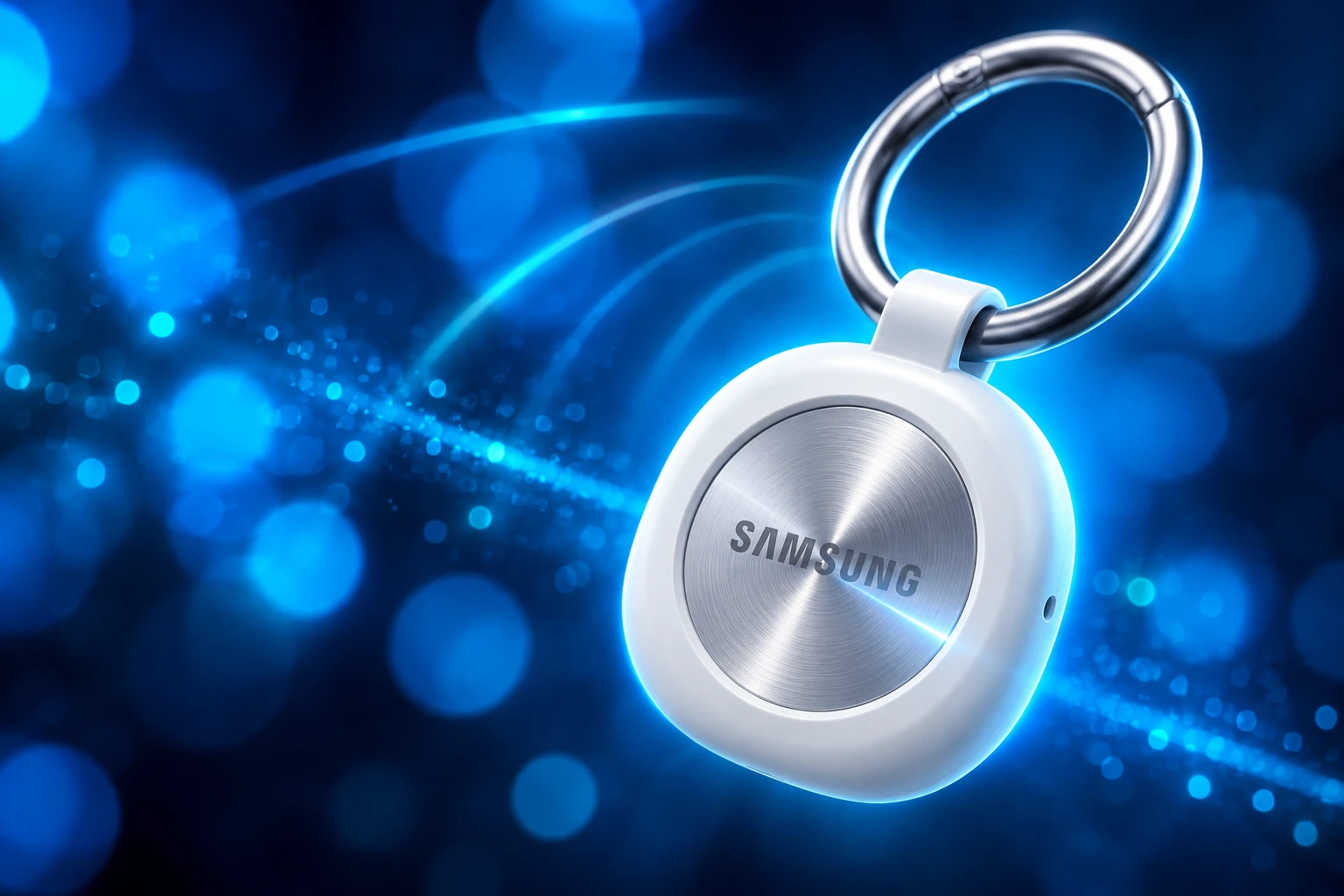
Compass View’s 60-Meter Trick Needs Four Phones
The ranging upgrade is Bluetooth 6.0 Channel Sounding, which Samsung says stretches Compass View to 60 meters in a clear line of sight, about three times farther than the previous generation. Closer in, ultra-wideband takes over for a tighter arrow. That handoff is the park-and-keys demo in the launch copy.
The 60-meter figure is not a general Galaxy feature. Samsung’s footnote limits Channel Sounding to four phones, with more “in the future.”
PHONES WITH CHANNEL SOUNDING AT LAUNCH
- Galaxy Z Fold8 Ultra: Foldable flagship on the Channel Sounding list.
- Galaxy Z Fold8: Standard Fold 8, same ranging radio.
- Galaxy S26 Ultra: Ultra slab that can run the 60-meter Compass View.
- Galaxy S26 Plus: The fourth and last model named in the footnote.
Compass View itself still runs on Galaxy phones with Android 12 or later that have UWB or Channel Sounding, so an older UWB Galaxy is not locked out of arrows. It is locked out of that new 60-meter start. Walls, other radios, and clutter cut the range, Samsung says, even on the four phones.
Bluetooth Channel Sounding distance measurements use phase-based ranging and round-trip time to guess how far two radios sit apart, down to tens of centimeters in lab talk. Both ends have to speak the same dialect. A SmartTag 3 in a coat pocket does nothing special for a phone that never shipped the radio.
Does the Galaxy SmartTag 3 Work With Find Hub?
No. The tag talks to the Galaxy Find Network through SmartThings Find. It does not appear on Google’s Find Hub network of Android devices, the Android 9 and up crowd that can map a lost Pixel, a pair of buds, or a Find Hub tracker. A Motorola, a OnePlus, or a Pixel will not register a SmartTag 3, and it will not anonymously relay one for someone else.
That split is older than this puck. Galaxy trackers have lived on Samsung’s offline-finding protocol since the first SmartTag. Google spent the years after SmartTag 2 turning Find My Device into Find Hub and inviting other Android phones in as nodes. Samsung’s third tag still declines the invitation.
WHO CAN USE A SMARTTAG 3
| Phone | Track a SmartTag 3 | Help find someone else’s | 60 m Compass View |
|---|---|---|---|
| Galaxy phone | Yes, in SmartThings Find | Yes, if Offline Finding is on | Only the four named 2026 models |
| iPhone | Yes, location, share, Search Nearby | No, it is not a network node | No |
| Pixel and other Android | No official app | No | No |
Google already sells a first-party answer for the phones Samsung will not serve. Pixel Tag pairs through Fast Pair on Android 9 or newer and rides a network of over one billion Android devices. That is a different pool from Samsung’s 900 million Galaxy nodes, and a Pixel Tag will not find a SmartTag 3 either. Two large Android finding nets now sit side by side, and the new Samsung puck still belongs to only one of them.
The iPhone headline is easy to over-read. It describes a Samsung client on iOS, not a tag that any Android phone can see. A stray claim that SmartTag 3 now works with non-Samsung Android phones is wrong on Samsung’s own paperwork.
The Tag Lost Its Key Ring for a Smaller Puck
Samsung cut the built-in mounting loop that sat on the last two tags. The new body is about 35% smaller by volume and 33% lighter, a rounded puck with an aluminum-decorated button. Attaching it to keys, a bag, luggage, or a pet collar now means buying a Silicone Case with a keyring or a Loop Case. Those cases are sold separately, and colors depend on the store.
White and Black are the two finishes. The rating is still IP67, which Samsung defines as water resistance in up to 1 meter (3.3 feet) for up to 30 minutes, not a beach or pool toy. Location data is encrypted, the company says, in the same privacy paragraph it has used on this line.
SMARTTAG 3 ON PAPER
- 550 days: Rated standard run on the in-box CR2032, from Samsung’s lab usage model, not a field test.
- 790 days: Power Saving Mode, which drops Compass View, volume and ringtone settings, and keeps basic Bluetooth LE finding.
- IP67: Dust and water resistance as rated, and it can fade with wear.
- NFC Lost Mode: A finder with NFC and internet can read a contact line or short message you stored first in SmartThings.
The smaller body is easier to hide in a suitcase pocket or a collar. It is also easier to swallow if it pops off, which is why the footnotes read like a pet-product warning. Inspect the case. If the puck comes loose, stop using it.
Alerts That Depend on a Passing Galaxy Phone
Most of the new software is not a better arrow. It is a prompt that fires when you are not looking at the map.
NEW PROMPTS ON THE TAG
- Place Notification: A trial geofence. You draw a zone, then get a ping when the tag moves in or out, aimed at a pet leaving a garden or a bike leaving a rack.
- Location History: A trail stored for up to 7 days, then wiped. Apple’s AirTag still does not keep a comparable path.
- Movement Detection Alert: Fires only after the tag has lost its phone, and only if a nearby Galaxy device that agreed to Offline Finding hears it.
- Left Behind Alert: A Bluetooth-loss ping on Galaxy, with false alarms if a wall drops the link. Not on iOS.
- SmartThings IoT Control: The physical button can fire a preset routine on compatible connected gear.
Place Notification and movement alerts lean on the same crowd as remote finding. If no opted-in Galaxy phone is nearby, the garden fence is just a drawing. Samsung says there can be delay, or no ping at all, depending on those neighbors and the room the tag is in. Owners who want their own handset to help other people should join the Galaxy Find Network by turning on Offline Finding in SmartThings.
That is the quiet cost of staying off Find Hub. A crowded Android city still has dead zones for a SmartTag 3 wherever the people walking by carry Pixels, Motorolas, or iPhones. The 900 million figure is a ceiling on Galaxy hardware, not a map of every sidewalk.
Mixed Homes Get a Workaround, Pixel Owners Do Not
The household Samsung wrote the iOS paragraph for is easy to picture: one Galaxy, one iPhone, a shared suitcase. The Galaxy owner pairs the tag. The iPhone owner gets a map and Search Nearby. Nobody in that kitchen needs a second brand of tracker for that one bag. Compass View and left-behind pings stay on the Samsung side of the table, which is a fair trade if the Galaxy is the phone that leaves the house with the keys.
The household the launch does not serve is the one that never bought a Galaxy. A Pixel user who wants a puck on Find Hub already has Pixel Tag, Chipolo, Pebblebee, and Motorola’s Moto Tag line. Those products do not gain anything from SmartTag 3. They also cannot see it if a Galaxy-owning roommate drops one in the communal laundry bag.
There is a long-running unofficial path, uTag, that patched SmartThings so an older SmartTag 2 could be set up on non-Samsung Android. It needed a modified app and Android 11 or later. Samsung did not bless it, and the new tag’s official iOS client does not replace it for Pixel owners. The company chose Apple’s phones as the first outsiders, and it chose them as viewers, not as extra radios.
Google, for its part, still treats a passing Galaxy as a possible Find Hub node for other people’s Android gear. Samsung did not return the favor for tags. The radios in those 900 million Galaxy devices remain a private finding grid that iPhones may watch and that Find Hub may not.
On Sale First in Korea on October 7
Hardware is done enough to date. Software limits are written into the footnotes. What is left is a staggered shop schedule and a U.S. price that the global press release never printed.
WHEN THE TAG GOES ON SALE
- October 7, 2026: Goes on sale first in Korea, in White and Black.
- Early November 2026: U.S. launch briefings schedule the American arrival at $29.99 for one tag and $99.99 for a four-pack.
- 2027: Additional markets follow, with no country list in the announcement.
The $29.99 single-tag figure matches the last generation’s U.S. street talk and sits next to Apple’s AirTag and Google’s Pixel Tag in the same band. Samsung’s own notice only says Korea, then the United States, then 2027. Case pricing is unlisted. Channel Sounding support for more Galaxy phones is a “may” in a footnote, not a date.
Until those later phones and later countries show up, the product on the table is a smaller Galaxy tag with a long CR2032 life, a 60-meter trick on four handsets, an iPhone app that cannot join the crowd, and a hard line against Find Hub. That is the tracker Samsung is shipping, not the open Android finder the iPhone headline can be mistaken for.

Clay Moulds From the Blyth Hoard Fit Peebles Fittings

Treasury Yields Hit a 24-Year High as AI Joins the Queue

Crew-12 Leaves the ISS With Fedyaev and Adenot Aboard

The Graziers Recall Puts the 60-Day Cheese Rule on Trial

Hugo Chavez’s Hollywood Welcome Meets a Film About Escape

Sons of Behemat Add a Witch and a Middle Rank

Canada Still Clears Mazatlán as the Cartel War Arrives

The FTC Suit That Targets Amazon’s Hidden Ad Floor

Samsung Leads Mistral’s Record European Sovereignty Round

Laepple Automotive Bets on a Vacant Detroit Die Shop
-
 GAMING2 months ago
Sons of Behemat Add a Witch and a Middle Rank
-
 NEWS2 years ago
Canada Still Clears Mazatlán as the Cartel War Arrives
-
 BUSINESS2 months ago
The FTC Suit That Targets Amazon’s Hidden Ad Floor
-
 NEWS2 months ago
Samsung Leads Mistral’s Record European Sovereignty Round
-
 NEWS2 months ago
Apple’s Foldable iPhone Event Revives the Fingerprint Button
-
 AUTO2 years ago
Laepple Automotive Bets on a Vacant Detroit Die Shop
-

 LIFESTYLE2 years ago
The Unstoppable Rise of Hot Honey: Are Food Trends Making UK Restaurant Menus All the Same?
-

 LIFESTYLE2 years ago
Women, Gym, and Affairs: A Complex Intersection