
BUSINESS
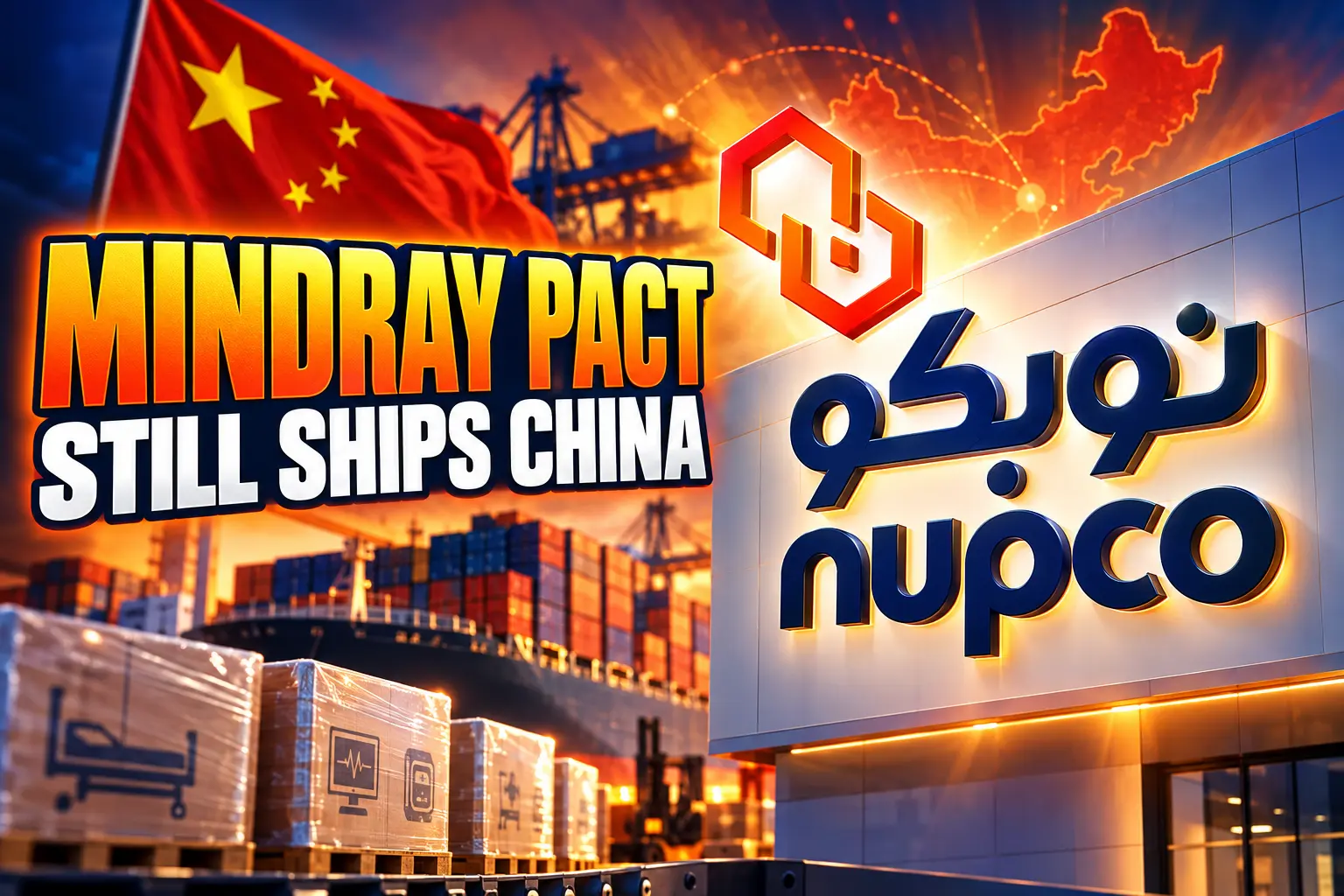
Mindray’s Saudi Pact Still Ships Monitors From China
The 2024 Mindray-NUPCO pact promised Saudi plants. Public ICU awards still list China as origin, with a virtual-hospital link the main live result.

Saudi Arabia’s health minister signed Mindray into a NUPCO research pact in Shenzhen on December 2, 2024, pitching local plants, jobs and tougher supply chains.
The paper promised research, development and medical innovation. The award sheets that followed still print China as the origin of the monitors.
AlJalajel Asked Shenzhen for Local Production
Fahad Abdulrahman AlJalajel walked the Mindray showroom with Fahad bin Mohammed AlShebel, chief executive of the National Unified Procurement Company, and Nasser Al Huqbani, chief executive of Health Holding Company. Wu Hao, president of Mindray, hosted them with senior vice president Li Zaiwen and Xu Kewen, general manager of the international division.
The ministry’s own note of the trip, issued on December 3, 2024, put the agenda in plain order: localize and transfer technology and knowledge, build supply chains that can take a shock, and create local jobs. AlJalajel thanked the company for help during COVID-19, then asked for a tighter, more local partnership.
We look forward to establishing broader and more localized cooperation with Mindray.
Fahad Abdulrahman AlJalajel, Minister of Health, at Mindray headquarters
Wu Hao walked the visitors through the firm’s Intelli-Digital mix of devices, IT and AI, and said the same stack could support early detection, public health work and home care under Vision 2030. He also said Mindray was speeding up local production in the region. Dr. Tommy Tan, the company’s strategic planning director, mapped Saudi cost and quality pressures onto problems Mindray already claims to run in China and elsewhere.
NUPCO and Mindray then signed a strategic memorandum on future healthcare work. NUPCO’s own account, posted the same day, framed the paper as a logistics and infrastructure bet, not a factory groundbreaking.
نتطلع في #نوبكو إلى مستقبل يسوده التميز في الخدمات اللوجستية الطبية، حيث وقعنا مذكرة تفاهم مع شركة mindray بحضور معالي وزير الصحة الأستاذ فهد الجلاجل، لتعزيز شراكات ترسخ أسس قوية لبنية تحتية صحية متقدمة في السعودية. pic.twitter.com/Rz1NSbUIhJ
— نـوبـكـو (@nupco) December 2, 2024
Huawei, BGI and a Four-Stop Shenzhen Circuit
Mindray was one door on a packed Shenzhen loop. The Saudi Press Agency later listed visits to Huawei, BGI Group, Shenzhen New Industries Biomedical Engineering, and Mindray before the minister flew on to Beijing for talks with China’s National Health Commission.
THE SHENZHEN STOPS
| Company | What was signed | Saudi counterpart |
|---|---|---|
| Mindray | Strategic memorandum on healthcare development | NUPCO |
| Huawei | Two memoranda on health-sector technology | NUPCO and Health Holding Company |
| BGI Group | Two memoranda on health-sector capabilities | NUPCO |
| SNIBE | Site visit and briefing, no pact named | Ministry delegation |
The pattern is the buyer’s. AlShebel sat in the Mindray room because NUPCO writes the public orders. A memorandum with the company that stocks government hospitals is how a foreign device maker gets close to that purse. It is also how Riyadh tries to turn a visit into local making, at least on paper.
What the Virtual Hospital Deal Installed
The first large Saudi deployment Mindray chose to write up after the visit was not a plant. It was software and a portable probe inside SEHA Virtual Hospital, the ministry’s 2021 telemedicine network, which Mindray calls the first virtual hospital in the Middle East and one of the largest of its kind.
SEHA already ties together 224 hospitals, offers 44 specialist services, and says it has served 58,000 people, with room for more than 480,000 patients a year. Mindray’s February 3, 2026 case study says the M9 scanner and MiCo+ imaging software now link 10 primary clinics in the major clusters so SEHA doctors can read ultrasound exams from a distance.
WHAT WENT LIVE AT SEHA
- The hardware: Mindray’s M9 hand-carried ultrasound, chosen for portability and an automated scan workflow the company brands iWorks.
- The software: MiCo+ medical imaging IT, used so specialists can see live images from clinics that lack their own ultrasound experts.
- The load: Mindray says 30 to 40 percent of those clinic scans need a SEHA teleconsult, and more than half of those cases are obstetrics and gynecology.
- The climate case: summer highs above 50C from April to October push patients, including pregnant women, into nearby clinics rather than big-city hospitals.
The WHO Results Report 2023, cited in the same case study, puts 68 percent of Saudi adults in the overweight group, which is why abdominal ultrasound is a routine screen for liver disease. Remote reading also lets female patients avoid a face-to-face exam with a male doctor. That is a real clinical win. It is also still an import of Chinese hardware and Chinese software, sitting on a Saudi network.
China Origin on the ICU Framework Sheets
Eleven months after the handshake, NUPCO posted final results for tender NPT0021/24, an open framework agreement for ICU kit and monitors, dated November 12, 2025. Mindray products are on the sheet. The origin column is not Saudi Arabia.
THE NUPCO AWARD SHEET
| Item | Model | Local bidder | Origin listed |
|---|---|---|---|
| Bedside monitor, adult and pediatric, 15 inch | BeneVision N15 | Ascend Advanced Healthcare Solutions | China |
| Transport ventilator, adult and pediatric | TV50 | Al Faisaliah Medical Systems | China |
| AED, school-clinic tender NPT0058/24 | Mindray AED | Ascend Advanced Healthcare Solutions | China |
Ascend, supplier code 400455, also won related modules, Wi-Fi cards and sensors for the BeneVision line, all tagged China. Comen, Biolight and Draeger sit on the same ICU agreement, so this is not a monopoly. It is a reminder that winning a NUPCO line still means shipping from Shenzhen, Nanjing or Wuhan, then billing through a Saudi agent.
Private hospitals kept buying the brand the same way. On October 29, 2025, AlFalah Hospital said it had signed with Fujifilm, Mindray and Roche at the Global Health Exhibition, a vendor row, not a groundbreaking. On May 9, 2026, Mindray Middle East and Africa said it had signed a digital-health memorandum with Hayat National Hospitals Group during another Shenzhen visit. More paper. Still no named factory gate in the Kingdom.
Turning a Handshake Into Tender Access
NUPCO is the reason a Shenzhen photo can move metal. The Public Investment Fund’s portfolio page states that NUPCO is fully owned by PIF, was set up in 2009, and holds registered capital of SAR 1.5 billion. Khalid Al-Ghamdi, the chief commercial officer, said at the 2025 PIF Private Sector Forum that yearly buying tops SAR 25 billion.
NUPCO IN ONE SNAPSHOT
- The network: more than 300 hospitals and 2,500 clinics, covering 97 percent of the country.
- The bed forecast: Al-Ghamdi said the market would need between 26,000 and 43,000 extra beds by 2030, with Expo 2030 and the 2034 World Cup adding load.
- The supplier cash: SAR 2.5 billion (about $667 million) in 2025 financing, split as SAR 500 million with Banque Saudi Fransi, SAR 1 billion with First Abu Dhabi Bank’s Saudi branch, and SAR 1 billion with Tameed for smaller vendors.
The company’s unified catalogue, whose medical-equipment list was refreshed in April 2026, states a third goal in so many words: attract foreign investment, transfer knowledge and localize industry. That sentence is the policy hiding inside every memorandum. A foreign brand that wants the SAR 25 billion flow is expected, over time, to make more of the product inside the Kingdom.
Western names already live on older NUPCO imaging agreements, including Siemens Healthcare and Philips Saudi Arabia Healthcare on a 2021 diagnostic-imaging round. Mindray’s 2024 paper put a Chinese monitor and ultrasound house on the same track, with local production named as the destination. The destination is the part that has not shown up on a map.
Fourteen Plants Abroad, None Named in Saudi Arabia
Mindray’s May 2026 draft listing papers, filed with the Hong Kong exchange and marked as incomplete and subject to change, give investors a global manufacturing scorecard as of December 31, 2025. The company says it has localized manufacturing projects in 14 countries, with 11 already in production. It does not publish the country list in the passages that mention Saudi Arabia.
The same draft puts 2025 sales at RMB 33.3 billion, of which RMB 17.7 billion, or 53 percent, came from overseas. It counts 64 foreign subsidiaries in 40 countries, more than 3,000 overseas staff with over 90 percent hired locally, and products in more than 190 countries. Four big Chinese plants in Shenzhen, Nanjing, Dangshan and Wuhan exceed 600,000 square metres of floor space. Saudi Arabia appears in a different paragraph, as a Vision 2030 case of “localized manufacturing and talent development,” and again as one of the high-end hospital markets cracked in 2025, alongside Türkiye, Brazil and Mexico.
WHAT WE KNOW
- The pact: NUPCO and Mindray signed on December 2, 2024, in front of the health minister.
- The live kit: M9 units and MiCo+ now serve 10 primary clinics on the SEHA network.
- The tender origin: BeneVision N15 monitors and TV50 ventilators on NPT0021/24 are listed as China-made.
- The investor line: the May 2026 draft tells investors Mindray supports Vision 2030 with localized manufacturing in Saudi Arabia.
WHAT IS UNCONFIRMED
- A named plant: no city, industrial zone, or licence number for a Saudi Mindray line appears in the company’s English case studies or the draft listing passages reviewed.
- A local-content score: no public figure states how much of a Saudi-bound monitor is made in the Kingdom.
- A headcount: Mindray KSA exists as a local office, but the draft’s 3,000-plus overseas staff figure is global, not a Riyadh payroll.
Wu Hao told the December visitors he wanted to speed local production in the region. Speed, in the documents that followed, has meant winning tenders and plugging probes into SEHA, which is easier than pouring a slab in an industrial city.
Local Content Now Decides Who Wins the Next Bid
Ken Research puts local makers at only 16.9% of Saudi medical-device demand in 2025, rising to 22.5 percent by 2031, and values that local industry at $1.06 billion in 2025, heading for $1.78 billion in 2031 at a 9.02 percent annual clip. It also credits localization with SAR 1.7 billion of GDP by 2030. Those are small shares in a market still fed by imports.
Mordor Intelligence sizes diagnostic imaging alone at $419.11 million in 2025, on track for $539.69 million by 2030 at a 5.19 percent clip, with X-ray holding 29.01 percent of that slice in 2024 and ultrasound the faster line at a 6.97 percent clip. Mindray sits on those vendor lists next to GE Healthcare, Siemens Healthineers and Philips. The fight is no longer only about who has the better probe. It is about who can put enough Saudi labour, parts and plant into the bid.
THE LOCAL-CONTENT PRESSURE
- The catalogue: NUPCO states, in public, that unified lists exist in part to pull in foreign plants and know-how.
- The regulator: Saudi Food and Drug Authority manufacturing guidance issued in 2025 describes three paths, full local making, partial assembly, and a hybrid technology-transfer route.
- The arithmetic: a 16.9 percent local share leaves most public-hospital metal still coming in through ports, which is exactly the gap Vision 2030 industrial policy is written to close.
A memorandum in a Shenzhen showroom can open the door to that catalogue. It cannot mark a BeneVision as made in Saudi Arabia. Investors reading the May 2026 draft are told Mindray supports Vision 2030 with localized manufacturing in Saudi Arabia, while the November 2025 award sheets still name China as the origin of the monitors going into public ICUs.

Clay Moulds From the Blyth Hoard Fit Peebles Fittings

Treasury Yields Hit a 24-Year High as AI Joins the Queue

Crew-12 Leaves the ISS With Fedyaev and Adenot Aboard

The Graziers Recall Puts the 60-Day Cheese Rule on Trial

Hugo Chavez’s Hollywood Welcome Meets a Film About Escape

Sons of Behemat Add a Witch and a Middle Rank

Canada Still Clears Mazatlán as the Cartel War Arrives

The FTC Suit That Targets Amazon’s Hidden Ad Floor

Samsung Leads Mistral’s Record European Sovereignty Round

Laepple Automotive Bets on a Vacant Detroit Die Shop
-
 GAMING2 months ago
Sons of Behemat Add a Witch and a Middle Rank
-
 NEWS2 years ago
Canada Still Clears Mazatlán as the Cartel War Arrives
-
 BUSINESS2 months ago
The FTC Suit That Targets Amazon’s Hidden Ad Floor
-
 NEWS2 months ago
Samsung Leads Mistral’s Record European Sovereignty Round
-
 AUTO2 years ago
Laepple Automotive Bets on a Vacant Detroit Die Shop
-
 NEWS2 months ago
Apple’s Foldable iPhone Event Revives the Fingerprint Button
-

 LIFESTYLE2 years ago
The Unstoppable Rise of Hot Honey: Are Food Trends Making UK Restaurant Menus All the Same?
-

 LIFESTYLE2 years ago
Women, Gym, and Affairs: A Complex Intersection