
SPORTS
Summer McIntosh Recovery Techniques: Rest Between Races
Summer McIntosh recovery techniques put a mixed-pace swim-down ahead of the nap. A youth study left lactate at 2.40 mmol/L, against 4.29 after steady swimming.

You finish a race and the clock starts on the next one. Summer McIntosh recovery techniques are the minutes after you touch the wall. Those minutes are food, time off your feet, a nap, and a cool-down swum at more than one pace.
A steady easy swim can leave more lactate in your blood than a mixed set of about the same length. Heart rate and how hard it felt can look the same either way. This page walks through her meet-day habits, the two cool-downs tested on national-level youth, and how to change the plan when the next race is soon.
Eating, Naps, and the Deck at a Long Meet
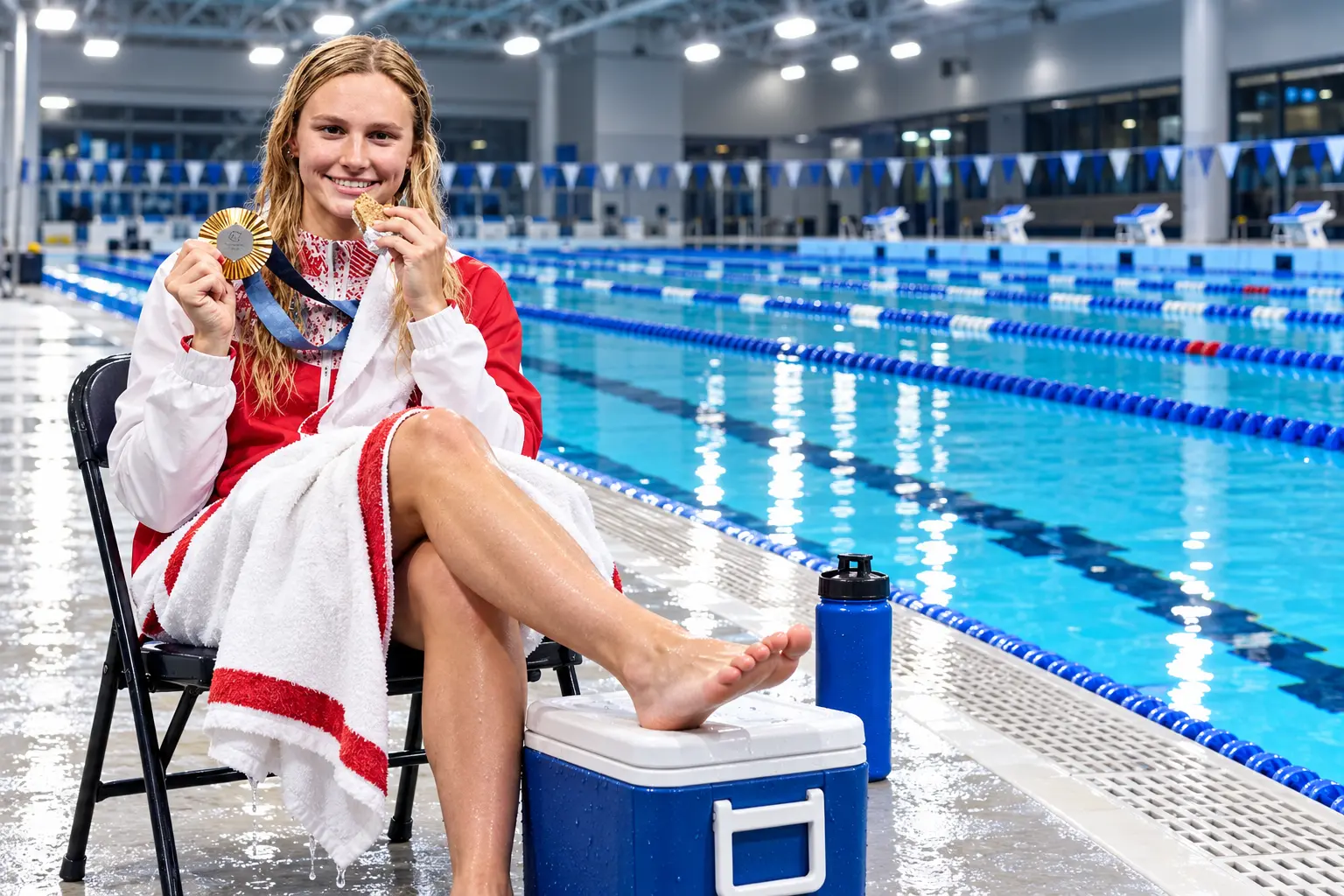
At Paris 2024, Summer McIntosh became the first Canadian with three gold medals at a single Games, with silver in the 400 freestyle and gold in the 400 individual medley, the 200 butterfly, and the 200 individual medley. She was 17 that week, and the job between those swims was the one she kept talking about.
She and coach Brent Arckey had mapped the nine-day program about a year earlier, counting heats, semifinals, and finals so almost no minute sat empty. Asked what she did from one session to the next, she ran through a plain list: dry off, eat as soon as possible, get a massage, take a long nap, eat again, go back to the pool, rest more, eat more, stay off her feet, drink water, and sleep again. Her line on the whole week was that once she dives in she is fine, and the work is recovering as well as she can before that dive.
“Just trying to sleep as much as possible even though it’s hard after all the adrenalin and excitement, along with eating as much as possible and just kind of letting your mind take a rest as well.”
Summer McIntosh, Canadian swimmer, during the Paris 2024 swimming meet
She has called herself a professional napper, a skill she ties to years of two-a-day training, and she has said the behind-the-scenes version is simpler than people expect: eating and sleeping, while limiting social media and extra time with family so she can treat each day like the first day of the meet. The Paris plan was built with Arckey. Her Swimming Canada profile listing Bob Bowman places her training base in Austin, Texas, which is a later setup than that Olympic week.
Why Does the Swim-Down Come Before the Nap?
The nap and the meal only help a body that has already started clearing the race. Swimming recovery belongs in the water first, because that is where active cool-downs have been shown to move blood lactate out faster than sitting on the deck or doing the same job on land. Hydrostatic pressure from the water supports the body, helps blood return from the legs, and gives the muscles a way to keep working without another race effort.
McIntosh’s public list starts once she is drying off, which is the part cameras catch between sessions. The piece that has to happen before that list is the swim-down, while the race is still fresh and before a long talk on the bulkhead. Coaches who wait to debrief until after the warm-down pool are protecting the next swim, not skipping the feedback.
Both a sloppy cruise and a planned set count as active recovery. They do not leave the same lactate number, which is the gap the next section puts in one place.
Two Post-Race Swim-Downs and the Lactate Reading
Blood lactate is the snapshot of how hard the race loaded the muscle. Right after the swim it sits very high, and the cool-down is there to bring it down before you race again. In a 2023 study of national-level youth swimmers, a varied swim-down left lactate at 2.40 mmol/L, against 4.29 mmol/L after a steady, self-paced swim-down.
The swimmers were national-level teens racing the 50, 100, 200, or 400 at a real meet. Half swam a coach-style set built the way many staffs already cool down. Half swam a set the researchers and a federation coach wrote with several paces, a kickboard, and fixed short rests. Everything in the cool-down was front crawl or kick, in a 25 meter pool next to the 50 meter racing pool, with readings taken about a minute after they got out.
| Piece of the cool-down | Varied swim-down | Steady coach swim-down |
|---|---|---|
| Opening | 300 m easy | 200 m steady |
| Kick | 2 x 50 m kick, first 10 m hard, last 15 m easy | Not in the set |
| Main swim | 6 x 50 m moderate, 20 seconds rest | 8 x 50 m self-paced |
| More kick | 4 x 25 m kick, moderate, 15 seconds rest | Not in the set |
| Close | 200 m easy | 2 x 100 m easy |
| Volume and time | 1,000 meters, 20 to 25 minutes | 800 meters, 15 to 25 minutes |
| Rest between pieces | Fixed short rests | Arbitrary |
| Lactate right after the race | 13.74 ± 2.30 mmol/L | 14.00 ± 3.21 mmol/L |
| Lactate after the cool-down | 2.40 ± 1.18 mmol/L | 4.29 ± 2.07 mmol/L |
| Heart rate after the cool-down | 104.16 ± 16.25 bpm | 105.72 ± 14.06 bpm |
| Effort after, on a 0 to 10 scale | 2.16 ± 1.11 | 2.08 ± 1.19 |
Both groups came off the race with lactate near 14 mmol/L and heart rates near 191 beats per minute, so one side did not get an easier final. Both cool-downs then dropped lactate, heart rate, and effort. Heart rate after the sets landed at 104.16 and 105.72 beats per minute, and effort landed near 2 on a 10-point scale. Those two readings did not separate the groups. Lactate did, and the gap was statistically significant. Place, stroke, and distance did not change that pattern.
She has not published her own distances. The set above is the tested one, not a claim about the lanes she uses in Austin or used in Paris. What matches her week is the order around it: water first, then food, then feet up, then sleep.
How to Swim the Varied Cool-Down
Use this when you have about 20 to 25 minutes and no race inside that window. The full varied set is 1,000 meters. Paces in the study were called easy, moderate, or hard by a coach on deck, so copy the shape and let your own coach name the speed.
- Walk to the warm-down pool before the long debrief, while you are still wet from the race.
- Swim 300 meters easy freestyle, with room in the stroke to breathe.
- Kick 2 x 50 meters: the first 10 meters hard, the last 15 meters easy, as the protocol states it.
- Swim 6 x 50 meters moderate freestyle with 20 seconds rest.
- Kick 4 x 25 meters at a moderate pace with 15 seconds rest.
- Swim 200 meters easy freestyle, then get out, dry off, and eat.
If the warm-down pool is short course, the 25 meter kicks are one length. If you only have a long-course lane, keep the same distances and the same rests. The point of the set is the change of pace and the short fixed rest, including a brief hard kick, rather than one comfortable speed from the flags to the end.
Summer McIntosh Recovery Techniques for the Gap You Have
The 1,000 meter set fits a gap of half an hour or more. A heat that goes again inside fifteen minutes needs a different cut of the same idea, and a day with no race needs less lactate work and more of the sleep she guards. Pick the gap you actually have.
A Second Race in the Same Session
Do not force 1,000 meters into a turnaround that is shorter than the set. A few minutes of easy swimming, a short piece near the fastest pace you could hold for a while, then easy swimming again, still gives you more than one pace.
- Leave the race lane and start the cool-down before you sit down.
- Swim easy, add a short threshold piece, then easy again, and get out with time to towel off.
- Sip a drink you already use in training, and be behind the blocks with your cap on.
Using lactate-threshold recovery before a second 200 left that next swim 1.67 seconds faster on average, and it was the only recovery pace that improved the second swim for every swimmer in a test of 14 college men. Sitting the whole break made the second swim slower. That test used about ten minutes of swimming, which is a size you can finish between events on a tight program.
Hours Between Prelims and Finals
This is the window McIntosh describes when she says the meet is mostly eating and sleeping. The lactate set happens once, early. The rest of the hours protect what the set just bought.
- Swim the full varied cool-down before you leave the building.
- Eat a meal you already trust as soon as you are dry, then eat again later.
- Get off your feet. A massage only if the person and the place follow your meet’s rules.
- Nap with an alarm that leaves time to eat again and warm up.
- Keep the phone and the extra visits short so the evening race still feels like a first race.
She has said recovery can feel like a job because choosing the right version takes energy of its own. On a two-race day, that choice is the full swim-down plus the hours lying down, not another fitness set in the hotel pool.
A Full Day Off After a Long Race
At Paris she had a day away from racing after the 400 freestyle and another after the 400 individual medley, then stacked races once the program tightened. Those off days were still recovery days. She caught up with a few people and tried to stay in the zone rather than turning the break into a day on her feet.
ON A DAY WITH NO RACE
Keep any swim light, eat on the same schedule you use in training, and protect the night’s sleep more than you chase extra yardage. The lactate from yesterday’s final is not the problem by the next morning. Freshness for day nine of a meet is.
Common Mistakes With a Post-Race Swim-Down
COMMON MISSES ON THE COOL-DOWN
- The long debrief: A talk on the bulkhead before any swimming gives the race time to stiffen.
- One comfortable pace: A steady self-paced cruise is what the coach protocol already was, and it left lactate at 4.29 mmol/L.
- Trusting the feeling: Heart rate near 105 and an effort score near 2 showed up after both sets, so those checks will not tell you which cool-down you swam.
- The full 1,000 too late: Starting a 20 minute set when you race again in 15 minutes steals the warm-up for the next event.
- Food after you are starving: She eats as soon as she can, then eats again, instead of waiting until the finals bus.
- A meet spent standing: Time on your feet between sessions is one of the things she and her coach watched on purpose.
A young swimmer should also skip an informal rubdown from a coach in a closed room. McIntosh lists massage as part of her own recovery, and at a junior meet that hands-on work belongs with the staff and the rules your team already follows.
Frequently Asked Questions
Does Lower Blood Lactate Mean a Faster Next Swim?
A lower lactate number is not a promise of a faster next race. Three recoveries in a separate test of international junior swimmers left different lactate levels, and the 200 meter times that followed sat at 2.24, 2.23, and 2.22 minutes without a statistically significant difference. Clear the lactate the youth races measured, then let the next race tell you whether the swim-down worked.
Is an 800 Freestyle Easier to Recover From Than a 200 Medley?
McIntosh finds the 800 freestyle easier to recover from than the 200 individual medley or the 200 butterfly, because that freestyle does not push her into an all-out sprint the whole way. She has also said that learning to recover between races still matters if she wants to keep racing several events. Your easier race is the one that does not empty you, which is not always the longest event on the program.
What Should You Do With No Warm-Down Pool?
Keep your arms and legs moving, then eat, if the meet has no warm-down water. The youth swim-down paper notes that earlier studies found in-water recovery removed blood lactate faster than sitting still or doing the work on land, so land movement is a backup. Use muscles you just raced with, skip a new stretch you have never practiced, and get a snack in before you stand around.
Do Sprinters Need a Different Swim-Down Than Distance Swimmers?
Sprinters and middle-distance swimmers can use the same varied cool-down. The lactate gap in the youth races did not depend on finishing place, race distance, or stroke, and the field covered the 50, the 100, the 200, and the 400. Men and women also showed no difference in lactate, heart rate, or effort after the same protocols. Place in the heat is not a reason to invent a second cool-down.
How Long Should You Nap Between Prelims and Finals?
No single nap length fits every gap between prelims and finals. McIntosh has described napping for about three hours after a 5 a.m. practice, and at a meet she talks about sleeping as much as she can even when the adrenaline makes it hard. Set an alarm that still leaves time to eat and warm up, and take the shorter nap if that is the gap you have.
On day nine of a meet the cool-down is still the same job as on day one: get in, mix the pace when the clock allows, keep it short when the next heat does not, then eat and lie down. Heart rate will not grade that work for you. The next race will.
Disclaimer: This guide is educational and explains published swimming research and public comments on meet-day recovery. It is not a training plan, a medical assessment, or personal coaching advice. Talk with your coach, and with a qualified sports medicine professional if you are hurt, ill, or returning after time away, before you copy a set. Lactate values, heart rates, and meet routines here reflect the sources reviewed and can change as new research and new schedules appear.

Clay Moulds From the Blyth Hoard Fit Peebles Fittings

Treasury Yields Hit a 24-Year High as AI Joins the Queue

Crew-12 Leaves the ISS With Fedyaev and Adenot Aboard

The Graziers Recall Puts the 60-Day Cheese Rule on Trial

Hugo Chavez’s Hollywood Welcome Meets a Film About Escape

Sons of Behemat Add a Witch and a Middle Rank

Canada Still Clears Mazatlán as the Cartel War Arrives

The FTC Suit That Targets Amazon’s Hidden Ad Floor

Samsung Leads Mistral’s Record European Sovereignty Round

Laepple Automotive Bets on a Vacant Detroit Die Shop
-
 GAMING2 months ago
Sons of Behemat Add a Witch and a Middle Rank
-
 NEWS2 years ago
Canada Still Clears Mazatlán as the Cartel War Arrives
-
 BUSINESS3 months ago
The FTC Suit That Targets Amazon’s Hidden Ad Floor
-
 NEWS2 months ago
Samsung Leads Mistral’s Record European Sovereignty Round
-
 AUTO2 years ago
Laepple Automotive Bets on a Vacant Detroit Die Shop
-

 NEWS3 months ago
Apple’s Foldable iPhone Event Revives the Fingerprint Button
-

 LIFESTYLE2 years ago
Hot Honey: What It Does on UK Restaurant Menus and at Home
-

 LIFESTYLE2 years ago
Women Gym Affairs: Why They Start and What to Do After