
NEWS
Saturn’s Closest Night Arrives With Its Thinnest Rings
Saturn’s October 4 opposition is the closest view of 2026, yet its rings sit only 7.5 degrees open after last year’s edge-on crossing.

Saturn reached opposition on October 4, shining at magnitude 0.3 from 8.43 AU with its rings tilted just 7.5 degrees south. Earth passed between the planet and the Sun at 12:21 UTC, so Saturn still rises at dusk, stays up all night, and sets near dawn.
To the naked eye it is a creamy-white point in Cetus, steady rather than twinkling, sitting under the Great Square of Pegasus. That is the easy part. The famous rings are another story.
Saturn Reached Opposition on October 4
Opposition is the night an outer planet sits opposite the Sun in our sky. Saturn, which orbits at 9.5 AU and takes 29.4 Earth years to go around the Sun, gets lapped by Earth about every 378 days, so the date slips later each year. The 2024 opposition fell on September 8. The 2025 date was September 21. The next one is October 18, 2027.
NASA listed the October 4 alignment as one of the year’s best opportunities to see the ringed planet. Dominic Ford’s ephemeris, run from JPL’s DE440 files, puts Saturn 8.43 AU from Earth at that moment, or 1.26 billion km (784 million miles), about 70 light-minutes out. The globe spans 19.7 arcseconds. At solar conjunction the same disk shrinks to 15.0 arcseconds.
SATURN AT OPPOSITION, OCTOBER 4
| Measure | Value |
|---|---|
| Exact time | 12:21 UTC |
| Brightness | magnitude 0.3 |
| Distance | 8.43 AU (1.26 billion km) |
| Globe size | 19.7 arcseconds |
| Ring tilt | 7.5 degrees south |
| Constellation | Cetus |
Those figures are the peak of a longer apparition, not a one-night cliff. Saturn entered retrograde on July 26 and will not resume eastward motion until December 11, so evenings through autumn still show a bright, high planet.
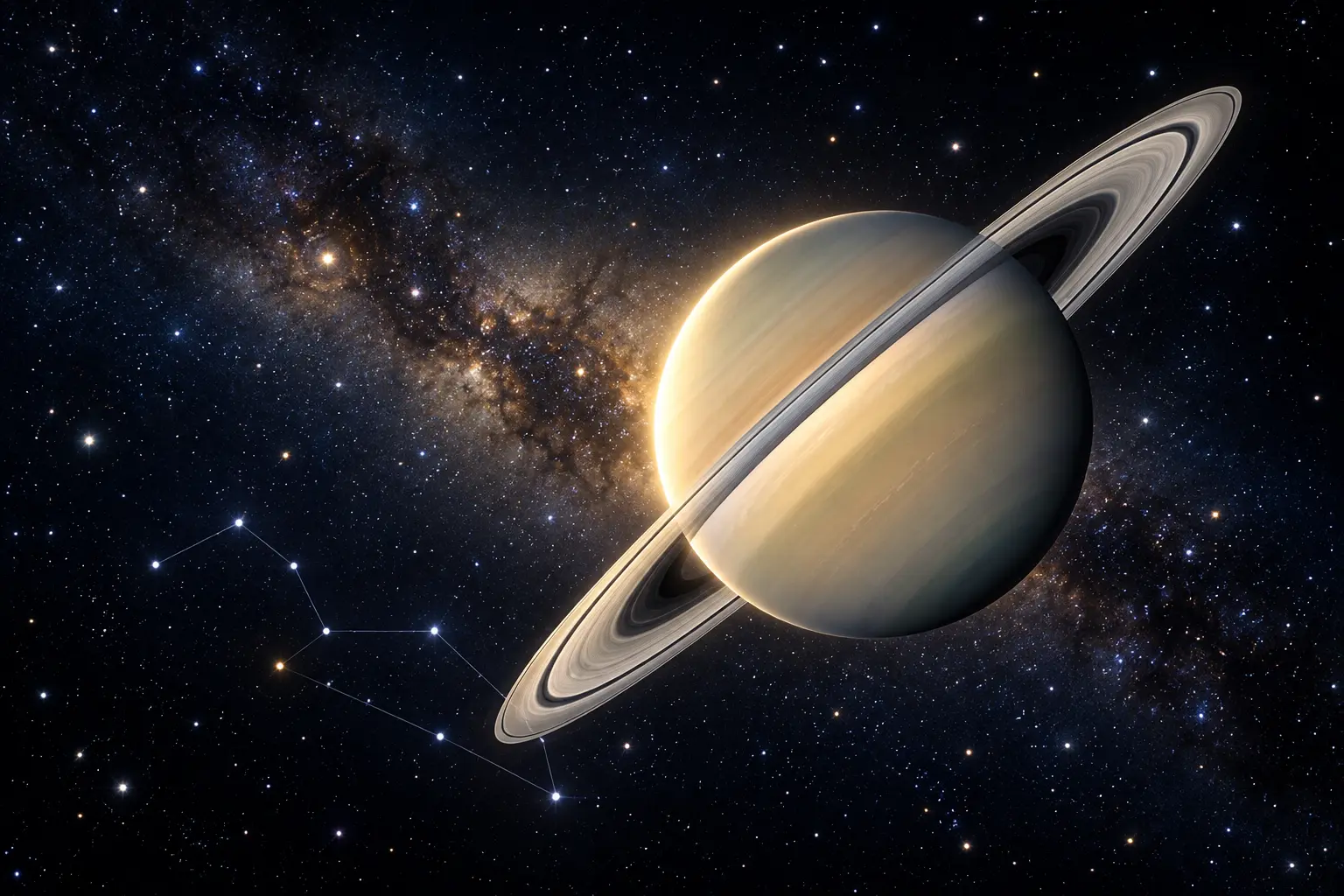
The Rings Are Back, but Only Just
Earth last passed through Saturn’s ring plane in March 2025, an event that comes every 13 to 15 years. The rings, a sheet of ice and dust, went edge-on and vanished in small telescopes. They have been opening again, and October 2026 is the first opposition of that new tilt. We are looking at the southern face, at 7.5 degrees south of edge-on.
That angle is enough to split the rings from the globe. It is not the wide, postcard oval people remember from the last maximum. Saturn’s axis leans 26.73 degrees, similar to Earth’s 23.5-degree tilt, so the ring opening follows Saturn’s seasons. A 7.5-degree slice is a start, not the full show.
The geometry is the joke of this opposition. The planet is as close and as bright as 2026 allows, yet the feature everyone points a telescope at is still a thin gold line. Regular observers who watched the rings collapse through 2024 and 2025 will see a real change. First-time viewers expecting a dinner-plate halo will get a sliver.
How to Find Saturn Under Pegasus
From Britain on the evening of October 5, Saturn is already well clear of the east-southeast horizon by 21:00 BST and keeps climbing as the night goes on. It lies in Cetus, near that constellation’s border with Pisces, under the Great Square of Pegasus. Around midnight it stands in the south. Fomalhaut, the bright star in Piscis Austrinus, sits farther down toward the horizon and gives a second check.
A waning crescent Moon, 34 percent lit and 23 days old on October 4, leaves the sky dark enough that the planet is not competing with glare. Southern latitudes get a higher altitude and a cleaner view through less air. The same creamy point is visible from either hemisphere.
HOW TO PICK IT OUT
- After dusk: Face east-southeast and wait until the sky is fully dark.
- The Square: Find the four stars of the Great Square of Pegasus, then look below them.
- The colour: Saturn is a moderately bright, creamy-white point at magnitude 0.3, brighter than nearby stars.
- The test: Its light stays steady instead of twinkling, and it shifts slowly against those stars from night to night.
You do not need an app to finish that hunt. If the point is steady, pale gold, and sitting under Pegasus in the late evening, you have Saturn.
What a Small Telescope Shows This Week
Binoculars help with colour and turn the planet into a tiny oval. They do not detach the rings. Claims that a cheap pair will show the ring system oversell that view. The honest binocular prize is a flattened disk, sometimes with a hint of “ears” in very steady air.
Any small backyard telescope changes the object. The rings separate from the globe as a thin oval, and Titan appears as a steady yellowish point off to one side. On September 3, Virginia imager Steven Bellavia recorded Dione, Tethys and Rhea as well, so those inner moons are already within reach of amateur gear this apparition.
WHAT YOU SEE BY GEAR
- Naked eye: A creamy-white, non-twinkling point at magnitude 0.3 in Cetus.
- Binoculars: A small bright oval; the rings do not split cleanly from the disk.
- Small telescope: Rings clearly detached at a 7.5-degree tilt, plus Titan as a star-like companion.
Hold the magnification modest on a shaky night. The rings are narrow, so extra power only magnifies the shimmer. A firm tripod and a patient eye beat a huge eyepiece.
Ice Particles Hide Their Own Shadows
For a few hours around the exact moment of opposition, the rings can look brighter against the globe than they do a week either side. Ford’s notes call this the Seeliger effect. The rings are a sea of ice particles. At most times we see some grains lit and some sitting in the shadows of their neighbours. At opposition the Sun is almost directly behind us, so those shadows fall straight behind the grains and we see far fewer of them.
The planet itself does not jump in brightness to the naked eye. The surge lives in the eyepiece, and only for observers who already know how Saturn usually looks. That is why the effect matters more this year than the extra tenth of a magnitude on the globe. The rings are skinny, so a brief backscatter boost is the one extra trick October 4 actually sold.
The same ice sheet is absurdly thin for its width, which is why it vanished last year and why 7.5 degrees still looks like a line.
Saturn’s ring system extends up to 175,000 miles (282,000 kilometers) from the planet, yet the vertical height is typically about 30 feet (10 meters) in the main rings.
NASA Science, Saturn Facts
NASA’s figures put the Cassini Division, the dark gap between rings A and B, at 2,920 miles (4,700 km) wide. The agency’s typically about 30 feet thick main-ring height is the number that makes an edge-on crossing look like a disappearance. Goddard’s ring sheet lists the C, B and A ring thicknesses in the same few-metre range, from about 5 metres in C up to 10 to 30 metres in A.
A Southern Face After Last Year’s Vanishing Act
Saturn is 9 times wider than Earth, with an equatorial diameter of 74,897 miles (120,500 km), and sunlight takes 80 minutes to cross the 9.5 AU from the Sun. A day there lasts 10.7 hours. That has not changed. What has changed is which hemisphere we see, and how the rings sit on it.
As of March 2025, NASA counted 274 confirmed moons, more than any other planet, with Titan still the one a small telescope will actually show. The rings themselves are ice and rock, from dust grains to house-sized chunks, each ring moving at its own speed. After the March 2025 crossing, the southern face is the one catching sunlight for earthly viewers.
THE 2026 APPARITION
- July 26, 2026: Saturn enters retrograde motion and begins its slow westward drift against the stars.
- October 4, 2026: Opposition at 12:21 UTC, with the planet 8.43 AU out and the rings 7.5 degrees south.
- December 11, 2026: Retrograde ends; Saturn resumes its usual eastward crawl and remains an evening object for a while longer.
The window is generous because Saturn is far out. Distance and disk size barely budge from week to week compared with Mars. Miss October 4 to cloud and the next clear night still shows a magnitude 0.3 planet with the same thin southern rings.
Hubble Caught a New Wave at the South Pole
The hemisphere now tipping toward Earth is also the one under new scrutiny. Saturn’s north pole has long hosted a six-sided jet stream about 20,000 miles across, with 200-mile-per-hour winds and a rotating storm at its centre, first seen by Voyager and later by Cassini. For decades the south pole had no counterpart.
A Hubble study published in September 2026, built on observations dating back to 2023, found a ten-sided atmospheric wave encircling the south pole. NASA’s October sky note said the feature appears to be strengthening, a rare chance to watch a giant pattern take shape. Raquel Villanueva of the Jet Propulsion Laboratory walked through that result in the same briefing that flagged the October 4 opposition.
On opposition day the Hubble account put the geometry in one line.
Just passing through…
Today, Earth's orbit passes between the Sun and Saturn. That means Saturn is opposite the Sun in our sky, so it's at "opposition" – the perfect time to catch a glimpse of the ringed planet.
For more October skywatching tips: https://t.co/IJbLPf5zuY pic.twitter.com/QXZFyLdrfN
— Hubble (@NASAHubble) October 4, 2026
That south polar wave is not visible in a backyard telescope. It is the scientific rhyme of this opposition: we are finally looking at the southern face again, and the spacecraft still watching Saturn from Earth orbit just found weather there that nobody had mapped as a regular-sided jet before.
After dark, the creamy point under Pegasus is still the thing to catch. A small telescope will turn it into a globe with a thin gold line. The line will widen in the years ahead. This week it is narrow, bright, and as close as 2026 will put it.

Clay Moulds From the Blyth Hoard Fit Peebles Fittings

Treasury Yields Hit a 24-Year High as AI Joins the Queue

Crew-12 Leaves the ISS With Fedyaev and Adenot Aboard

The Graziers Recall Puts the 60-Day Cheese Rule on Trial

Hugo Chavez’s Hollywood Welcome Meets a Film About Escape

Sons of Behemat Add a Witch and a Middle Rank

Canada Still Clears Mazatlán as the Cartel War Arrives

The FTC Suit That Targets Amazon’s Hidden Ad Floor

Samsung Leads Mistral’s Record European Sovereignty Round

Women, Gym, and Affairs: A Complex Intersection
-
 GAMING1 month ago
Sons of Behemat Add a Witch and a Middle Rank
-
 NEWS2 years ago
Canada Still Clears Mazatlán as the Cartel War Arrives
-
 BUSINESS1 month ago
The FTC Suit That Targets Amazon’s Hidden Ad Floor
-
 NEWS1 month ago
Samsung Leads Mistral’s Record European Sovereignty Round
-
 LIFESTYLE2 years ago
Women, Gym, and Affairs: A Complex Intersection
-

 AUTO2 years ago
Laepple Automotive Bets on a Vacant Detroit Die Shop
-

 AUTO2 years ago
Tamil Nadu Auto Keeps Growing Inside a Climate Red Zone
-

 LIFESTYLE2 years ago
The Unstoppable Rise of Hot Honey: Are Food Trends Making UK Restaurant Menus All the Same?