
NEWS
NASA Splits Its Moon Base Hunt Between Ice and a Cave
NASA picked three PRISM payloads for Moon Base, sending a cave hunt to Marius Hills while ice and hazard tools aim at the south pole.

NASA selected three Moon-bound instrument suites on Sept. 30, 2026, to scout ice, quakes and a possible cave for Moon Base.
The suites were chosen through the agency’s PRISM program and will ride under the Commercial Lunar Payload Services initiative, with two aimed at the south pole and the third at a hole on the near side.
Three Payloads Aimed at Two Places
NASA’s Science Mission Directorate named the three new scientific investigations in release 26-080 and corrected the GIMLI and DISCO full names on Oct. 2. The packages are meant to map resources, look for natural shelters, and score surface hazards before crews try to stay.
Nicky Fox, associate administrator of the Science Mission Directorate, cast the work as homework for people who have to last through lunar night.
NASA Science is building the ultimate interplanetary survival guide to ensure that science goes first to the lunar surface to provide our future astronaut crews with the vital information, resources, and safety precautions needed ahead of time to survive the night on the Moon
Nicky Fox, associate administrator, NASA Science Mission Directorate
Brad Bailey, who directs the Exploration Science Strategy Integration Office, said each new PRISM pick strengthens the agency’s ability to put science on the surface as Artemis and Moon Base move from talk to hardware.
THE THREE PRISM SUITES
| Payload | Principal investigator | Target | Job |
|---|---|---|---|
| LEMS-SP | Mehdi Benna, University of Maryland, Baltimore County | South Pole | Long-term watch on micrometeoroids, gases and quakes |
| GIMLI | Nathaniel Putzig, Planetary Science Institute | Marius Hills Pit | Hunt for a lava tube that could serve as a shelter |
| DISCO | Ariel Deutsch, NASA Ames Research Center | Polar micro-cold traps | First ground measurements of hidden ice, plus plume and traffic tests |
Two of those boxes belong with the outpost NASA already draws at the south pole. The third belongs to a volcanic hole far from that ice.
NASA has selected three new science investigations through its PRISM program to prepare for humanity’s first lunar outpost, @NASAMoonBase.
From monitoring hazards to finding natural shelters and mapping water ice, take a look at the science paving the way for lunar exploration:… pic.twitter.com/rzOR0QjAoy
— NASA Science (@NASAScience_) September 30, 2026
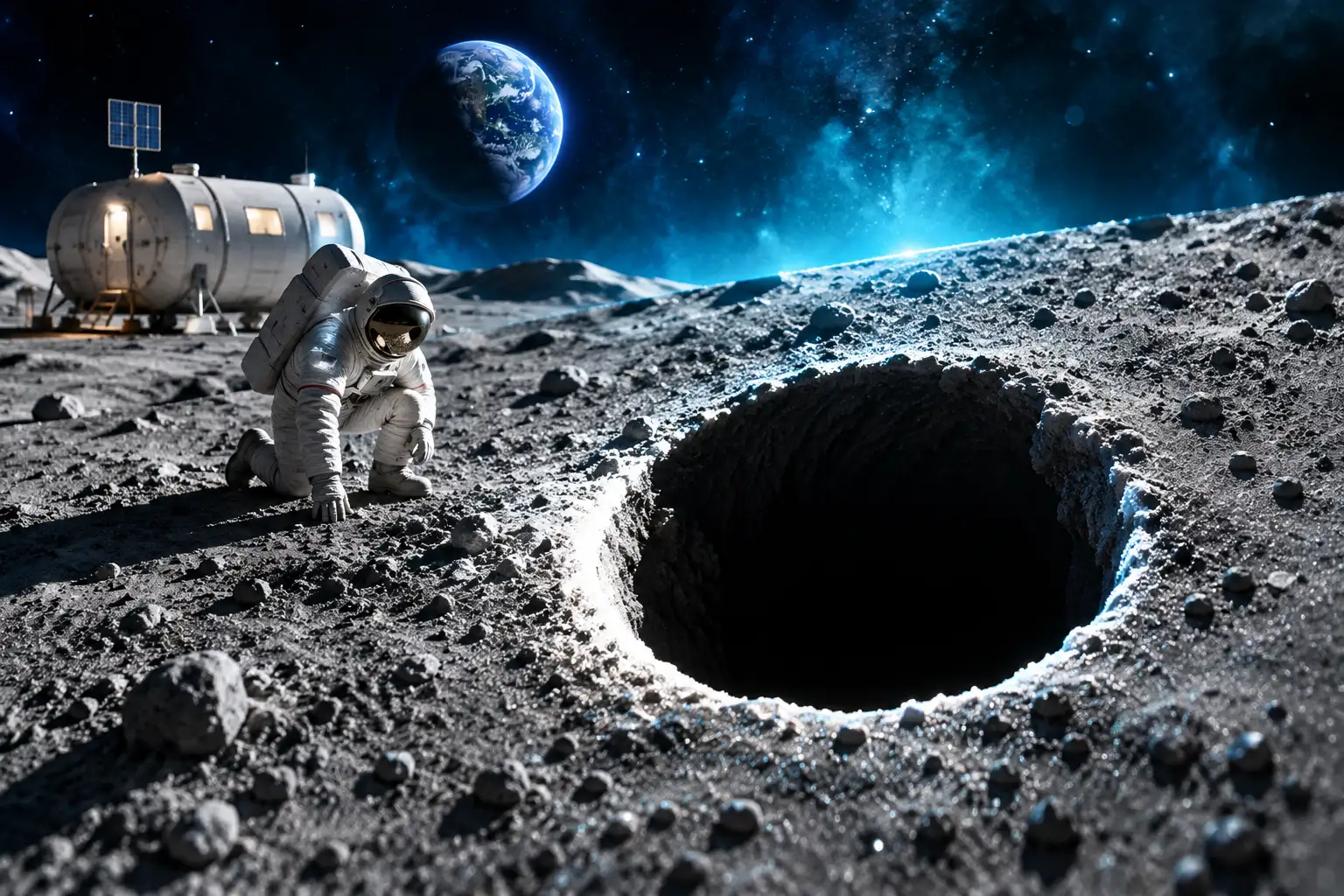
The Shelter Sits Far From the Water
NASA’s own artwork for the announcement shows habitats, rovers and cargo near the lunar south pole. That is also where LEMS-SP will sit, and it is where DISCO is supposed to weigh ice that crews might later turn into water, air or fuel.
GIMLI goes somewhere else. The Marius Hills Pit lies in an old volcanic field on the near side, among sinuous rilles in the region of Oceanus Procellarum. A Japanese SELENE team led by Junichi Haruyama spotted the hole from orbit. Later Lunar Reconnaissance Orbiter frames showed a collapse that looks like a skylight in a buried tube.
If that tube is real and empty, rock overhead could block radiation and micrometeoroids and keep the airless interior far steadier than the boiling-and-freezing surface. NASA said confirming such voids now could shift habitat planning toward ready made shelters. That sentence is doing a lot of work, because the shelter under study is not under the polar camp.
A lava tube at Marius Hills would not roof a south pole station. Polar ice, if it is there in useful amounts, also would not fill a mid-latitude cave. The agency is paying to test both ideas at once, on different ground, and a yes on either one does not settle the other.
Orbital hints already lean one way at this pit. SELENE radar echoes paired with GRAIL gravity data in 2017 pointed to a mass deficit stretching about 60 kilometers west of the hole. That is still an inference from altitude. GIMLI is the first funded attempt to check it with tools on the dirt.
How GIMLI Will Probe the Marius Hills Pit
LROC’s later, high-Sun frames put the opening at 58 by 49 meters across and 40 meters deep. The pit sits in the middle of a rille, which is why geologists have treated it as a collapsed tube roof, maybe punched by an impact, rather than a random crater.
Putzig, a senior scientist and associate director at the Planetary Science Institute, is sending a mixed kit instead of a single camera stare into the dark. PSI is partnering with Honeybee Robotics, a Blue Origin company, on a lander and a rover supplied through CLPS. The Norwegian Space Agency will furnish the ground-penetrating radar.
GIMLI’S FOUR LOOKS UNDERGROUND
- Ground-penetrating radar: Reflections pick out buried boundaries and any void that runs away from the pit.
- Active-source seismic gear: The team will make the ground ring on purpose and time how the waves travel, a method idle on the Moon since Apollo crews last did it.
- A gravimeter: Empty space holds less mass than rock, so a gravity dip along the rim would argue for a cavity.
- Cameras: They will shoot the surface and the exposed walls, which stack lava flows and soil that usually stay buried.
Putzig has wanted that seismic piece back in planetary work for a long time. “It’s long been a desire of mine to reintroduce intentional active-source seismic methods to planetary science, as it has essentially not been done since the Apollo astronauts conducted the first seismic surveys on the Moon,” he said. Radar and gravity ride along so a single noisy method cannot carry the claim.
A blank result would still be a result. Gareth Morgan, a PSI senior scientist and deputy principal investigator, has said a confirmed tube would show how lunar volcanism actually moved. The walls would still record eruption gaps even if the pit is only a pit. Amanda Hendrix, PSI’s director and chief executive, called the project the sort of question the institute has been circling from orbit and can now take to the ground.
DISCO Targets Ice in Tiny Shadows
Ariel Deutsch’s Depth Imager with Spectral and Color Optics is the polar half of the resource bet. DISCO is supposed to make the first direct, on-the-ground measurements of ice hidden in micro-cold traps, the small patches that stay cold enough for ice to last even when they are not famous craters of permanent night.
Those traps matter because a crew can reach a one-meter shadow more easily than the floor of a huge polar crater. They also fail more easily. Shallow ice is easier to lose, so a ground reading beats another orbital maybe. Deutsch’s suite will try to say where the ice is and how much of it is there, which is the difference between a poster and a mining plan.
DISCO has a second job that only shows up once landers start repeating the same neighborhood. It will watch how rocket exhaust tears at the soil and how stable that soil is for driving. A south pole camp that sees regular traffic will throw grit, change the surface, and maybe move the very ice it came for. The payload is as much a construction survey as a science camera.
NASA’s line is blunt: the data should help crews work safely and help engineers turn ice into a usable resource for Moon Base. That conversion is still a future machine. DISCO is the scale and the map, not the plant.
A Hazard Station for the Polar Camp
Mehdi Benna’s Lunar Environment Monitoring Station-South Pole is the insurance policy for the site NASA actually wants to occupy. LEMS-SP is designed as a self-running post that stays after the lander is done posing.
It will count falling micrometeoroids, track volatiles that drift into the Moon’s thin outer gas layer, and use a short period seismometer to catch moonquakes and other shaking. NASA says those records could supply the hazard scores that keep Moon Base hardware intact. In plainer terms, the station is there to tell engineers how often the sky and the ground will hit whatever they bolt down.
Benna’s box does not look for a cave and it does not weigh ice. It assumes people and machines will live on the polar surface, through nights that last for days of Earth time, and it tries to price that choice. If GIMLI’s tube is real, LEMS-SP still has to do this job, because the polar camp and the near-side hole are not the same address.
What CLPS Still Has to Prove
PRISM is how the Science Mission Directorate buys science-driven suites of instruments and puts them on commercial landers. The cadence NASA wants is more lunar flights, with American companies hauling science, exploration gear and tech to the surface and into orbit. These three suites join that line. They do not yet have a ride on the calendar.
GIMLI needs both a lander and a rover, which is a heavier ask than a single deck box. Honeybee Robotics will handle much of the build, including the active seismic system, the gravimeter and the cameras, and will help run the instruments after touchdown. Until NASA issues a CLPS task order, none of that hardware has a launch vehicle, a landing ellipse or a date.
WHAT WE KNOW
- The selection: NASA has funded LEMS-SP, GIMLI and DISCO as PRISM suites for Moon Base.
- The leads: Benna, Putzig and Deutsch are the named principal investigators, at UMBC, PSI and Ames.
- The split: GIMLI is bound for the Marius Hills Pit; LEMS-SP is a south pole station; DISCO goes after polar micro-cold traps and landing blast.
- The GIMLI partners: Honeybee Robotics builds major pieces; the Norwegian Space Agency provides the radar; a rover is in the plan.
WHAT IS UNCONFIRMED
- The ride: No CLPS vendor, lander model or launch date has been assigned to any of the three.
- The cave: No surface measurement has yet shown that the Marius Hills Pit opens into a large tube.
- The ice: DISCO has not flown, so the amount and usefulness of ice in micro-cold traps remain an orbital argument.
Commercial lunar deliveries have already shown that getting a box to the surface is the first hard problem, not a paperwork step. These instruments only change habitat plans if they land, run through the night, and send back numbers. Until then, NASA has bought the right questions.
If GIMLI finds a tube, the agency will still have to decide whether a mid-latitude cave is worth a second camp, far from the polar ice DISCO is being sent to weigh.
Frequently Asked Questions
What Is NASA’s PRISM Program?
PRISM, or Payloads and Research Investigations on the Surface of the Moon, is the Science Mission Directorate’s main call for principal-investigator suites that fly on CLPS landers to high-value spots. Earlier selections went after the Reiner Gamma swirl, Schrödinger basin on the far side, the Gruithuisen Domes and a south polar region, so the new Moon Base trio sits on top of a list that already mixes geology, seismology and biology rather than starting from zero.
What Is a Micro-Cold Trap on the Moon?
It is a small patch of lasting shadow, down to about 1 centimeter across, cold enough that water ice can survive. A 2020 Nature Astronomy paper on micro cold traps on the Moon put the total cold-trap area at about 40,000 square kilometers, found that 10-20 percent of that area sits in these tiny shadows, and said about 60 percent of the whole lies in the south, which is why a polar imager like DISCO can chase ice without lowering itself into a giant crater.
Why Would a Lava Tube Help a Lunar Crew?
Tube interiors are shielded by rock from cosmic rays, meteoroid hits and the swing between lunar day and night, and they stay at a more constant temperature, the way caves do on Earth. That is the protection NASA named in the GIMLI write-up: thermal stability plus a barrier against ionizing radiation and micrometeoroid bombardment, without having to haul an equivalent roof from Earth.
Who Is Building Hardware for the GIMLI Payload?
Honeybee Robotics is PSI’s commercial partner for project management and for the active-source seismic system, gravimeter and cameras, and it will help integrate those tools on the lander and rover. Co-investigators come from Boise State University, Johns Hopkins University, the Lunar and Planetary Institute and the University of Oslo, with Norway’s space agency on the radar, so the pit survey is already an international bench even before a U.S. lander company is named.

Clay Moulds From the Blyth Hoard Fit Peebles Fittings

Treasury Yields Hit a 24-Year High as AI Joins the Queue

Crew-12 Leaves the ISS With Fedyaev and Adenot Aboard

The Graziers Recall Puts the 60-Day Cheese Rule on Trial

Hugo Chavez’s Hollywood Welcome Meets a Film About Escape

Sons of Behemat Add a Witch and a Middle Rank

Canada Still Clears Mazatlán as the Cartel War Arrives

The FTC Suit That Targets Amazon’s Hidden Ad Floor

Samsung Leads Mistral’s Record European Sovereignty Round

The Unstoppable Rise of Hot Honey: Are Food Trends Making UK Restaurant Menus All the Same?
-
 GAMING1 month ago
Sons of Behemat Add a Witch and a Middle Rank
-
 NEWS2 years ago
Canada Still Clears Mazatlán as the Cartel War Arrives
-
 BUSINESS1 month ago
The FTC Suit That Targets Amazon’s Hidden Ad Floor
-
 NEWS1 month ago
Samsung Leads Mistral’s Record European Sovereignty Round
-
 LIFESTYLE2 years ago
The Unstoppable Rise of Hot Honey: Are Food Trends Making UK Restaurant Menus All the Same?
-

 LIFESTYLE2 years ago
Women, Gym, and Affairs: A Complex Intersection
-

 AUTO2 years ago
Laepple Automotive Bets on a Vacant Detroit Die Shop
-

 AUTO2 years ago
Tamil Nadu Auto Keeps Growing Inside a Climate Red Zone