
LIFESTYLE
The Graziers Recall Puts the 60-Day Cheese Rule on Trial
Sierra Nevada recalled all Graziers raw milk cheese after E. coli O26 hospitalized eight people, three with kidney failure, under a 1949 aging rule.

Sierra Nevada Cheese Company recalled every Graziers raw milk cheese on September 24, 2026, after E. coli O26:H11 hospitalized eight people, three with kidney failure. The Centers for Disease Control and Prevention has counted 13 illnesses in nine states, with a median age of 5, and the investigation is still open.
The cheeses met the federal aging rule that lets raw milk cheddar cross state lines. Investigators still cannot name a lot, and leftover bricks have a long shelf life.
Median Age 5, and Three Cases of Kidney Failure
CDC’s snapshot is blunt for a specialty cheese sold in ordinary stores. Over half of the sick people are children 5 years old and younger. Ages run from 1 to 58. Sixty-two percent of the 13 patients are female.
Eight people were hospitalized, 62 percent of those with information available. Three developed hemolytic uremic syndrome (HUS), a form of kidney failure that can follow a Shiga toxin-producing E. coli infection. No deaths have been reported.
13 confirmed illnesses is the official floor, not a ceiling. CDC says the true number is likely much higher because many people recover without a stool test, and it can take three to four weeks to tie a sick person to a larger outbreak.
THE OUTBREAK COUNT
- Illnesses: 13 people in California, Colorado, Georgia, Kentucky, Michigan, Nevada, Oregon, Tennessee, and Utah.
- Hospital care: 8 people admitted; 3 of them developed HUS.
- Onset window: July 7, 2026, through August 26, 2026, with the last known illness starting on August 26.
- Who ate it: All 9 people interviewed, 100 percent, reported eating Graziers raw milk cheese, against 4.9 percent in CDC’s FoodNet Population Survey.
California and Nevada each have three cases. The other seven states have one apiece. Whole genome sequencing shows the bacteria from patients are closely related, which is how investigators treat a shared food source.
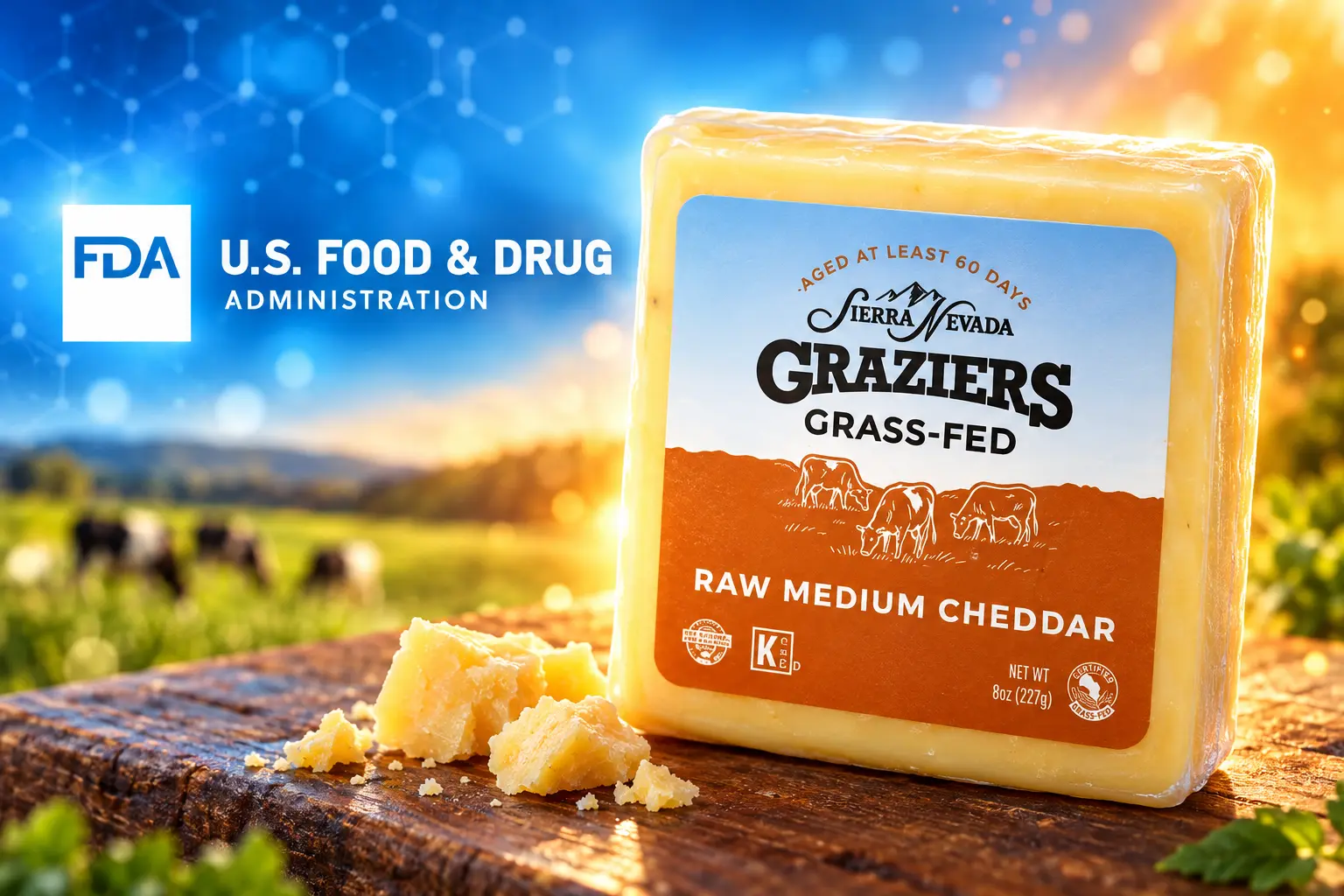
Sierra Nevada Recalled Every Graziers Raw Milk Cheese
The Food and Drug Administration’s outbreak page still lists 13 illnesses and three HUS cases, with nationwide distribution and no store list. Illnesses have been tied to Graziers Raw Milk Medium Cheddar. The firm pulled the other raw milk flavors anyway, plus the big loaves that delis cut and rewrap.
Retail packs are 8-ounce squares and a 16-ounce medium cheddar brick. Food service and wholesale customers also received 5-pound loaves and 40-pound cheddar blocks. If a store cut those loaves and sold slices under its own label, FDA says that cheese should come off the counter too.
THE RECALLED GRAZIERS PACKAGES
| Product | Package | UPC or item |
|---|---|---|
| Graziers Raw Milk Monterey Jack | 8-oz square | 6-87652-16400-9 |
| Graziers Raw Milk Jalapeño Jack | 8-oz square | 6-87652-16403-0 |
| Graziers Raw Milk Medium Cheddar | 8-oz square | 6-87652-16506-8 |
| Graziers Raw Milk Sharp Cheddar | 8-oz square | 6-87652-16507-5 |
| Graziers Raw Milk Medium Cheddar | 16-oz brick | 6-87652-16501-3 |
| Graziers Raw Milk Monterey Jack | 5-lb loaf | Item 6425 |
| Graziers Raw Milk Jalapeño Jack | 5-lb loaf | Item 6426 |
| Graziers Raw Milk Medium Cheddar | 5-lb loaf | Item 6510 |
| Graziers Raw Milk Sharp Cheddar | 5-lb loaf | Item 6511 |
| Graziers Raw Milk Cheddar block | 40-lb block | Items 6515 and 6516 |
Sierra Nevada Cheese Company of Willows, California, told customers to return the cheese for a refund or throw it out. Questions go to (530) 934-8662 on weekdays, or recallinfo@sierranevadacheese.com.
Why the Company Could Not Name a Lot
Investigators tied the illnesses to Graziers Raw Milk Medium Cheddar but could not identify a lot, date code, or production date, so the company recalled every Graziers raw milk cheese still in distribution, including sharp cheddar, jalapeño jack, Monterey jack, 5-pound loaves, and 40-pound cheddar blocks sold to food service. There is no code on a label that clears a package.
FDA contacted the firm on September 24, 2026, and recommended a recall. Sierra Nevada Cheese Company agreed that same day, stopped production and shipment of all Graziers raw milk cheese, and notified customers who had bought it directly. The written company notice is dated September 28. FDA posted it on September 29.
That is 79 days after the first illness began on July 7. CDC has said a lag of three to four weeks is typical when labs match a patient to an outbreak. A hard cheese with a long shelf life stretches the problem, because a brick bought in July can still be in a fridge in October.
THE INVESTIGATION CLOCK
- July 7, 2026: First known illness begins.
- August 26, 2026: Last known illness begins.
- September 24, 2026: FDA notifies Sierra Nevada Cheese Company and the firm starts the recall.
- September 25, 2026: CDC and FDA post the outbreak, still the agencies’ current public update into early October.
- September 29, 2026: FDA publishes the full company recall notice with UPCs and the 40-pound blocks.
FDA says it is still trying to find the source of contamination and whether any other products are involved. No product test result has been posted on the outbreak page.
At this time, the investigation has not been narrowed to a specific lot, date code, or production date. Therefore, out of an abundance of caution, Sierra Nevada Cheese Company is recalling all the Graziers Raw Milk Cheese products listed below currently in distribution.
Sierra Nevada Cheese Company, recall notice posted by FDA
Online argument jumped straight to raw-milk politics. These bricks were already legal aged cheddar in retail coolers, which is a different problem than a farm-gate milk jug.
Cheddar Law Still Treats 60 Days as Enough
Raw milk is milk that has not been heated to kill bacteria. Federal cheddar identity rules still allow that milk if the cheese is at least 60 days at 35 °F. The line in 21 CFR 133.113 dates to a 1949 bet that acid, salt, and time would finish the job pasteurization would have done.
FDA’s own sampling later undercut that bet. In a July 21, 2016, summary of a 2014 through 2016 assignment, the agency wrote that evidence already indicated 60 days may not eliminate the bacteria.
Evidence indicates that aging raw milk cheese for 60 days may not eliminate or adequately reduce E. coli O157:H7 and Salmonella in raw milk cheese, thus posing a potential hazard to consumers.
U.S. Food and Drug Administration, Summary Report: Raw Milk Cheese Aged 60 Days, July 21, 2016
FDA collected 1,606 samples of raw milk cheese aged 60 days, 473 of them domestic (29 percent) and 1,133 imported (71 percent). Each named pathogen came in under 1 percent. Generic E. coli, a marker of dirty processing, turned up in 87 samples, 5.4 percent. The report also cited a 2012 CDC paper that counted 27 foodborne outbreaks tied to raw milk cheese from 1993 to 2006.
This outbreak is E. coli O26:H11, a Shiga toxin-producing strain, not O157:H7. The aging rule does not name a serogroup, and it does not require a heat step. For a toddler, the distinction is academic. CDC tells families to choose pasteurized milk and dairy, and it flags children under 5 as more likely to get a severe foodborne illness.
The Same Willows Plant Already Failed a Listeria Test
This is the first outbreak CDC and FDA have hung on Sierra Nevada Cheese Company. It is not the first pathogen California pulled from the same Glenn County plant.
On August 27, 2025, State Veterinarian Dr. Annette Jones ordered a statewide recall of Bella Capra goat cheddar after the California Department of Food and Agriculture found Listeria monocytogenes in a routine sample collected August 14 at the manufacturing and packaging facility. The order covered 6-ounce squares of Sierra Nevada Bella Capra Goat Cheese, Raw Milk Goat Cheddar, lot 90423255, sell-by May 29, 2026. No illnesses were reported.
The company told retailers it had third-party tests that were negative before and after the state result, and that it was pulling the lot anyway. Thirteen months later, a different raw milk cheddar from the same Willows address is in a nine-state STEC outbreak, and the firm still cannot point to a production date.
Four Outbreaks in Cheese That Met the Rule
Graziers is the fourth U.S. raw milk cheese E. coli outbreak posted since February 2024. Twin Sisters Creamery in Ferndale, Washington, said its recalled wheels were aged at least 60 days, the same legal floor. Washington State Department of Health later counted 10 cases, nine in Washington and one in Oregon, and one hospitalization. Cheese samples tested positive for E. coli O103 and O26.
RAW MILK CHEESE E. COLI OUTBREAKS SINCE FEBRUARY 2024
| Cheese | Posted | Illnesses | Hospitalized | HUS |
|---|---|---|---|---|
| RAW FARM raw cheddar | February 2024 | 11 | 5 | 2 |
| Twin Sisters aged raw milk cheese | October 2025 | 10 | 1 | not listed |
| RAW FARM raw cheddar | March 2026 | 9 | 3 | 1 |
| Graziers raw milk cheeses | September 2026 | 13 | 8 | 3 |
Those four outbreaks add to 43 confirmed illnesses and 17 hospitalizations in 31 months. Six HUS cases were counted in the RAW FARM and Graziers outbreaks alone. Twin Sisters’ notice does not list HUS.
The Graziers hospitalization rate sits well above the other three. Three kidney-failure cases in a 13-person cluster is also high for a non-O157 STEC, and CDC has not said which toxin genes this O26:H11 strain carries.
Leftover Cheese Is Still in Home Fridges
FDA’s public update was still dated September 25 heading into October, with the same 13 illnesses and the same open status. Hawaii’s Department of Health warned residents on October 2 that the cheese had reached retailers including Down to Earth, and that no illnesses had been reported in Hawaii. Other state health desks kept repeating the same fridge check days later, which is what a long-shelf-life recall looks like when lots cannot be narrowed.
Symptoms of STEC infection usually start a few days after the food, and FDA says they can take up to nine days. CDC lists severe stomach cramps, diarrhea that is often bloody, and vomiting. Call a doctor for bloody diarrhea, diarrhea lasting more than two days, a fever above 102°F, or signs of dehydration. HUS is the complication that puts small children in the hospital with kidney failure.
IF YOU BOUGHT GRAZIERS RAW MILK CHEESE
- Do not eat it: Throw it out or take it back for a refund, including frozen pieces.
- Unlabeled leftovers: If you rewrapped cheese and cannot tell whether it is Graziers, throw it away.
- Clean the path: Wash boards, knives, drawers, and containers with hot soapy water or run them through a dishwasher.
- Watch kids closely: Children under 5, older adults, and people with weak immune systems are the ones HUS hits hardest.
FDA still has not named how the cheese was contaminated, and CDC has not added a case since the August 26 onset. A 40-pound block that left Willows in midsummer can still be sliced in a deli case, which is why the recall covers every Graziers raw milk cheese and not a handful of codes.
Disclaimer: This article is news reporting on a federal outbreak investigation and a company recall. It is informational only and is not medical advice, a diagnosis, or a guide to treating E. coli infection or hemolytic uremic syndrome. Anyone who ate recalled Graziers cheese and has symptoms, and anyone making decisions for a child, should contact a licensed physician or other qualified clinician. Illness counts, product lists, and investigation status reflect FDA, CDC, and state notices available on October 7, 2026, and those figures can change as more patients are confirmed or more lots are tested.

Clay Moulds From the Blyth Hoard Fit Peebles Fittings

Treasury Yields Hit a 24-Year High as AI Joins the Queue

Crew-12 Leaves the ISS With Fedyaev and Adenot Aboard

The Graziers Recall Puts the 60-Day Cheese Rule on Trial

Hugo Chavez’s Hollywood Welcome Meets a Film About Escape

Sons of Behemat Add a Witch and a Middle Rank

Canada Still Clears Mazatlán as the Cartel War Arrives

The FTC Suit That Targets Amazon’s Hidden Ad Floor

Samsung Leads Mistral’s Record European Sovereignty Round

Women, Gym, and Affairs: A Complex Intersection
-
 GAMING1 month ago
Sons of Behemat Add a Witch and a Middle Rank
-
 NEWS2 years ago
Canada Still Clears Mazatlán as the Cartel War Arrives
-
 BUSINESS1 month ago
The FTC Suit That Targets Amazon’s Hidden Ad Floor
-
 NEWS1 month ago
Samsung Leads Mistral’s Record European Sovereignty Round
-
 LIFESTYLE2 years ago
Women, Gym, and Affairs: A Complex Intersection
-

 AUTO2 years ago
Laepple Automotive Bets on a Vacant Detroit Die Shop
-

 AUTO2 years ago
Tamil Nadu Auto Keeps Growing Inside a Climate Red Zone
-

 LIFESTYLE2 years ago
The Unstoppable Rise of Hot Honey: Are Food Trends Making UK Restaurant Menus All the Same?