
ENTERTAINMENT
Hugo Chavez’s Hollywood Welcome Meets a Film About Escape
Seventeen years after Hugo Chávez walked the Venice carpet, Escaping Venezuela premieres in New York with the people Hollywood’s favorite guest left behind.

Reason’s Escaping Venezuela has its world premiere October 13 at New York’s IFC Center, with Venezuelan entrepreneur Carlos Mora on the panel. He helped judges and journalists flee, then was jailed and tortured, while Hollywood rolled out a carpet for Hugo Chavez.
The film, directed by Reason executive editor Jim Epstein and narrated by Venezuelan journalist Germania Rodríguez Poleo, uses Mora’s ruined business as the thread through a national collapse. Co-producer César Báez said the point was to enter the life of an ordinary Venezuelan rather than rest the story on party leaders.
Carlos Mora Gets the New York Screen
Mora’s company was wrecked after Chavez imposed price controls, seized industries, and shut down critical media. He answered by running an escape line for dissident judges, journalists, and other people the state had marked.
The regime caught him. He was imprisoned in a military jail and tortured before he got out and took his family to the United States. Reason’s film follows that arc, then widens to blackouts, hunger, censorship, and the flight of 8 million people, about a quarter of the country.
Spanish-language posts around the trailer keep returning to the Mora family, not to Oliver Stone. That is the swap the New York night makes. The man Hollywood never cast is the one sitting on the IFC stage.
Báez has said Reason plans more screenings after New York and then a digital release. The magazine is already taking names at escapingvenezuela.reason.com for the streaming date.
What Escaping Venezuela Puts on Film
Escaping Venezuela opens on the U.S. raid that seized Nicolás Maduro, then rewinds through the decades that emptied the country. Epstein’s trailer, posted by ReasonTV on August 5, 2026, walks from Chavez’s election through street protests, empty shelves, and a nation that once took in migrants and then began exporting them.
The film’s own bill of particulars is blunt: price controls, nationalizations, a silenced press, then starvation, blackouts, political killings, and mass flight. Reason frames the picture as a warning for U.S. voters who hear Democratic Socialists of America-aligned candidates and have never watched those policies run a country.
IFC Center screening and panel details put Mora in the room with the people who made the film.
THE OCTOBER 13 NIGHT AT IFC
- The clock: Doors open at 6:00 p.m. and the screening starts at 6:30 p.m., with a panel after the credits.
- The stage: Epstein, narrator Germania Rodríguez Poleo, Mora, and Reason editor at large Nick Gillespie, who will moderate.
- The house: IFC Center, 323 Sixth Avenue, a 2-hour-30-minute in-person program, general admission $20.
- The warm-up: A preview screening at the Cato Institute on September 30 already ran in Washington, with a 7:15 p.m. discussion Epstein did not stream.
Cato’s extra voice that night was Jesús Armas, a former political prisoner tortured under Maduro, sitting with Poleo and Cato’s Ian Vásquez. The Village premiere is the public bow. Washington already saw the cut.
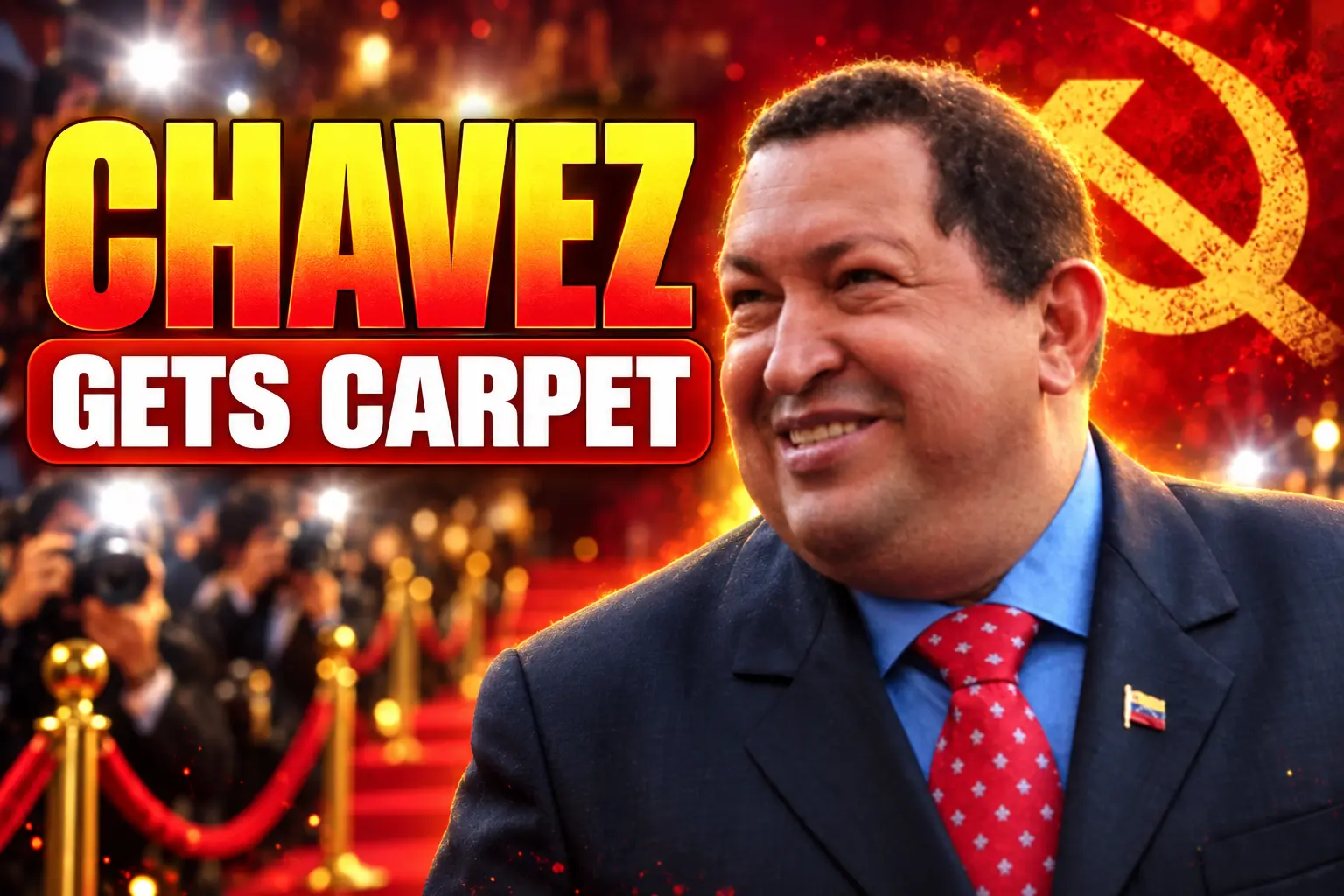
A President Walked the Venice Carpet in 2009
Seventeen years before Mora’s name goes on an IFC marquee, Chavez walked into the Sala Grande at the Venice Film Festival as the star of Stone’s South of the Border. Stone took the president’s hand and raised it in a victory grip after the house announcer skipped an official introduction.
Stone told buyers the Western press had drawn “an outrageous caricature” of Chavez and joked that the president was “a buddy movie star” with a Hollywood career waiting “after they remove him from the presidency.” He had started the project in January 2009 as a rebuttal to U.S. coverage, then turned it into a road movie through a string of left presidents.
Michael Moore got more than an hour with Chavez on the Lido. Moore later said Chavez was “happy to finally meet someone Bush hated more than him.” A New York Film Festival screening of the same film brought Chavez into Lincoln Center’s Walter Reade Theater with Evo Morales, where the Venezuelan president spotted Danny Glover in the room, embraced him, and kissed Susan Sarandon.
Sean Penn had been in the orbit since 2007. He stood with Chavez at an election rally in August 2012 and flew to a candlelight vigil in Bolivia that December, when the president was already dying of cancer.
He’s one of the most important forces we’ve had on this planet, and I’ll wish him nothing but that great strength he has shown over and over again. I do it in love, and I do it in gratitude.
Sean Penn, actor, candlelight vigil in Bolivia, December 2012
Chavez died on March 5, 2013, at 58. Penn’s statement said the United States had “lost a friend it never knew it had,” that “poor people around the world lost a champion,” and that “Venezuela and its revolution will endure under the proven leadership of Vice President Maduro.” Stone called Chavez “a great hero to the majority of his people.” In 2010 Penn had said people who called Chavez a dictator “should be jailed.”
Oil Money Bought a Movie That Never Played
Glover’s tie to Caracas was not only a hug on a festival aisle. In May 2007, Venezuela’s congressional finance commission approved $17.8 million for Toussaint, Glover’s planned directing debut on Haitian revolutionary Toussaint Louverture, with state studio Villa del Cine as partner. Villa del Cine itself had opened in 2006 as a $13 million government complex built to fight what Chavez called Hollywood’s cultural hold.
Venezuelan director Jose Novoa said that sum could have funded five years of local cinema. Glover later said U.S. and British producers asked him, “Where are the white heroes?” The film did not get made. A second Caracas-backed project, a Simón Bolívar picture drawn from Gabriel García Márquez, also stayed on the page.
In August 2013 Glover told La Nación Chavez “was not only my friend, he was my brother,” and that his vision “can only be compared to that of leaders like Nelson Mandela.” He said he cried when Chavez died. Hollywood got the toast. Venezuelan crews did not get the five years of production Novoa had counted.
FOUR GUESTS OF THE CHAVEZ YEARS
| Name | What they gave him | Where it landed |
|---|---|---|
| Oliver Stone | South of the Border at Venice, a raised-hand bow | A death statement calling Chavez a hero |
| Sean Penn | Friendship from 2007 through the Bolivia vigil | A pledge that Maduro would keep the revolution |
| Michael Moore | An hour on the Lido and a defense of the oil story | A tweet that 75% of extreme poverty was gone |
| Danny Glover | $17.8 million for Toussaint and the word “brother” | An unmade film and a Mandela comparison |
Those four men got access, footage, and, in Glover’s case, a state check. Mora got a military prison. The New York premiere is the first time that ledger shares a room.
The Poverty Claim Meets the Exodus
Moore’s line after Chavez died is still the cleanest version of the story Hollywood sold. He wrote that Chavez “declared the oil belonged 2 the ppl” and “used the oil $ 2 eliminate 75% of extreme poverty, provide free health & education 4 all.” Mark Weisbrot, who co-wrote South of the Border, had published a 2007 paper arguing poverty had already fallen hard during the oil boom. The boom did not hold.
Hugo Chavez declared the oil belonged 2 the ppl. He used the oil $ 2 eliminate 75% of extreme poverty, provide free health & education 4 all
— Michael Moore (@MMFlint) March 6, 2013
THE COLLAPSE AFTER THE BOOM
- Living standards: Research collected by the Economics Observatory found living standards fell 74 percent between 2013 and 2023, the fifth-largest drop in modern economic history.
- Output per person: The same work puts a 61 percent per capita contraction by the end of the 2010s, already among the worst peacetime collapses on record.
- The private sector: From 1999 the state took more than 1,000 firms and millions of hectares across farms, banks, cement, iron, oil, shops, and telecoms.
- The people who left: Reason’s film counts 8 million, about a quarter of the population. UNHCR still calls Venezuela the largest displacement situation in the Americas, with more than 7 million people inside the country in need of aid.
The 75 percent poverty cut and the later 74 percent fall in living standards are not the same ledger. One was a boom-year talking point. The other is what Mora’s generation walked out of.
Maduro Is Already in a Manhattan Jail
Penn’s 2013 bet on Maduro is now a court file in the same city as IFC. U.S. forces took Maduro and Cilia Flores from their Caracas compound on January 3, 2026. Gen. Dan Caine said units hit the compound at 2:01 a.m. local time and were “over the water” at 4:29 a.m. with the couple aboard. They went to New York on narco-trafficking charges. Maduro told a Manhattan judge, “I was captured,” and pleaded not guilty. The trial is set for 2027.
The film starts on that raid. Then it spends its running time on the years when a festival crowd still wanted Chavez in the front row.
FROM RCTV TO THE VILLAGE
- May 27, 2007: RCTV, Venezuela’s oldest private network after 53 years, goes dark at 23:59:59 and is replaced by state channel TVes. Human Rights Watch said the move threatened free speech.
- May 2007: The finance commission approves $17.8 million for Glover’s Toussaint.
- September 2009: Chavez and Stone take the Sala Grande for South of the Border.
- March 5, 2013: Chavez dies. Penn, Stone, Moore, and Glover publish their tributes.
- January 3, 2026: U.S. forces seize Maduro and fly him toward a New York dock.
- September 30, 2026: Cato screens Epstein’s cut in Washington.
- October 13, 2026: Mora walks into IFC Center as the face of the story.
The geography is tight on purpose. The man Hollywood said would carry the revolution sits in U.S. detention in New York. The man who ran an escape line takes questions in a Sixth Avenue theater.
Learn From Our Tragedy, She Tells New York
Poleo, who left the country she is now narrating, has been the film’s public voice in the days before the premiere. On October 5 she wrote that she and Epstein would stay after the IFC screening and asked New York to come anyway.
“Come learn from our tragedy, because it can happen anywhere,” Poleo wrote.
That is the ask on October 13. Not another festival bow for a head of state. A narrator, a director, and Carlos Mora, taking questions in a room Hollywood once reserved for Hugo Chavez.

Hugo Chavez’s Hollywood Welcome Meets a Film About Escape

Googlebooks Hit Shelves With Finished Hardware and a New OS

The NFL Hits Jed York With the 2014 Irsay Penalty

Run Hide Fight Infidels Hits the Paywall, Not Hollywood

Samsung Raises Galaxy S26 Prices After Its Phone Unit Goes Red

Sons of Behemat Add a Witch and a Middle Rank

Canada Still Clears Mazatlán as the Cartel War Arrives

The FTC Suit That Targets Amazon’s Hidden Ad Floor

Apple’s Foldable iPhone Event Revives the Fingerprint Button

Women, Gym, and Affairs: A Complex Intersection
-
 GAMING4 weeks ago
Sons of Behemat Add a Witch and a Middle Rank
-
 NEWS2 years ago
Canada Still Clears Mazatlán as the Cartel War Arrives
-
 BUSINESS1 month ago
The FTC Suit That Targets Amazon’s Hidden Ad Floor
-
 NEWS1 month ago
Apple’s Foldable iPhone Event Revives the Fingerprint Button
-
 LIFESTYLE2 years ago
Women, Gym, and Affairs: A Complex Intersection
-

 LIFESTYLE2 years ago
The Unstoppable Rise of Hot Honey: Are Food Trends Making UK Restaurant Menus All the Same?
-

 NEWS4 weeks ago
Samsung Leads Mistral’s Record European Sovereignty Round
-

 ENTERTAINMENT3 years ago
The Flying Monkeys in Wizard of Oz