
AUTO
10 Rarest Sleeper Cars of the ’90s: How the Counts Work
Rarest sleeper cars of the ’90s, ranked by full factory build counts, with the outside shop behind each car and the checks that stop a bad listing.

A sleeper from the 1990s looks like a car you would not turn to watch. The quick parts sit under a plain body, and a second company often fitted them because the main factory line was too narrow, too busy, or never laid out for that engine.
Rarity follows the full factory run of the fast version. It does not follow one model year, one gearbox, or the horsepower printed in an ad. The ten names guides keep repeating are all here, with the full count beside the smaller slice those guides quote.
You also get the shop that finished each car, and the paperwork worth asking for before a rare-car price leaves your account. A famous sedan can be a wonderful sleeper and still be the wrong car to call scarce.
Factory Sleepers and the Plain-Body Test
In the United States the word is sleeper. In Britain the same idea is a Q-car. Either way, the car has to do two jobs at once: keep up with much louder machinery, and pass for ordinary transport when it is parked.
A factory sleeper left the works that way. An owner can build a quiet fast car in a garage, and that car can be a blast, but it is a different object from a numbered run with a build card. This page stays with cars the factory, or a factory contractor, finished and sold.
Three checks sort a real one from a lookalike before you ever talk price.
- The body: It should pass for the ordinary model at a glance, even if the wings are a bit wider or the wheels are a size up.
- The engine: The fast motor, blower, or turbo setup was installed on the line, not swapped in years later.
- The count: The number you use is every fast version the factory built, across every year it offered that version.
Guides often fail the third check. They take the smallest year, or the manual cars only, and print that figure as if it were the whole model. The table further down puts both numbers in one place so you can see the gap.
Outside Shops Behind the Fast Versions
The parent company owned the badge. A smaller shop usually owned the hard part of the job. That split is why these runs stayed short, and why a badge on the trunk is a weak proof of what you are buying.
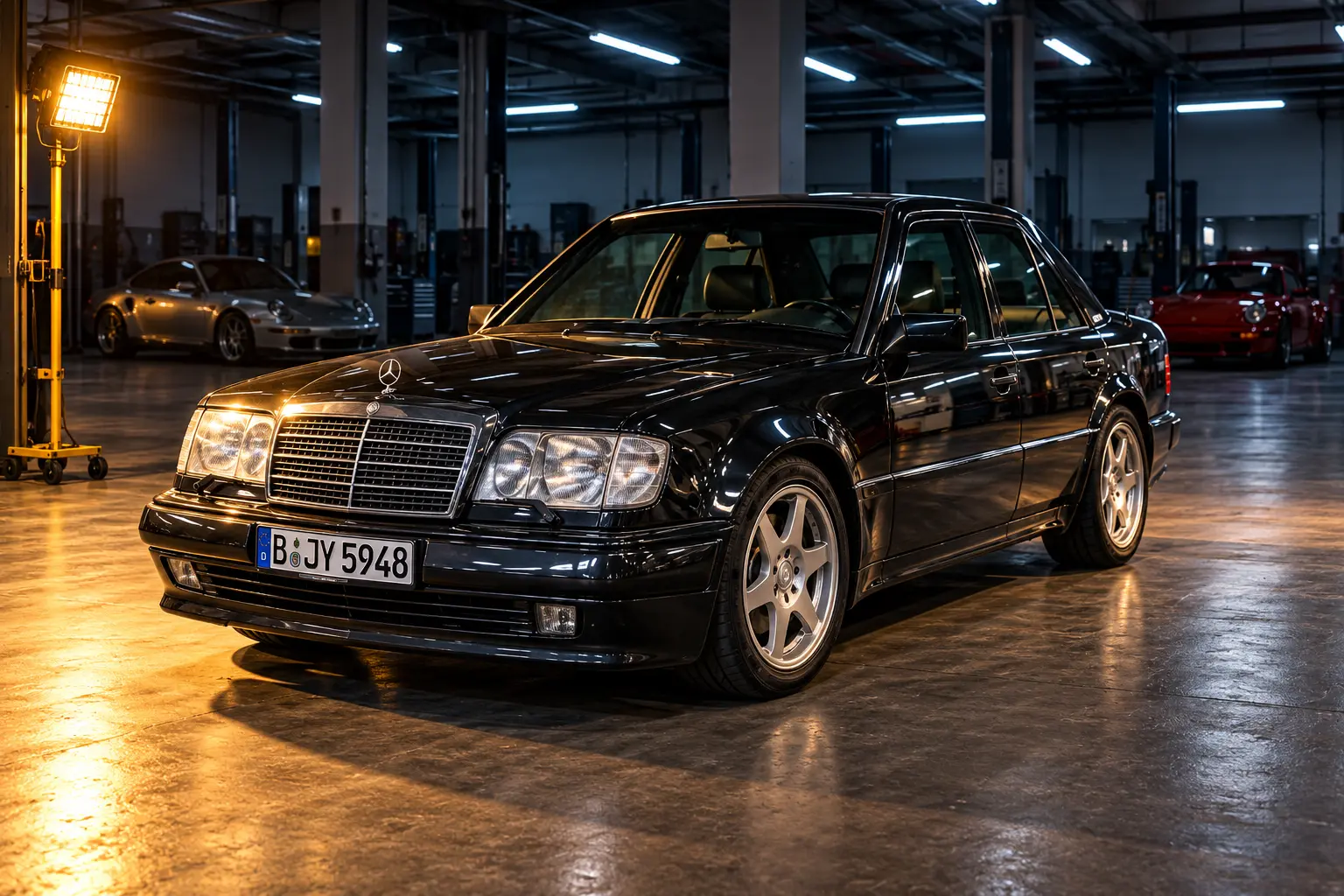
Daimler-Benz gave Porsche the 500 E in 1988 because the Sindelfingen line for the W124 could not take the wider body, and retooling it would not have paid. Porsche carried 90 percent of the development, under the working title Project 2758, and fitted the five-liter V8 from the 500 SL. The brief was a car that still looked like a W124 on first glance.
Plenty of power, but without being ostentatious, both dynamic and luxurious at the same time. The 500 E is not a showy vehicle. It represents pure understatement, and catches the eye only at second glance.
Michael Mönig, Prototype Management, Porsche Newsroom
Lotus did the same kind of work for General Motors on the Carlton and Omega, and engineered the cylinder head on the Dodge Spirit R/T. Yamaha finished the Taurus SHO V8 in Japan after Ford cast the blocks in Windsor, Ontario. Production Automotive Services in Troy, Michigan, built the GMC Syclone and Typhoon away from the main truck line. AMG, still an independent tuner in those years, offered the E60 package on the finished Mercedes.
When you shop one of these cars, you are shopping that contractor’s work as much as the badge on the grille. The build card, the option code, or the VIN character is how you prove the contractor touched that exact car.
Build Counts for the Rarest Sleeper Cars of the ’90s
Read the middle column as the count to use when someone calls the car rare. Read the last column as the smaller slice that shows up in roundups and in some ads. Both columns are real. They are not the same quantity.
| Car | Years | Count to use | Smaller slice people quote |
|---|---|---|---|
| Mercedes-Benz E60 AMG, option code 957 | On the 500 E and E 500 | 149 cars with that code | A 6.0-liter badge with no code |
| Lotus Carlton and Lotus Omega | 1990 to 1992 | About 950 | A single national market |
| Dodge Spirit R/T | 1991 to 1992 | 1,399 U.S. sales | 191 U.S. sales in 1992 |
| Oldsmobile Achieva SCX | 1992 to 1993 | 1,146 then 500 | 500, as if 1993 were the only year |
| Audi RS2 Avant | March 1994 to July 1995 | 2,891 | The early plan of 2,200 |
| GMC Syclone | 1991 to 1992 | 2,998 | The 1991 run alone |
| Mercury Cougar XR7 | 1990 model year | 823 manual, 3,333 automatic | The manual cars treated as every XR7 |
| GMC Typhoon | 1992 to 1993 | 4,697 | 2,200, which is the 1993 year only |
| Mercedes-Benz 500 E and E 500 | 1990 through April 1995 | 10,479 | Any one model year |
| Ford F-150 SVT Lightning | 1993 to 1995 | 11,563 | 2,280, the 1995 year only |
The Chevrolet Impala SS is a genuine sleeper and a bad entry on a rare list. Chevy sold 6,303 of them in 1994.
The next year moved 21,434 Impala SS cars. In 1996 that single model year was 41,941 cars, which puts the badge in a different world from a Lotus run.
The V8 Taurus SHO, built from 1996 through 1999, stays under 20,000 cars. That is uncommon next to a plain Taurus, and it is still not in the company of the Spirit R/T or the RS2. A one-year SHO figure in the low thousands is a slice of that V8 run, not a separate rarer car.
Mercedes-Benz 500 E Assembly in Two Cities
The 500 E bowed at the Paris show in 1990 and reached buyers in the spring of 1991. In the summer of 1993 a facelift renamed it the E 500. The mechanical idea did not change with the badge.
The shuttle between plants is set out in Porsche’s own history of the 500 E. Bodies did not stay in one factory.
- Mercedes-Benz sent body parts from Sindelfingen to the Reutter building in Zuffenhausen, where Porsche built the shell, including the wider front wings.
- Each shell went back to Sindelfingen for paint, then returned to the Rössle Bau for the engine, the gearbox, and final assembly.
- The loop took 18 days.
- Every car crossed between the two cities twice.
- Daily output began at 10 cars and later rose to 20.
The first 14 cars were converted by hand at Weissach. After those, the work moved into the prototype building, and then into the series line described above.
Porsche’s total, through April 1995, is 10,479 cars, and every one is a four-seater. The rear gear was so large that there was no room to mount a center rear seat. If a listing shows a three-person rear bench, it is not this car.
- Engine: The 5.0-liter V8 from the 500 SL, rated at 326 PS (240 kW) and 480 newton metres.
- Gearbox: A four-speed automatic was the only transmission.
- Pace: About 6.1 seconds from 0 to 100 km/h, depending on model year, with the top speed limited to 250 km/h.
- Body: 56 millimetres wider than a base W124, and 23 millimetres lower, with the battery moved to the right side of the trunk so the nose was not all engine.
Model years inside that 10,479 are not equal, which is where the tiny numbers come from. The registry of every 500 E lists 235 cars for 1990 and 83 cars for the 1995 E 500, with the busy years in between.
A 1995 car is scarce inside the family. It is still one of the 10,479, not a separate model that replaces that total. Pay for the year if you want the year, and do not let a seller quote the small year as the size of the whole project.
Mercedes-Benz E60 AMG and Option Code 957
The truly small Mercedes in this story is not the 500 E. It is the E60 package AMG fitted while it was still an outside firm. The factory marker is option code 957.
The same registry documents 149 cars carrying code 957. It also lists six further cars as E60 conversions that do not carry the code, which is why a 6.0-liter engine and an AMG plaque are not enough on their own.
Many cars advertised as E60s started as normal 500 E or E 500 sedans and gained a larger engine later. Those conversions can be quick and honest. They are not the 149-car package, and the price should say so. Ask for the build data that shows 957 before you treat the car as the factory article.
Lotus Carlton and Audi RS2 Avant Details
Lotus and GM built a four-door that could embarrass period supercars, then painted every one the same green. Audi and Porsche built a family wagon in the same Zuffenhausen neighborhood and started the RS line with it. Neither car was sold new through American dealers.
Lotus Carlton and Lotus Omega
Britain got the Vauxhall Carlton version. The rest of Europe got the Opel Omega version. Lotus’s own page on the Omega still lists the car as type 104, built from 1990 to 1992.
- Run: About 950 cars, one specification, one color called Imperial Green.
- Engine: The straight six grew to 3.6 liters with twin turbos, from a 204 bhp base motor to 377 bhp at 5,200 rpm and 419 lb-ft at 4,200 rpm.
- Gearbox and weight: A six-speed manual, and a listed weight of 1,655 kg.
- Speed: Lotus states a top speed of 283 km/h and says the car claimed the fastest-production-car title when it went on sale. Treat that title as Lotus’s claim, and treat 283 km/h as the figure the company still prints.
Another paint color means a later respray unless the paperwork shows otherwise. The green is not a styling option you could tick. It is how the cars left Hethel.
Audi RS2 Avant
Audi planned about 2,200 wagons and stopped at 2,891, built from March 1994 to July 1995. Of those, 180 were right-hand drive, for Britain, New Zealand, and South Africa. The United States was not on the list, nor were most markets outside Europe. A few cars also went to Hong Kong, Brazil, and the markets already named.
The motor is the turbo five-cylinder, rated at 315 PS and 410 newton metres, with a six-speed manual and quattro. Porsche assembled the cars at the Rössle Bau, the same Zuffenhausen hall that finished 500 E sedans, and the parts list shows it: brakes and wheels shared with Porsche models of the day, and a numbered plaque on the console.
WAGON, NOT A SEDAN SWAP
- Body: Every RS2 is an Avant. A sedan with RS2 badges is a different Audi.
- Plaque: The console plaque is a production sequence number, useful next to the paperwork, not a substitute for it.
- Market: An American car is an import. It was not delivered new by a U.S. Audi dealer.
The early plan of 2,200 is a real internal target. It is not the number of wagons that exist. Use 2,891 when you judge how often one should come up for sale.
Dodge Spirit R/T and Oldsmobile Achieva SCX
These two are the small American sedans and coupes that actually earn a rare label. Both wear ordinary compact clothes. Both depend on a code or a year, not on a wild body kit.
Dodge Spirit R/T
Dodge sold the Spirit as a plain midsize sedan and, for two years, a fast one. Every R/T was built in Mexico. The motor is a 2.2-liter turbo four with a 16-valve head engineered by Lotus, rated at 224 horsepower, and the only gearbox was a five-speed manual. Dodge advertised the car as the fastest sedan built in America.
U.S. sales were 1,208 in 1991 and 191 in 1992, which is the 1,399 in the table. The 1991 color split was 774 red and 434 white. In 1992 the split was 92 red, 68 white, and 31 silver, with a lower first gear, woodgrain on the dash, and a speedometer marked to 150 mph.
The whole Spirit line sold 97,242 cars in the United States in 1991, so the R/T was a speck on the dealer lot even when it was new. A 1992 car is the smaller year. A 1991 car is still an R/T, and it is not rare in the way 191 cars are rare. Say which year you are pricing.
Oldsmobile Achieva SCX
The SCX is the last of Oldsmobile’s W-machines, a coupe on the ordinary Achieva with the high-output Quad 4. Oldsmobile built 1,146 of them for 1992, when the W41 engine was rated at 190 horsepower. For 1993 the run was 500 cars, and emissions changes brought the rating down to 185 horsepower. Together the two years stay under 1,650 cars.
Eleven of those coupes are a step rarer still. Six cars in 1992 and five in 1993 carried the C41 code: no air conditioning, a baffled tank, and a calibration that let the engine spin higher. Those were aimed at race teams. A C41 car and a normal SCX with air conditioning are both factory SCX cars, and they are not the same listing.
The decals and the silver stripe are easy to copy. The RPO sticker in the trunk, near the spare, is the line that shows W41 and either C41 or C60. Read that sticker before you read the stripes.
Mercury Cougar XR7 and the Thunderbird Super Coupe
For 1990 the Cougar XR7 was the supercharged car in Mercury’s line, with a 3.8-liter V6 at 210 horsepower and 315 lb-ft, four-wheel discs, and anti-lock brakes. Marti production figures for that model year put the whole Cougar run at 81,240 cars. Inside it, the LS accounted for 77,084, the automatic XR7 for 3,333, and the manual XR7 for 823.
The five-speed was the standard XR7 gearbox. The automatic was the option, and buyers still ordered the automatic in far greater numbers. The uncommon car is the one that came as standard. If a seller points at an XR7 and says it is one of a few hundred, ask whether the car is one of the 823 manuals or one of the 3,333 automatics. This split is the 1990 model year, not a promise about every XR7 Mercury ever built.
The Ford Thunderbird Super Coupe of the same period used this blown 3.8 in a lower coupe on the related chassis. It is a sleeper in the same family. A manual Thunderbird is the car to separate from the automatics, and the seller still needs a build count rather than a nickname. No single manual-only total for the 1995 Thunderbird is solid enough to rank it above the cars in the table.
GMC Syclone, Typhoon, and the SVT Lightning
The truck sleepers won their reputation because a work shape is a better disguise than a sports coupe. They are also where one model year gets pasted over a three-year story.
GMC Syclone and GMC Typhoon
Both used a turbocharged 4.3-liter V6, all-wheel drive, and a four-speed automatic, and both were assembled by Production Automotive Services rather than on the ordinary GMC line. The Syclone is the Sonoma pickup. The Typhoon is the two-door Jimmy.
Syclone production was 2,995 trucks for 1991, plus three more booked as 1992, for 2,998. Typhoon production was 2,497 in 1992 and 2,200 in 1993, for 4,697. The 2,200 figure is a real year. It is not the Typhoon.
Published ratings for the Typhoon are 280 horsepower and 350 lb-ft. That is a lot of motor in a tall two-door, and it is also a truck you should expect to see more often than a Syclone. If an ad calls a Typhoon one of about 2,200, check the model year before you accept the sentence.
Ford F-150 SVT Lightning, 1993 to 1995
Ford’s Special Vehicle Team built the first Lightning on the regular-cab, two-wheel-drive F-150 with a 5.8-liter Windsor V8. The rating is 240 horsepower and 340 lb-ft, and published road figures put 0 to 60 mph at 7.6 seconds with a top speed of 110 mph. The letter R in the VIN is the factory mark. Badges on a normal F-150 do not make one of these trucks.
- 1993: 5,276 trucks, 2,691 black and 2,585 red, with no white that year.
- 1994: 4,007 trucks, 1,382 black, 1,165 red, and 1,460 white.
- 1995: 2,280 trucks, 824 black, 695 red, and 761 white.
Add the three years and the first-generation total is 11,563. The 1995 row is the one roundups lift out and treat as the rarity of the Lightning. It is the smallest year. It is a third of the story, not the story. Later Lightnings, from 1999 on, are a different and much larger generation and do not belong in this count.
How to Check a ’90s Sleeper Before You Pay
You now have a count for each famous name. The listing in front of you still has to match one row, one year, and one specification. Work through the car in this order.
- Write down which count the seller is using: one year, one gearbox, one option, or the full run. If they cannot say, you do not have a price yet.
- Match the gearbox to the row. A manual 1990 Cougar XR7 is the 823-car spec. An automatic from that year is one of 3,333. The Typhoon and the first Lightning left as four-speed automatics.
- On a Mercedes, read option code 957 before an E60 price. A larger engine with no code is a conversion, and a three-across rear seat is not a 500 E at all.
- On a Lightning, find the R in the VIN, then match the color to the year. White in 1993 is not a factory Lightning color.
- On a Spirit R/T, a 1992 U.S. car sits in the 191-sale year, and a 1991 U.S. car sits in the 1,208-sale year. On an Achieva, read the trunk sticker for W41 and for C41 or C60.
- On a Lotus, start with Imperial Green and the type. On an RS2, start with the Avant body and the console plaque, and remember it was not a U.S.-dealer car.
PAPERWORK THAT EARNS THE PRICE
- Build card: Option codes should match the fast version from the factory, not an engine that arrived ten years later.
- Gearbox: Manual and automatic runs are different sizes on the Cougar, and the sleeper trucks were automatics when new.
- Paint: A Lotus left in Imperial Green, so another color needs a documented respray.
- Seats: A real 500 E has four seats, with the battery in the right side of the trunk.
A clean test drive does not replace any line on that list. These cars are old enough that good ones and rebuilt ones can feel alike for a few miles. The paper is what ties the car in the photo to the row in the table.
Frequently Asked Questions
What Does Q-Car Mean?
In Britain a Q-car is a sleeper, a fast car dressed as an ordinary one. The name echoes naval Q-ships, warships fitted out to look like plain freighters. On a British ad for a Lotus Carlton you will see Q-car more often than sleeper, and the car is the same machine either way.
Were the Sleeper Trucks Sold With a Manual Gearbox?
The GMC Typhoon and the first Ford SVT Lightning came with a four-speed automatic. A manual box in one of those trucks was added later, and it does not move the truck into a smaller factory run. The manual that was rare from day one, on this list, is the five-speed 1990 Cougar XR7.
Can a Normal W124 Be Rebuilt Into a 500 E?
A standard W124 can take a V8 and a set of wider wings, and it will still sit outside the factory run. The real car was widened at the start of the build, carries its battery in the trunk, and has no center rear seat. A converted shell can be a good fast sedan. It is not one of the cars Porsche and Mercedes counted.
Which Rare Sleepers Were Never Sold New in the United States?
The Lotus Carlton, also badged Lotus Omega, and the Audi RS2 Avant were not sold new by American dealers. Imported cars show up now because the 25-year import rule has long since opened for early-1990s vehicles. The Spirit R/T, the Achieva SCX, the two GMCs, the Cougar XR7, the first Lightning, and the 500 E were sold new in the United States.
What Goes Wrong on a V8 Taurus SHO?
The 3.4-liter Yamaha V8 used from 1996 through 1999 can lose a camshaft sprocket. Yamaha attached that sprocket by swaging it to the cam, and the joint can let go. People who keep these cars have the sprockets pinned or welded before the valve timing slips, so ask for that receipt rather than trusting a quiet idle.
A 1990 500 E is one of 235 cars in that model year on the registry, inside a run of 10,479. The ad is only as rare as the paperwork that matches one of those two numbers, and the same test is the one to use on every other car above.

Clay Moulds From the Blyth Hoard Fit Peebles Fittings

Treasury Yields Hit a 24-Year High as AI Joins the Queue

Crew-12 Leaves the ISS With Fedyaev and Adenot Aboard

The Graziers Recall Puts the 60-Day Cheese Rule on Trial

Hugo Chavez’s Hollywood Welcome Meets a Film About Escape

Canada Still Clears Mazatlán as the Cartel War Arrives

Sons of Behemat Add a Witch and a Middle Rank

The FTC Suit That Targets Amazon’s Hidden Ad Floor

Samsung Leads Mistral’s Record European Sovereignty Round

Laepple Automotive Bets on a Vacant Detroit Die Shop
-
 GAMING2 months ago
Sons of Behemat Add a Witch and a Middle Rank
-
 NEWS2 years ago
Canada Still Clears Mazatlán as the Cartel War Arrives
-
 BUSINESS2 months ago
The FTC Suit That Targets Amazon’s Hidden Ad Floor
-
 NEWS2 months ago
Samsung Leads Mistral’s Record European Sovereignty Round
-
 AUTO2 years ago
Laepple Automotive Bets on a Vacant Detroit Die Shop
-

 NEWS3 months ago
Apple’s Foldable iPhone Event Revives the Fingerprint Button
-

 LIFESTYLE2 years ago
Hot Honey: What It Does on UK Restaurant Menus and at Home
-

 LIFESTYLE2 years ago
Women Gym Affairs: Why They Start and What to Do After