NEWS
Apple’s Foldable iPhone Event Revives the Fingerprint Button
Apple set a September 9 event for a foldable iPhone expected to replace Face ID with Touch ID, the reverse of the iPhone X debut.

Apple has set its Surprise and shine iPhone show for September 9 at 10 a.m. Pacific, inside Apple Park in Cupertino.
John Ternus will host it eight days after becoming chief executive, with the iPhone 18 Pro models and a rumored foldable iPhone sharing the same stage.
Apple Park Gets a New Host on September 9
Greg Joswiak posted the invite on August 26, a sun-bright Apple logo over the line Surprise and shine, and pointed to Wednesday, September 9. Apple’s own note on the Surprise and shine event on September 9 is almost the same sentence, which is how these invites usually work.
Surprise and shine! It’s almost time for the #AppleEvent, on Wednesday, September 9! pic.twitter.com/SLkIcNmLwP
— Greg Joswiak (@gregjoz) August 26, 2026
The keynote streams on Apple’s website, the Apple TV app, and YouTube, with a press gathering on the Cupertino campus and prerecorded pieces mixed in. Ternus took the chief executive job on September 1, after the board named him in an April 20 plan, and Tim Cook moved the same day to executive chairman.
Cook ran Apple for 15 years. Ternus, 51, spent those years, and more, as a hardware engineer. He joined the product design team in 2001, became a vice president of Hardware Engineering in 2013, and joined the executive team in 2021. He is the first engineer in the chief executive chair since Steve Jobs.
He also designed a large share of the devices he is about to announce. That is the odd timing of the night: a new boss presenting a lineup that was tooled while he still reported to Cook.
The Last Time the iPhone Changed Shape
Apple last broke the iPhone’s body on September 12, 2017, when it announced iPhone X. The phone dropped the Home button, stretched a 5.8-inch OLED to the edges, and introduced Face ID through a TrueDepth camera that maps a face with more than 30,000 infrared dots.
Face ID on iPhone X introduces a revolutionary new way to securely unlock, authenticate and pay.
Apple, iPhone X press release, September 12, 2017
Philip Schiller, then senior vice president of Worldwide Marketing, called iPhone X the future of the smartphone and tied that future to TrueDepth, the Super Retina display, and the A11 Bionic chip. The new shape started at $999. Pre-orders opened October 27, 2017, and stores got it on November 3, after the conventional iPhone 8 had already gone on sale on September 22.
That split still matters, because the 2026 foldable is also expected to trail the Pro models into shops. Apple has run the premium-shape-later play before. The 2017 version used the delay to put Face ID as the way to unlock, pay, and open apps, and to retire the fingerprint Home button on the flagship.
NINE YEARS BETWEEN SHAPE CHANGES
- September 12, 2017: Apple announces iPhone X, drops the Home button, and introduces Face ID at $999.
- September 22, 2017: iPhone 8 reaches stores while the new shape is still weeks away.
- April 20, 2026: Apple names Ternus incoming CEO and Cook executive chairman, effective September 1.
- August 26, 2026: Joswiak posts the Surprise and shine invite for September 9.
- September 1, 2026: Ternus becomes CEO; Cook becomes executive chairman.
- September 9, 2026: Apple hosts the show at Apple Park at 10 a.m. Pacific.
Mark Gurman has called the folding phone the most significant overhaul in the iPhone’s history, grouping it with iPhone 4, iPhone 6, and iPhone X. Those earlier jumps still left a slab in your pocket. This one is supposed to open like a small tablet.
Face ID Does Not Fit the New Body
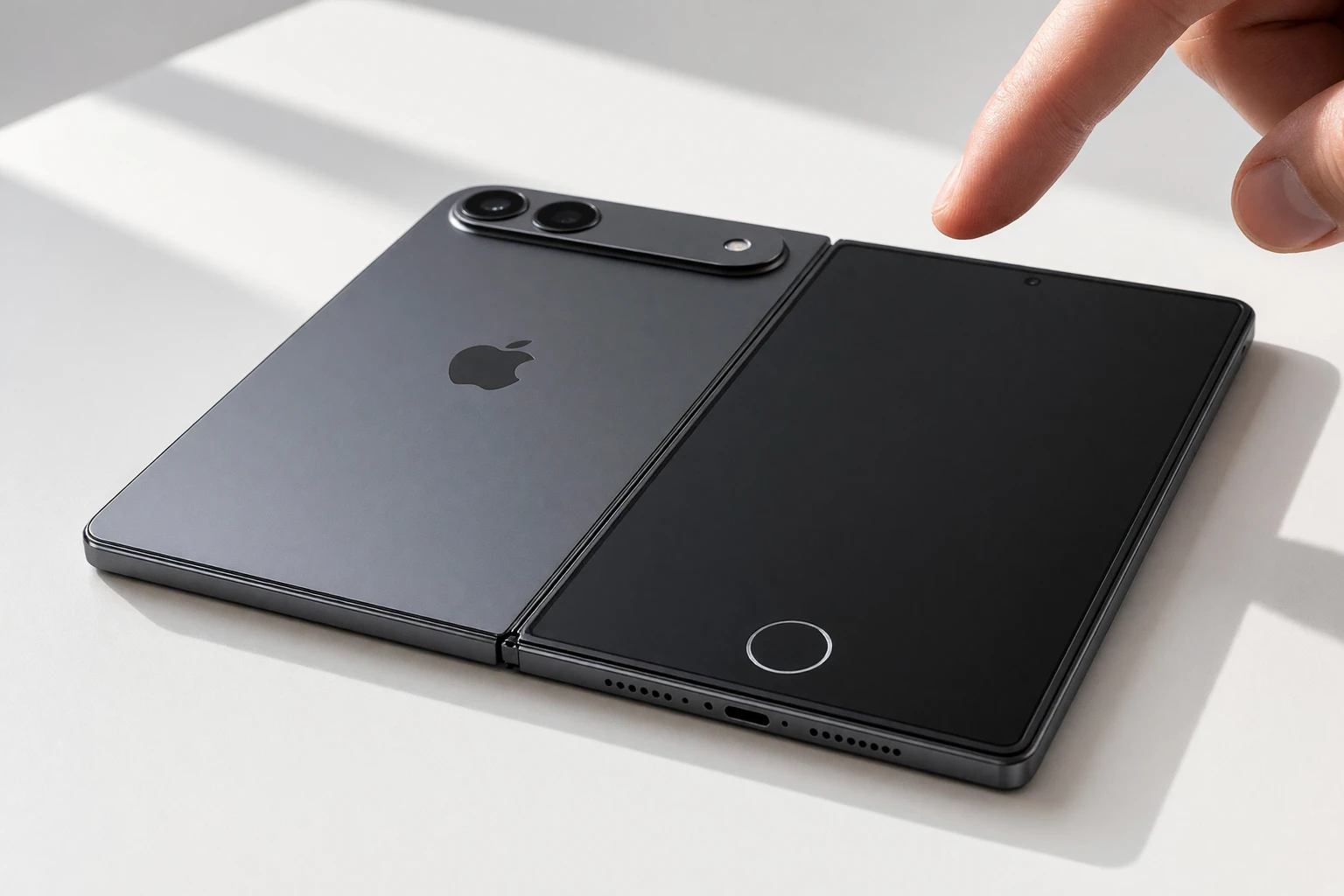
The catch in the 2026 design is thickness. Analysts describe a phone that is about 4.5mm when open, thinner than the iPhone Air at 5.6mm, and about 9mm to 9.5mm when closed. Gurman has said the front panel is too thin for the TrueDepth array, so Apple is expected to skip Face ID and put Touch ID in the side button, the way it already does on several iPads.
He laid that out earlier as a book-style foldable with Touch ID, Apple’s C2 modem, four cameras in total, and eSIM only. The outer camera is expected to sit in a hole-punch instead of the pill that houses Face ID on current iPhones.
Apple had just finished pulling fingerprints off the iPhone line. Touch ID left with the iPhone 16e, after years in which Face ID defined the flagship. Putting a sensor back in the power button is the cleanest way to keep the open phone that thin, and it is also the feature that will dominate the first reviews if Apple confirms it.
The louder product problem is the price next to those cuts. A folding iPhone still has to win over people who never wanted a Galaxy Fold, and a flagship that drops face unlock plus a zoom lens makes that sale harder, not easier.
What the Foldable Is Expected to Be
Leaks describe a short, wide book with a 4:3 inner screen, closer to an iPad mini than to a tall Android fold. Closed, the cover is about 5.5 inches. Open, the inner OLED is about a 7.8-inch panel, half an inch under the 8.3-inch iPad mini. The chassis is expected to mix titanium and aluminum, with liquid metal in the hinge, and Apple has spent years chasing a crease that is almost invisible.
THE EXPECTED FOLDABLE AGAINST THE 2017 BENCHMARK
| Detail | iPhone X (2017) | Foldable iPhone (expected) |
|---|---|---|
| Body | All-glass slab | Book-style fold, 4:3 inner screen |
| Unlock | Face ID | Touch ID in the side button |
| Main display | 5.8-inch OLED | 7.8-inch inner, 5.5-inch cover |
| Launch price | $999 | $2,000 to $2,500 |
| Rear cameras | Dual 12MP with telephoto | Dual 48MP, no telephoto |
The rumored name is iPhone Ultra; other notes still say iPhone Fold. Dummy units that have circulated show a raised two-lens camera bump, no Action Button, and no obvious MagSafe ring, though Gurman has since said MagSafe charging can still fit, as it did on the thin iPhone Air.
The inner screen is meant to feel like a small iPad, with two apps side by side and a wider layout in iOS 27. It is not expected to run iPad apps. Storage rumors sit at 256GB, 512GB, and 1TB. Samsung is expected to build a custom foldable OLED for Apple, with touch sensors in the panel to save thickness. That would put Apple’s first folding phone on a panel from the company that already sells the Galaxy book-fold Apple is trying to leapfrog.
The Pro Phones Stay Familiar, the Calendar Does Not
The conventional half of the stage is easier to sketch. iPhone 18 Pro and iPhone 18 Pro Max are expected to keep last year’s sizes and add Apple’s A20 Pro chip on a 2nm process, the C2 cellular modem, a variable-aperture main camera, and a slightly smaller Dynamic Island. Dark cherry is the color that keeps coming up, next to black, silver, and light blue. Memory costs are expected to push prices up.
The volume phones are not in this show. The standard iPhone 18, the iPhone 18e, and the next iPhone Air are being held for spring 2027, which splits the annual iPhone drop for the first time in years. September becomes the Pro-and-fold night. Spring becomes the night for everyone else.
WHAT SEPTEMBER 9 IS EXPECTED TO SHOW
- iPhone 18 Pro and Pro Max: A20 Pro on 2nm, the C2 modem, a variable-aperture main camera, and a smaller Dynamic Island, with dark cherry among the colors.
- The foldable: A titanium and aluminum book, 5.5-inch cover, 7.8-inch inner screen, Touch ID, dual rear cameras, C2 modem.
- Wearables: Apple Watch Series 12, Apple Watch Ultra 4, and AirPods 5.
- Held for spring 2027: Standard iPhone 18, iPhone 18e, and the next iPhone Air.
Watch and AirPods details are thinner than the phone leaks. The watches are expected to take new processors and another pass at health tracking. Software dates for iOS 27 and the rest of the autumn releases should land in the same hour, even if the foldable itself ships later than the Pros, the way iPhone X did.
A $2,000 Book With a Fingerprint Button
Analyst Ming-Chi Kuo has put the foldable at $2,000 to $2,500, and Gurman has used a similar band. That is about twice to two and a half times the iPhone X launch price, on a device that is also expected to omit a telephoto camera because the body has no room for one.
Early testers inside Apple, in Gurman’s telling, like the hinge and the way software opens into an iPad-like layout, and they treat the missing zoom and the missing Face ID as the two holes in an otherwise finished object. Some of that object still has to be built. Notes from the spring described hinge units that failed Apple’s open-and-close tests even as launch timing held.
WHAT WE KNOW
- The show: September 9 at 10 a.m. Pacific, Apple Park, streamed on Apple’s site, YouTube, and the Apple TV app.
- The boss: Ternus is CEO as of September 1; Cook is executive chairman and stays on for policymaker work.
- The invite: Surprise and shine, posted by Joswiak on August 26.
WHAT IS UNCONFIRMED
- The name: iPhone Ultra and iPhone Fold are both still rumor labels.
- The omissions: No Face ID, no telephoto, and a later ship date than the Pro models until Apple says so on stage.
- The price: The $2,000 to $2,500 band is an analyst range, not a list price.
A folding iPhone at that money is still a specialist buy for a company that sells slabs by the hundred million. The people who have wanted an iPhone that opens like a book will not care about the fingerprint button. Everyone else will compare it with an iPhone 18 Pro that still has Face ID and a zoom lens, and that comparison is the tax Apple pays for waiting until the crease looked finished.
Ternus Inherited the Hardware He Already Built
Apple’s April 20 statement is the cleanest record of the handoff. Cook stays in the building, with a brief that includes talking to governments, and Arthur Levinson, the longtime non-executive chairman, becomes lead independent director. Ternus joins the board the same day he becomes CEO.
Having spent almost my entire career at Apple, I have been lucky to have worked under Steve Jobs and to have had Tim Cook as my mentor.
John Ternus, Apple chief executive, April 20, 2026 statement
Cook, in the same release, called Ternus an engineer with the soul of an innovator and said he was the right person to lead Apple. Under Cook, Apple said, market value went from about $350 billion to $4 trillion, more than 1,000 percent, and yearly revenue went from $108 billion in fiscal 2011 to more than $416 billion in fiscal 2025. The company now cites more than 2.5 billion active devices and more than 500 stores.
Those figures are Cook’s record. The September 9 hour is Ternus’s first chance to put a product in front of that installed base as CEO, and the product with the most airtime is expected to be a phone that undoes the unlock method Apple spent nine years treating as settled. The stream starts at 10 a.m. Pacific. The side button will either have a fingerprint sensor or it will not.