
NEWS
Philippine Chip Plants Face a 188,000-Worker Gap
Electronics exports rebounded to $49.64 billion, but a 188,000-worker gap still hangs over Philippine chip plants.

Philippine electronics exports rose 16.11 percent to $49.64 billion in 2025, nearly matching the 2022 peak. The Second Congressional Commission on Education now counts a 188,000-worker hole in advanced manufacturing by 2035 if training stays on its present path.
In September 2024, former Intel Shanghai general manager Glenn Kiro told a Muntinlupa panel that students had to be pulled into science, technology, and mathematics. Orders came back. The classrooms did not fill at the same speed.
Electronics Exports Rebound, Then the Hiring Crunch Starts
The Semiconductor and Electronics Industries in the Philippines Foundation said electronics exports grew 16.11 percent, from $42.75 billion in 2024 to $49.64 billion in 2025, a haul equal to 58.81 percent of all Philippine merchandise exports and a hair under the revised 2022 peak of $49.66 billion. Semiconductor components and devices led the rebound, up 18.67 percent on the year.
SEIPI president Dan Lachica later raised the group’s 2026 call from flat, then from 5 percent, to 10 percent, a band of $53 to $54 billion, after first-half shipments ran hotter than the cautious script written around wars and supply-chain noise. He said the extra demand came from gear that supports artificial intelligence and data centers, not from a local AI-chip wafer line, which the country still does not have.
The Board of Investments’ 2026 industry profile puts employment at about 368,000 in 2025, with the sector contributing 10.3 percent of manufacturing value added. About 70 percent of electronics firms here still work in semiconductor manufacturing services, which in Philippine plants means assembly, test, and packaging rather than front-end wafer fabs. That mix pays the export bills. It also sets the hiring list: operators, mechanics, and process technicians first, design engineers later.
THE EXPORT RUN FROM 2024 TO 2026
| Year | Electronics exports | Share of PH exports |
|---|---|---|
| 2022 (revised peak) | $49.66 billion | – |
| 2024 | $42.75 billion | 58.4 percent |
| 2025 | $49.64 billion | 58.81 percent |
| 2026 SEIPI forecast | $53 to $54 billion | not yet posted |
BOI figures put the semiconductor product line itself at $34.62 billion in 2025, inside that wider electronics total. Lachica has said the country’s share of the global semiconductor market was about 5 percent last year, against about 1 percent of electronics manufacturing services. The plants know how to finish chips. They do not yet have the headcount to climb the next rung at the speed the order book implies.
Only 15 Percent of STEM Students Feed Chip Plants
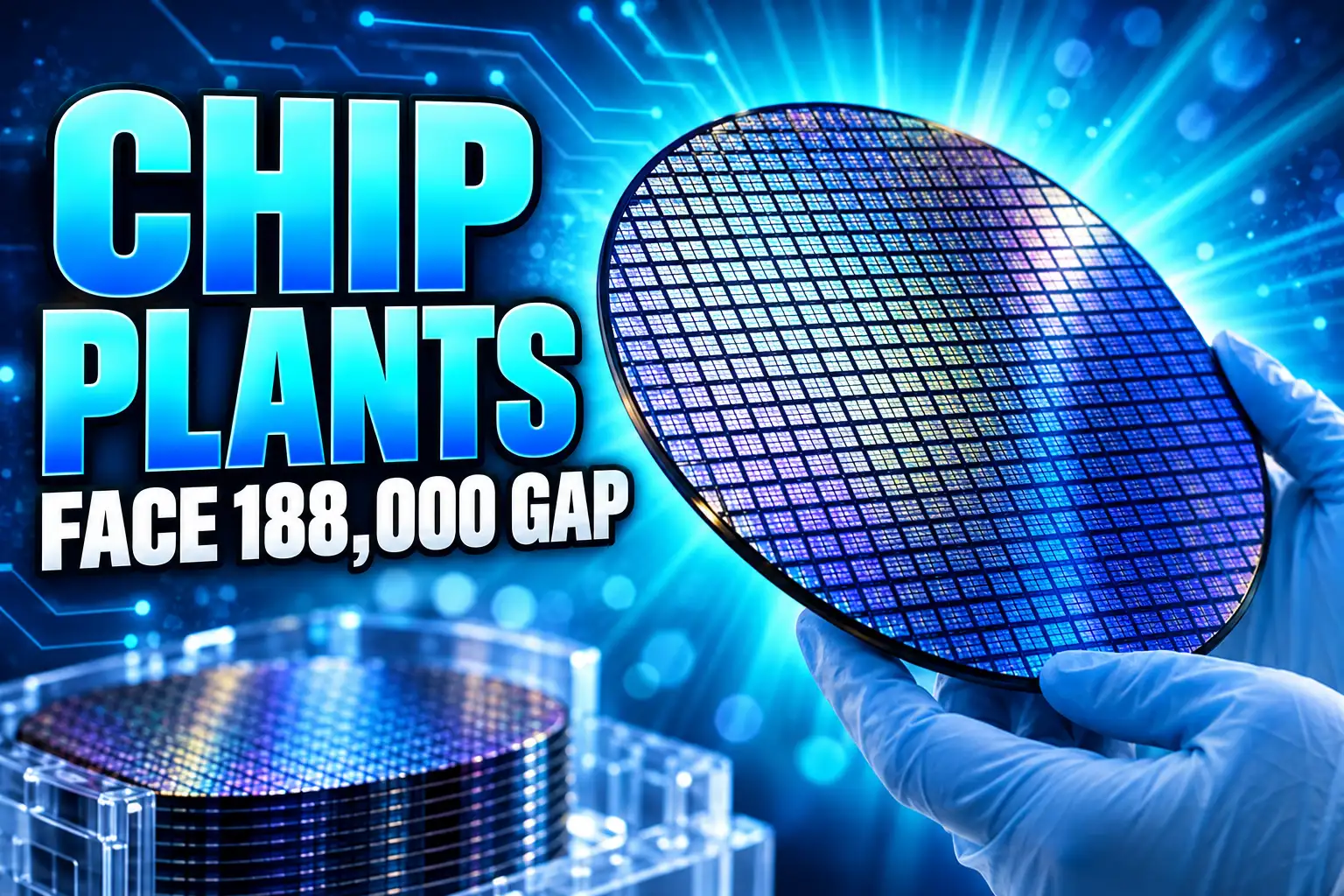
EDCOM II’s January 2026 workforce plan finds that only 15 percent of STEM enrollees take courses that typically feed semiconductor careers, leaving plants to hire from a shallow slice of an already thin science pipeline. The same chapter projects that advanced manufacturing will need about 626,000 workers by 2035 and will have about 438,000 on baseline trends, an 188,000-worker gap through 2035 if nothing in training changes.
Most of that hole is not a missing PhD. About 163,000 of the unfilled roles are semi-skilled technical jobs that TESDA-style programs are supposed to fill: equipment assemblers, production clerks, electronics mechanics, and machine operators. Skilled technical posts add about 20,000. Semi-skilled non-technical work adds about 4,000, and skilled non-technical work about 1,000. The backbone of an ATP floor is the group the school system is least aligned to produce.
THE 188,000-WORKER HOLE BY 2035
- The headline gap: About 626,000 workers wanted in the cluster against about 438,000 available, leaving 188,000 unfilled if trends hold.
- The floor jobs: Roughly 163,000 of those openings are semi-skilled technical posts TESDA tracks are meant to supply.
- The 2028 squeeze: The sector will need about 69,000 new semi-skilled workers against about 36,000 semiconductor-related NC graduates a year, a gap of about 33,000.
- The 2035 TVET shortfall: Demand for new semi-skilled workers rises to nearly 118,000, and the shortfall swells to about 81,000 as NC output stays near 36,000 against a theoretical cap of about 61,800.
- The wrong certificates: Only 1 to 3 percent of NC completions in senior high and technical-vocational institutes are semiconductor courses, about 30,000 graduates a year against about 55,000 needed, an annual gap near 26,000.
The mismatch runs both ways. EDCOM II counts about 19,000 degree-holders already sitting in assembly work, a “profession ceiling” that keeps TVET graduates from moving up and leaves college-trained staff in jobs that do not use the degree. A DTI survey cited in the same plan found that manufacturing firms rated only 11 percent of entry-level hires as fully ready. Nearly 95 percent of the semiconductor workforce is packed into Calabarzon, Central Luzon, Central Visayas, and Metro Manila, while only about a third of the relevant senior-high TVL tracks sit in those same regions, so even the students who pick the right course are often in the wrong place.
A ₱70 Million Fix Against a Decade of Scores
The 2022 Programme for International Student Assessment, run by the OECD, is the floor under that pipeline. Out of 81 participating countries, the Philippines ranked 76th in mathematics and 79th in science. Mean scores were 355 in mathematics, 356 in science, and 347 in reading, against OECD averages of 472, 485, and 476. In the OECD country note, 16 percent reached Level 2 in mathematics, against 69 percent across OECD countries, and almost no Filipino 15-year-olds reached Level 5 or 6.
THE PISA FLOOR UNDER THE PLANTS
- Math: 355 points, 76th of 81, with 16 percent at Level 2 against a 69 percent OECD average.
- Science: 356 points, 79th of 81, against an OECD average of 485.
- Reading: 347 points against an OECD average of 476.
- Top end: Almost no students hit Level 5 or 6 in mathematics, the band that models a complex problem.
Those scores are now four years old, and they still govern who walks into an electronics engineering lecture. Kiro put the same problem in plain language at Xinyx Design’s Unlocked session in Muntinlupa on September 20, 2024, when electronics exports were still sliding and SEIPI was warning of a 10 percent full-year contraction. PSA figures that May had put electronics shipments at $3.56 billion, down 5.1 percent.
Oxford Economics, in a June 2024 note on what was then a $40 billion industry, wrote that developing human capital “should be a joint effort between government and the private sector.” The joint effort that followed is real, and it is small next to the hole.
CHED in December 2025 approved a ₱70 million semiconductor talent program under the Semiconductor and Electronics Industry Advisory Council, grouping OSAPIEA, DTI, CHED, TESDA, DOST, DepEd, and industry. The package sent 25 Filipino teachers and researchers to Arizona State University from January 2026, funds stackable Level 5 diplomas in microelectronics and semiconductor assembly, and published an Electronics Career Map from entry jobs to diploma tracks.
The initiative will modernize curricula and strengthen institutional capacity, enabling Filipino graduates to lead and compete in the global semiconductor and electronics landscape.
Shirley C. Agrupis, CHED chairperson, DTI statement on the ₱70 million program
TESDA Secretary Francisco “Kiko” Benitez said the aim is to deliver technicians who can walk onto a line and keep learning as the tools change. OSAPIEA Undersecretary Angel Ignacio called a reliable talent pipeline “critical to sustaining investment and expansion.” On September 15, 2026, TESDA’s official account opened a Skills Accelerator Portal with Arizona State University for semiconductor and electronics courses, and restated the agency’s seat on SEIAC.
TESDA, in coordination with Arizona State University (ASU), invites interested participants to register for the Skills Accelerator Portal, which provides access to industry-aligned learning opportunities for the semiconductor and electronics sector. 📷📷 pic.twitter.com/bcdejfhd1E
— TESDA (@tesdaofficial) September 15, 2026
Twenty-five faculty seats and a new portal are the right kind of work. They are also a different unit of measure from 188,000 missing roles by 2035.
Why Plants Spend Two to Three Years Training New Engineers?
Employers told the OECD that a lack of engineers is a bottleneck for growth, and that a new hire still needs an average of two to three years of in-house training before the person is productive on the line. That lag is expensive in two directions at once: the plant pays to finish the graduate, and the finished engineer becomes easier to hire away, including overseas, which the OECD flags as a brain-drain loop inside the same chapter.
The OECD’s 2024 study, paid for with United States Department of State support under the CHIPS Act’s International Technology Security and Innovation Fund, also recorded the Board of Investments’ target of 128 thousand engineers and technicians by 2028, and noted that a public work plan for that number had not yet been posted when the report went to press. Some plants told the researchers they can train even a high-school graduate if the in-house program is built well. Others still screen as if a bachelor’s degree were the only ticket, which shrinks the pool EDCOM II is trying to widen with ladderized tracks.
We have to inspire our young students to be interested in science, in technology, in mathematics. Unfortunately, today, we’re not doing very well on the education side.
Glenn Kiro, former Intel Shanghai general manager, Xinyx Design Unlocked, Muntinlupa, September 20, 2024
Kiro, speaking when the cycle was still down, also said the country had to “embrace STEM” and talk more loudly about the work already done in local plants. The 2025 rebound did that advertising for him. It did not shorten the two to three years a new engineer spends inside the factory before yield numbers can rest on that person.
April 2025 underemployment, per PSA as cited by EDCOM II, was 14.6 percent. The commission also found that 24 percent of graduates with a specialized degree work in an unrelated industry. Chip firms are competing for the same STEM remnant with software, BPO analytics, and jobs abroad, after spending those extra years to make a hire useful.
Malaysia and Vietnam Already Sit Further up the Skill Ladder
EDCOM II states, in a line the rest of the chapter then documents, that the Philippines is behind Malaysia and Vietnam in most high-skill requirements. That is the regional scoreboard the export rebound does not change. Malaysia has spent years thickening OSAT and advanced packaging. Vietnam has scaled electronics manufacturing and back-end assembly. Philippine plants remain a reliable testing and EMS base, which is a real business, and a lower-skill one.
Lachica has been blunt that the country is strong in assembly, test, and packaging and is only starting to grow IC design, and that without a wafer fab it cannot close the chain. The DTI’s semiconductor and electronics roadmap still aims at $110 billion in annual electronics exports by 2030, a jump that would require the plants to sell more than twice the 2025 haul. Capital can be announced in a season. The 15 percent STEM feed and the 36,000 NC graduates cannot.
Neighbor governments are not waiting for Philippine PISA scores to move. When a memory or analog line can be staffed in Penang or a Vietnamese industrial park with less time on the trainer’s clock, the next expansion does not have to land in Calamba or Clark. The second effect of the talent gap is not an empty local factory. It is a factory that stays on last year’s product mix while the higher-value work goes next door.
Pax Silica and the $110 Billion Target Need Bodies
Policy has moved faster than the classroom. Administrative Order No. 31, issued in March 2025, set up SEIAC as the President’s advisory body on the sector. The United States in 2024 began programming a $500 million International Technology, Security, and Innovation Fund under the CHIPS and Science Act, a five-year pool meant to catalyze private investment across partner countries, including the Philippines. Ramin Toloui, then a State Department assistant secretary, said the fund would target areas that unlock larger private outlays, and named the Philippines as a significant player in assembly, testing, and packaging.
The Philippines joined the United States-led Pax Silica grouping in April 2026. The visible local piece is a 4,000-acre industrial site at New Clark City in Tarlac, inside the Luzon Economic Corridor, pitched for semiconductor packaging, electronics, AI computing, and critical-minerals work, with construction talked about for 2028. Those acres do not hire anyone until the operators exist.
THE POLICY CALENDAR SINCE 2024
- September 20, 2024: Kiro tells the Xinyx panel that STEM interest and government-level education have to move if the plants are to compete.
- March 2025: Administrative Order No. 31 creates SEIAC and puts a whole-of-government wrap on semiconductor promotion.
- October 2025: SEIAC presents a five-year action plan on a school-to-industry pipeline, ladderized programs, and a New Clark economic-zone pilot.
- December 27, 2025: CHED approves ₱70 million for ASU faculty immersion, stackable diplomas, and an Electronics Career Map.
- April 2026: The Philippines joins Pax Silica; the New Clark site is listed as the local footprint.
- August 2026: SEIPI lifts its 2026 export call to 10 percent after the 2025 rebound.
- September 15, 2026: TESDA opens the ASU Skills Accelerator Portal for semiconductor and electronics learners.
The calendar is crowded. The arithmetic is not. A 368,000-person industry that just booked $49.64 billion still draws from 15 percent of STEM students, still finishes about 36,000 of the right NC certificates a year, and still faces a 188,000-worker hole by 2035 on EDCOM II’s books. The ASU portal TESDA opened in September 2026 is the latest patch on that pipe. The 2035 gap remains the number the plants will hire against.

Clay Moulds From the Blyth Hoard Fit Peebles Fittings

Treasury Yields Hit a 24-Year High as AI Joins the Queue

Crew-12 Leaves the ISS With Fedyaev and Adenot Aboard

The Graziers Recall Puts the 60-Day Cheese Rule on Trial

Hugo Chavez’s Hollywood Welcome Meets a Film About Escape

Sons of Behemat Add a Witch and a Middle Rank

Canada Still Clears Mazatlán as the Cartel War Arrives

The FTC Suit That Targets Amazon’s Hidden Ad Floor

Samsung Leads Mistral’s Record European Sovereignty Round

Laepple Automotive Bets on a Vacant Detroit Die Shop
-
 GAMING2 months ago
Sons of Behemat Add a Witch and a Middle Rank
-
 NEWS2 years ago
Canada Still Clears Mazatlán as the Cartel War Arrives
-
 BUSINESS2 months ago
The FTC Suit That Targets Amazon’s Hidden Ad Floor
-
 NEWS2 months ago
Samsung Leads Mistral’s Record European Sovereignty Round
-

 NEWS2 months ago
Apple’s Foldable iPhone Event Revives the Fingerprint Button
-
 AUTO2 years ago
Laepple Automotive Bets on a Vacant Detroit Die Shop
-

 AUTO2 years ago
Tamil Nadu Auto Keeps Growing Inside a Climate Red Zone
-

 LIFESTYLE2 years ago
The Unstoppable Rise of Hot Honey: Are Food Trends Making UK Restaurant Menus All the Same?